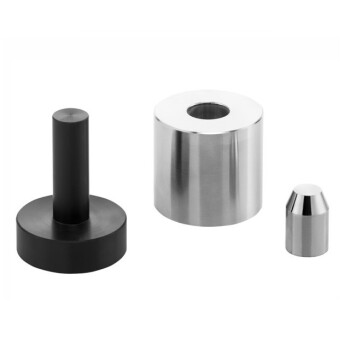
Precision cylindrical molds are strictly necessary to guarantee that Glass Ionomer Cement (GIC) specimens achieve standardized geometric dimensions. For modified GIC specifically, these molds ensure the samples meet exact specifications—typically a diameter of 6mm and a thickness of 2mm—required by international protocols like ISO 9917-1:2007. This dimensional uniformity is the baseline requirement for obtaining valid mechanical property data.
Precision molding eliminates physical irregularities that create false stress points. This ensures that any failure during testing is caused by the material's actual limits, not by the shape of the specimen.
The Critical Role of Geometry in Testing
Adherence to ISO Standards
International standards, specifically ISO 9917-1:2007, dictate precise dimensions for GIC testing to ensure consistency across different laboratories. Using precision molds is the only reliable way to produce specimens that consistently meet these strict regulatory requirements.
Eliminating Stress Concentrations
Irregular shapes or uneven surfaces create stress concentrations—focal points where force accumulates disproportionately. These weak points cause premature structural failure, leading to data that underestimates the cement's true strength.
Ensuring Comparable Data
Standardization allows for the objective comparison of different GIC modifications. By removing geometry as a variable, researchers can confirm that performance differences are due to the inherent properties of the material, not the preparation method.
The Mechanics of Accurate Analysis
Calculation Precision
Mechanical testing relies on formulas that require precise input variables, specifically pressure area and specimen thickness. Precision molds provide the rigid constraint necessary to ensure these dimensions are constant, preventing mathematical errors in strength calculations.
Surface Flatness Requirements
Accurate bending strength testing and microstructure analysis require exceptional surface flatness. High-precision molds prevent surface deviations that would otherwise disrupt the uniform distribution of load during testing.
Common Pitfalls to Avoid
The Risk of Experimental Error
Without high-precision molds, shape variations introduce significant experimental errors. This makes it difficult to determine if observed changes—such as those seen in harsh environments—are real material responses or artifacts of the specimen's shape.
Distorted Heat Release Data
While more critical in large-aggregate cements, the principle of size effect remains relevant; improper mold sizing can distort thermal readings. Precision molds ensure the specimen volume is representative, allowing for accurate thermal conductivity and heat release analysis.
Making the Right Choice for Your Goal
To ensure your GIC testing is both valid and valuable, consider your specific objectives:
- If your primary focus is Regulatory Compliance: Ensure your molds are calibrated to produce 6mm x 2mm specimens to satisfy ISO 9917-1:2007 standards.
- If your primary focus is Material Research: Use high-precision molds to ensure surface flatness, isolating the material's inherent properties from geometric variables.
Precision molding is not just a preparation step; it is the fundamental control that validates the accuracy of your entire dataset.
Summary Table:
| Key Requirement | Importance in GIC Testing | ISO 9917-1:2007 Standard |
|---|---|---|
| Dimensional Precision | Ensures uniform diameter and thickness for calculation accuracy | Typically 6mm diameter x 2mm thickness |
| Stress Distribution | Eliminates physical irregularities that cause premature failure | Required for valid mechanical data |
| Surface Flatness | Prevents load disruption during bending/compression tests | Essential for structural integrity |
| Reproducibility | Allows for objective comparison between material modifications | Baseline for cross-lab validation |
Elevate Your Materials Research with KINTEK
Precision in specimen preparation is the foundation of scientific breakthrough. KINTEK specializes in comprehensive laboratory pressing solutions, providing the high-precision molds and equipment necessary for consistent, ISO-compliant GIC testing. Whether you are conducting advanced battery research or dental material trials, our manual, automatic, and heated models—along with our specialized cold and warm isostatic presses—ensure your data reflects the true properties of your material.
Ready to eliminate experimental error? Contact us today to find the perfect precision molding solution for your laboratory needs!
References
- Kamala Devi, Subhabrata Maiti. A Comparative In Vitro Analysis of Antimicrobial Effectiveness and Compressive Resilience in Chirata and Terminalia arjuna Modified Glass Ionomer Cement. DOI: 10.7759/cureus.52198
This article is also based on technical information from Kintek Solution Knowledge Base .
Related Products
- Lab Cylindrical Press Mold for Laboratory Use
- Cylindrical Lab Electric Heating Press Mold for Laboratory Use
- Assemble Lab Cylindrical Press Mold for Laboratory Use
- Lab Cylindrical Press Mold with Scale
- Lab Polygon Press Mold
People Also Ask
- What is the purpose of incorporating cartridge heaters into a lab press mold for MLCC block compression? Optimize Results
- Why is precise cooling management of the lab press mold necessary? Protect Core Integrity in Thermoforming
- What is the function of a pressing tool in thermoplastic panels? Master Precision Shaping & Fusion Bonding
- Why is a high-performance laboratory molding press critical for in-situ electrolyte formation? Unlock Battery Success
- How does the geometry of laboratory molds influence mycelium-based composites? Optimize Density and Strength