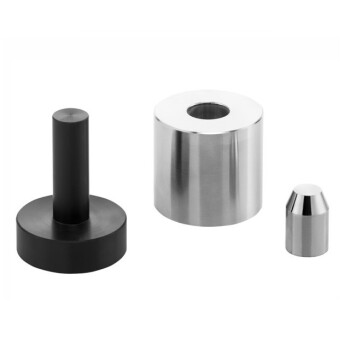
To measure the true performance of Li7P3S11, you must transform loose powder into a dense solid. A laboratory press is utilized to apply extreme pressure—approximately 510 MPa—to the electrolyte powder. This force causes the particles to undergo plastic deformation, resulting in a tightly packed pellet that eliminates the air gaps found in the raw powder.
Core Takeaway Testing loose powder measures the resistance of the empty space between particles rather than the material itself. High-pressure molding eliminates these voids, minimizing grain boundary resistance to ensure the data reflects the intrinsic bulk physical properties of the Li7P3S11 material.
The Science of Densification
Plastic Deformation and Pore Elimination
Raw Li7P3S11 exists as a powder containing significant microscopic voids and pores. When subjected to hydraulic pressure around 510 MPa, the particles physically deform and reshape. This plastic deformation forces the material to flow into empty spaces, creating a solid, cohesive mass.
Minimizing Grain Boundary Resistance
In a loose powder state, the resistance at the contact points between grains (grain boundaries) is incredibly high. This resistance dominates the measurement, obscuring the actual conductivity of the crystal structure. High-pressure cold-pressing maximizes the contact area between particles, effectively short-circuiting this artificial resistance.
Creating Continuous Transport Pathways
Lithium ions require a continuous medium to move effectively. Densification creates uninterrupted pathways for ionic transport throughout the pellet. Without this continuity, the measured ionic conductivity would be artificially low due to the physical gaps in the ion's path.
The Role of Geometric Precision
Standardization for EIS Calculations
Electrochemical Impedance Spectroscopy (EIS) is the standard method for calculating ionic conductivity. The mathematical formulas used to interpret Nyquist plots require precise values for the sample's thickness and surface area.
Eliminating Dimensional Errors
A high-precision laboratory press ensures the resulting pellet has a uniform thickness and a regular shape. This geometric consistency removes dimensional variables from the resistance equation. It ensures that changes in impedance are due to material properties, not irregular pellet shape.
Understanding the Trade-offs
The Risk of Under-Pressing
If the applied pressure is insufficient (significantly below 510 MPa for Li7P3S11), the pellet will retain internal micropores. This results in "false" data where the measured conductivity is lower than the material's actual capability, leading to incorrect conclusions about the material's viability.
Differentiating Intrinsic vs. Extrinsic Factors
It is crucial to understand that the press changes the sample state, not the chemical composition. The goal is to remove extrinsic factors (porosity, poor contact) so that only the intrinsic factors (bulk conductivity) remain. Failure to press adequately means you are testing the quality of your sample preparation, not the quality of the electrolyte itself.
Ensuring Data Reliability
To obtain defensible scientific data, the preparation phase is just as critical as the testing phase.
- If your primary focus is determining intrinsic conductivity: Apply sufficient pressure (approx. 510 MPa) to induce plastic deformation and ensure the measurement reflects the bulk material, not the grain boundaries.
- If your primary focus is EIS accuracy: Use a precision mold to guarantee a pellet with uniform thickness, allowing for the exact calculation of conductivity based on resistance and geometry.
High-pressure molding is not merely a shaping step; it is a prerequisite for isolating the true physical properties of solid-state electrolytes.
Summary Table:
| Parameter | Influence on Measurement | Objective of High-Pressure Pressing |
|---|---|---|
| Particle State | Loose powder creates air gaps | Induces plastic deformation for a dense solid pellet |
| Grain Boundaries | Increases artificial resistance | Maximizes contact area to isolate intrinsic conductivity |
| Ion Pathways | Discontinuous paths lower readings | Creates uninterrupted transport pathways for Li-ions |
| Geometry | Irregular shapes cause EIS errors | Ensures uniform thickness and area for precise calculations |
Maximize the Accuracy of Your Battery Research with KINTEK
Precise data starts with superior sample preparation. KINTEK specializes in comprehensive laboratory pressing solutions tailored for solid-state electrolyte research. Whether you need manual, automatic, heated, or glovebox-compatible models, our equipment delivers the extreme pressure (up to 510 MPa and beyond) required for plastic deformation and pore elimination in materials like Li7P3S11.
From cold and warm isostatic presses to high-precision dies, we provide the tools to eliminate extrinsic variables and reveal the true bulk physical properties of your materials.
Ready to elevate your lab’s efficiency and data reliability?
Contact KINTEK Today to Find Your Pressing Solution
References
- Trần Anh Tú, Nguyễn Hữu Huy Phúc. Synthesis of Li <sub>7</sub> P <sub>3</sub> S <sub>11</sub> solid electrolyte in ethyl propionate medium for all-solid-state Li-ion battery. DOI: 10.1039/d5ra05281e
This article is also based on technical information from Kintek Solution Knowledge Base .
Related Products
- Lab Polygon Press Mold
- Special Shape Lab Press Mold for Laboratory Applications
- Lab Round Bidirectional Press Mold
- Lab Isostatic Pressing Molds for Isostatic Molding
- Lab Infrared Press Mold for No Demolding
People Also Ask
- What is the purpose of incorporating cartridge heaters into a lab press mold for MLCC block compression? Optimize Results
- How do the design and geometric precision of pressing molds and mandrels affect the quality of PTFE composite samples?
- What role do precision positioning and pressure molds play in single-lap joints? Ensure 100% Data Integrity
- What are the requirements for pressing molds when using SSCG? Key Materials for Complex Single Crystal Production
- How do industrial-grade pressure molds affect zinc metal pouch cells? Maximize Energy Density & Performance