The Invisible Interval
In materials science, the most critical moments often occur not during the peak of an experiment, but in the transitions between states.
Polylactic Acid (PLA) is a material with a "memory." When heated, its molecular chains are fluid, chaotic, and liberated. When cooled, they seek a state of equilibrium. The problem is that "equilibrium" in a free-cooling environment usually means warping, shrinking, and structural failure.
The immediate transfer from a hot press to a cold press is not merely a logistical step; it is a systemic intervention designed to arrest molecular motion before the material can betray its intended form.
The Mechanics of the "Thermal Lock"
When PLA is under heat, we are essentially negotiating with its polymer chains. We provide energy to make them move; we apply pressure to force them into a specific geometry.
However, the moment the heat source is removed, a race begins.
1. Freezing the Chain Arrangement
In the hot press, the polymer chains have been melt-shaped. They are held in a specific thickness. Moving the sheet immediately to a cold press "freezes" these chains.
- Without the lock: Chains shift, relax, and recoil.
- With the lock: The intended arrangement is preserved in a solid state.
2. Preventing the Inward Pull
Thermoplastics are prone to thermal contraction. As they cool, they pull inward. A cold press acts as a mechanical cage. By applying constant pressure during the transition to room temperature, you deny the material the freedom to shrink unevenly.
The Psychological Trap of "Room Temperature"
In many labs, there is a tendency to view cooling as a passive process—something that happens "naturally." But in high-precision research, "natural" is synonymous with "uncontrolled."
Uncontrolled cooling creates a temperature gradient: the edges cool faster than the core. This disparity introduces internal stresses that might not appear for hours or days, eventually manifesting as a sudden crack or a subtle bow in the sheet.
Managing Crystallization Morphology
The rate of cooling dictates the crystal structure of the PLA.
- Rapid Quenching: Results in smaller, uniform crystals. This leads to better optical clarity and fewer brittle spots.
- Slow Cooling: Allows for large, uneven crystal growth, which can cloud the film and create points of mechanical weakness.
Precision by Design: The Technical Guidelines
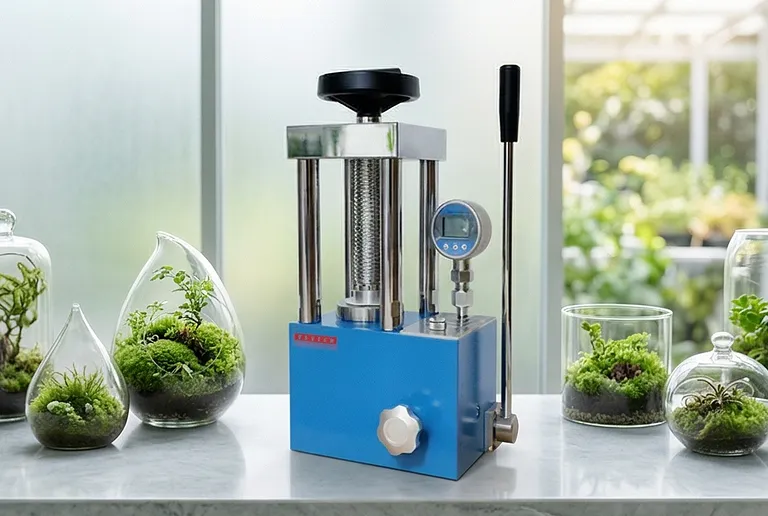
To master the transition, one must view the cold press as an equal partner to the hot press. The following table illustrates the stakes of this transition:
| Factor | Cold Pressing Action | Material Outcome |
|---|---|---|
| Polymer Chains | Rapid kinetic arrest | Prevention of molecular relaxation |
| Internal Stress | Mechanical constraint | Elimination of surface ripples and twists |
| Thermal History | Uniform heat extraction | Consistent, repeatable sample data |
| Dimensions | Constant pressure (approx. 1 MPa) | Flatness and thickness precision |
The Systems Approach to Pressing
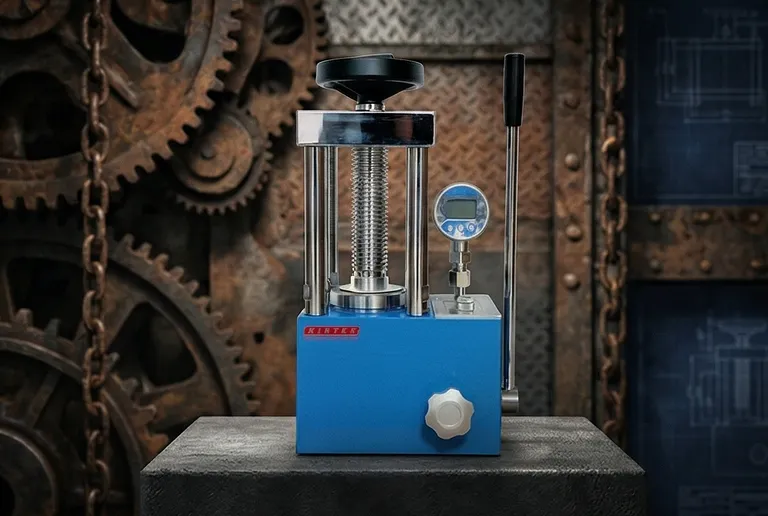
Precision in the lab is rarely the result of a single machine; it is the result of a workflow.
If your primary focus is dimensional accuracy, the cold press must be pre-set. The "open time"—the seconds the PLA spends in the air between presses—is the enemy. If your focus is optical clarity, the efficiency of the cooling system (such as integrated water-cooling) becomes the primary variable.
Engineering the Perfect Sample

At KINTEK, we understand that the integrity of a PLA sheet—or a high-capacity battery electrode—depends on the stability of its thermal history.
We specialize in comprehensive laboratory pressing solutions designed to bridge the gap between "melt" and "solid." From manual and automatic heated presses to specialized cold and warm isostatic presses, our equipment is engineered to provide the constant pressure and rapid thermal control required for advanced material research.
Whether you are working within the constraints of a glovebox or developing the next generation of sustainable polymers, the transition matters as much as the heat.
Related Products
- Electric Split Lab Cold Isostatic Pressing CIP Machine
- Electric Lab Cold Isostatic Press CIP Machine
- Automatic Laboratory Hydraulic Press Lab Pellet Press Machine
- Laboratory Hydraulic Split Electric Lab Pellet Press
- Laboratory Hydraulic Press Lab Pellet Press Machine for Glove Box
Related Articles
- Beyond Brute Force: The Elegant Physics of Cold Isostatic Pressing
- The Isotropic Imperative: Why Uniform Pressure Defines the Life of a Superconductor
- The Architecture of Uniformity: Why Omnidirectional Pressure Defines Ceramic Destiny
- Shaping vs. Perfecting: The Strategic Divide Between Cold and Hot Isostatic Pressing
- The Silent Geometry of Density: Why Isotropic Pressure is the Soul of Advanced Ceramics



















