
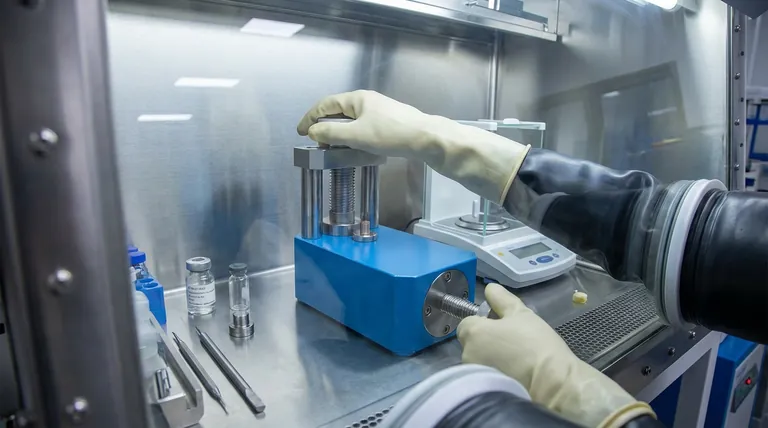
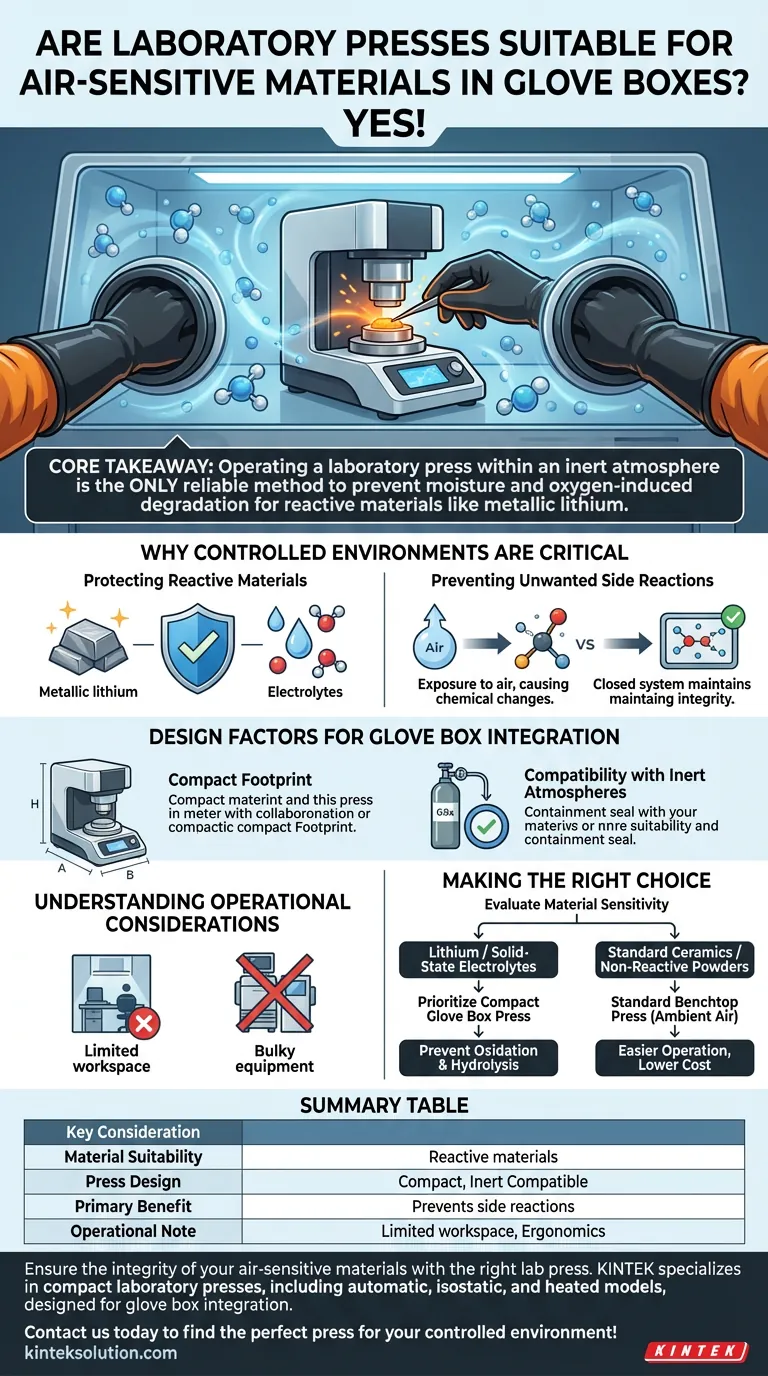
Yes, laboratory presses are highly suitable for processing air-sensitive materials inside a glove box. Many modern laboratory presses are specifically engineered with a compact footprint, allowing them to be easily installed and operated within controlled environments like argon glove boxes. This capability is standard practice for research involving materials that degrade rapidly upon exposure to air.
Core Takeaway: Operating a laboratory press within an inert atmosphere is the only reliable method to prevent moisture and oxygen-induced degradation. This workflow is essential for ensuring the performance and safety of reactive materials like metallic lithium.
Why Controlled Environments Are Critical
Protecting Reactive Materials
When working with advanced materials, environmental control is often as important as the processing method itself. Materials such as metallic lithium and certain advanced electrolyte components are highly sensitive to moisture and oxygen.
Preventing Unwanted Side Reactions
Exposure to ambient air, even for a few seconds during pressing, can trigger immediate chemical changes. Using a press inside a glove box prevents these unwanted side reactions. This safeguards the integrity of the final assembled device, ensuring that test results reflect the material's true properties, not its degradation products.
Design Factors for Glove Box Integration
The Necessity of a Compact Footprint
Space inside a glove box is a premium resource. Laboratory presses suitable for this application are designed to be physically compact without sacrificing the force required for processing.
Compatibility with Inert Atmospheres
These presses are built to function reliably within inert atmospheres, typically argon or nitrogen. The design allows researchers to perform high-pressure tasks without breaking the containment seal of the controlled environment.
Understanding the Operational Considerations
Managing Limited Workspace
While compact presses fit inside the box, the working area remains restricted. You must account for the ergonomics of loading and unloading samples through heavy gloves.
Equipment Selection Constraints
Not every press is suitable for this application. You are limited to models specifically designed with a small footprint. Standard floor-standing units or bulky benchtop models will likely be too large for the antechamber or the main workspace of the glove box.
Making the Right Choice for Your Research
To determine if you need to move your pressing operations inside a glove box, evaluate your material sensitivity.
- If your primary focus is working with Lithium or Solid-State Electrolytes: You must prioritize a compact press designed for glove box integration to prevent immediate oxidation and hydrolysis.
- If your primary focus is standard ceramics or non-reactive powders: A standard benchtop press in ambient air is sufficient, allowing for easier operation and lower equipment costs.
By matching your equipment environment to your material's chemical stability, you ensure the validity of your research data.
Summary Table:
| Key Consideration | Description |
|---|---|
| Material Suitability | Essential for reactive materials (e.g., metallic lithium, solid-state electrolytes) that degrade in air. |
| Press Design | Requires a compact footprint and compatibility with inert atmospheres (argon/nitrogen). |
| Primary Benefit | Prevents unwanted side reactions by maintaining a controlled environment during pressing. |
| Operational Note | Workspace is limited; ergonomics of loading/unloading samples through gloves must be considered. |
Ensure the integrity of your air-sensitive materials with the right lab press.
KINTEK specializes in compact laboratory presses, including automatic lab presses, isostatic presses, and heated lab presses, designed specifically for integration into glove boxes. Our equipment helps researchers working with reactive materials like lithium and solid-state electrolytes prevent degradation and achieve accurate, reliable results.
Contact us today to find the perfect press for your controlled environment and enhance the safety and validity of your research!
Visual Guide
Related Products
- Laboratory Hydraulic Press Lab Pellet Press Machine for Glove Box
- Heated Hydraulic Press Machine with Heated Plates for Vacuum Box Laboratory Hot Press
- 24T 30T 60T Heated Hydraulic Lab Press Machine with Hot Plates for Laboratory
- Laboratory Hydraulic Press Lab Pellet Press Button Battery Press
- Automatic Heated Hydraulic Press Machine with Hot Plates for Laboratory
People Also Ask
- How does a laboratory hydraulic press contribute to the preparation of Li3-3xScxSb samples? Optimize Ionic Conductivity
- What is the function of a laboratory hydraulic press in FT-IR of curcumin-coated MWCNTs? Achieve Optical Clarity.
- Why is a laboratory hydraulic press required for compression molding boron-siloxane? Solve High-Loading Density Challenges
- What role does a laboratory hydraulic press play in the preparation of piezoelectric ceramic discs for DC-PG? | KINTEK
- What role does a laboratory hydraulic press play in reaction pellets? Optimizing Lunar Soil and Metal Fuel Density



















