
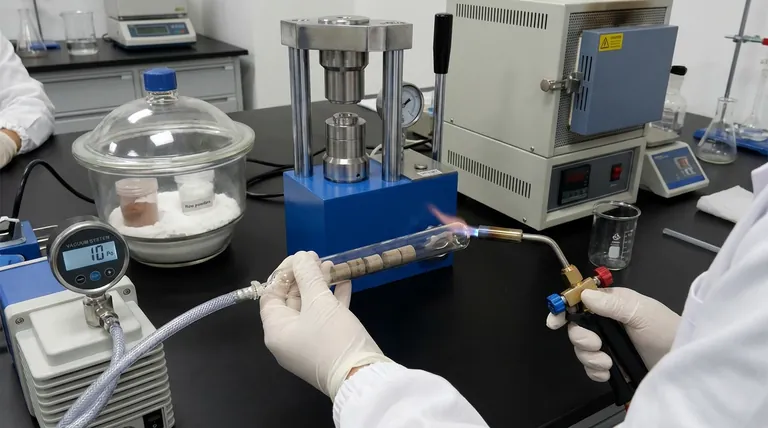
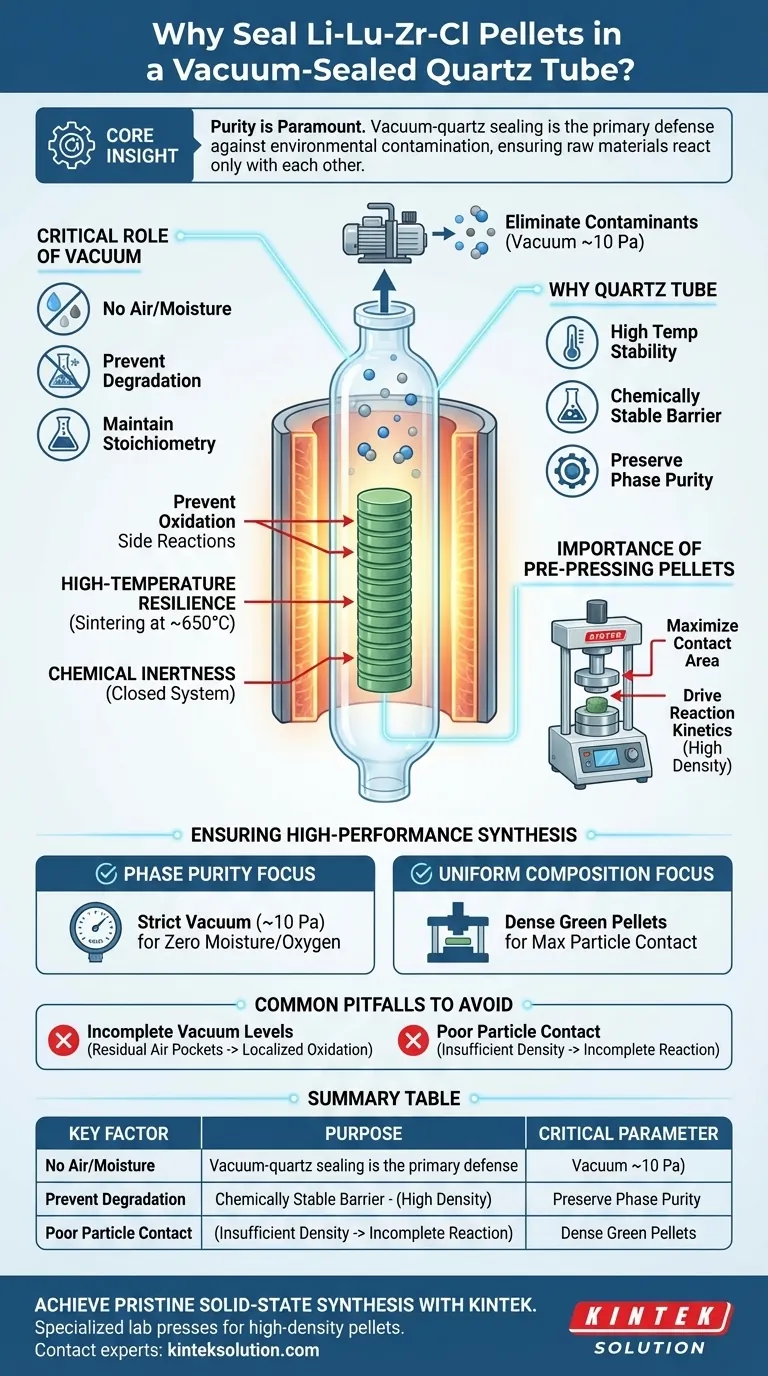
Vacuum sealing pressed pellets is a mandatory containment strategy used to preserve chemical integrity during the high-temperature synthesis of Li-Lu-Zr-Cl electrolytes. This process serves two immediate functions: the vacuum environment eliminates air and moisture to prevent oxidation side reactions, while the quartz tube acts as a chemically inert vessel capable of maintaining a closed system at 650°C.
Core Insight: The synthesis of solid-state electrolytes relies heavily on purity. Sealing pellets in vacuum-quartz tubes is the primary defense against environmental contamination, ensuring the raw materials react only with each other rather than with the surrounding atmosphere.
The Critical Role of the Vacuum Environment
Eliminating Contaminants
Creating a vacuum of approximately 10 Pa within the tube is the most effective way to remove ambient air and moisture. Without this step, the raw materials would be exposed to oxygen and humidity during heating.
Preventing Side Reactions
At high temperatures, reactant powders are highly reactive. The vacuum prevents oxidation and other detrimental side reactions that would otherwise degrade the material and alter the final stoichiometry.
Why Quartz is the Standard Container
High-Temperature Resilience
The synthesis requires sintering at temperatures around 650°C. Quartz is selected because it maintains structural integrity and does not soften or deform under this specific thermal load.
Chemical Inertness
Quartz provides a chemically stable barrier between the sample and the furnace environment. This closed system prevents the introduction of external impurities that could compromise the phase purity of the final electrolyte.
The Importance of Pre-Pressing the Pellets
Maximizing Contact Area
Before sealing, the raw powders are pressed into dense "green pellets." This step is crucial because it forces the reactant particles into intimate physical contact.
Driving Reaction Kinetics
The high density achieved through pressing promotes the kinetics of the solid-state reaction. This physical proximity is essential for obtaining a target product with high phase purity and uniform composition during the heat treatment.
Common Pitfalls to Avoid
Incomplete Vacuum Levels
If the vacuum level does not reach the approximate 10 Pa threshold, residual air pockets remain. This can lead to localized oxidation on the pellet surface, creating insulating impurity phases.
Reaction Kinetics vs. Containment
While the quartz tube protects the chemistry, it cannot fix poor particle contact. If the pellets are not pressed to a sufficient density prior to sealing, the reaction may remain incomplete even if the vacuum seal is perfect.
Ensuring High-Performance Synthesis
To achieve a high-conductivity Li-Lu-Zr-Cl electrolyte, you must balance mechanical preparation with environmental control.
- If your primary focus is Phase Purity: Ensure the quartz tube is sealed under a strict vacuum (approx. 10 Pa) to eliminate all traces of moisture and oxygen.
- If your primary focus is Uniform Composition: Prioritize compacting the raw powders into dense green pellets to maximize particle-to-particle contact before heat treatment.
Success in solid-state synthesis is defined by your ability to maintain a pristine, isolated environment at high temperatures.
Summary Table:
| Key Factor | Purpose | Critical Parameter |
|---|---|---|
| Vacuum Environment | Eliminates air/moisture to prevent oxidation and side reactions | ~10 Pa vacuum level |
| Quartz Tube | Provides a chemically inert, high-temperature-resistant container | Withstands sintering at ~650°C |
| Pre-Pressed Pellets | Maximizes particle contact for complete and uniform reaction | High-density 'green' pellets |
Achieve Pristine Solid-State Synthesis with KINTEK
Perfecting your solid-state electrolyte synthesis requires precise environmental control and reliable equipment. KINTEK specializes in high-performance lab press machines, including automatic lab presses and heated lab presses, which are essential for creating the high-density pellets needed for successful reactions.
Our expertise supports researchers like you in developing next-generation batteries by ensuring the purity and uniformity of your materials. Let us help you optimize your preparation process.
Contact our experts today to discuss how our laboratory solutions can enhance your synthesis workflow and results.
Visual Guide
Related Products
- Laboratory Hydraulic Split Electric Lab Pellet Press
- Manual Laboratory Hydraulic Pellet Press Lab Hydraulic Press
- Automatic Laboratory Hydraulic Press Lab Pellet Press Machine
- Laboratory Hydraulic Pellet Press for XRF KBR FTIR Lab Press
- Automatic Laboratory Hydraulic Press for XRF and KBR Pellet Pressing
People Also Ask
- What are the emerging trends in the design and materials of lab pellet presses? Modernize Your Lab Efficiency
- How do lab pellet presses support customization and flexibility? Optimize Your Sample Prep for Any Material
- What are common lab pellet press issues? Expert Troubleshooting Guide for Reliable Material Research
- What are the common operational types of lab pellet presses? Choosing the Right Manual, Automatic, or Hydraulic System
- Why use a laboratory pellet press for solid-state battery evaluation? Ensure Accuracy in Interface Stability Testing



















