
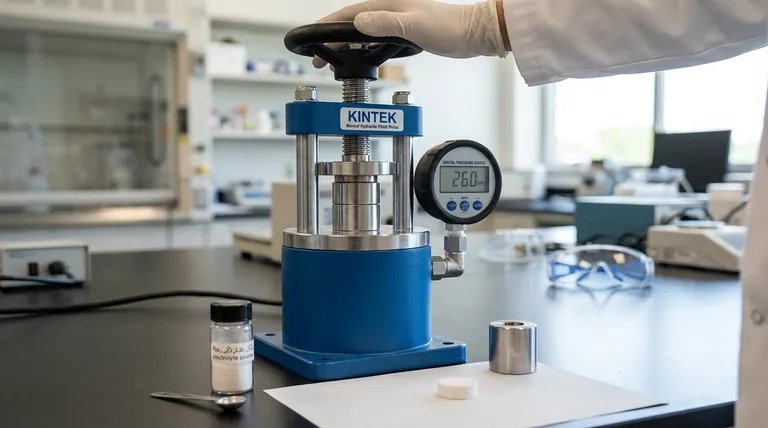
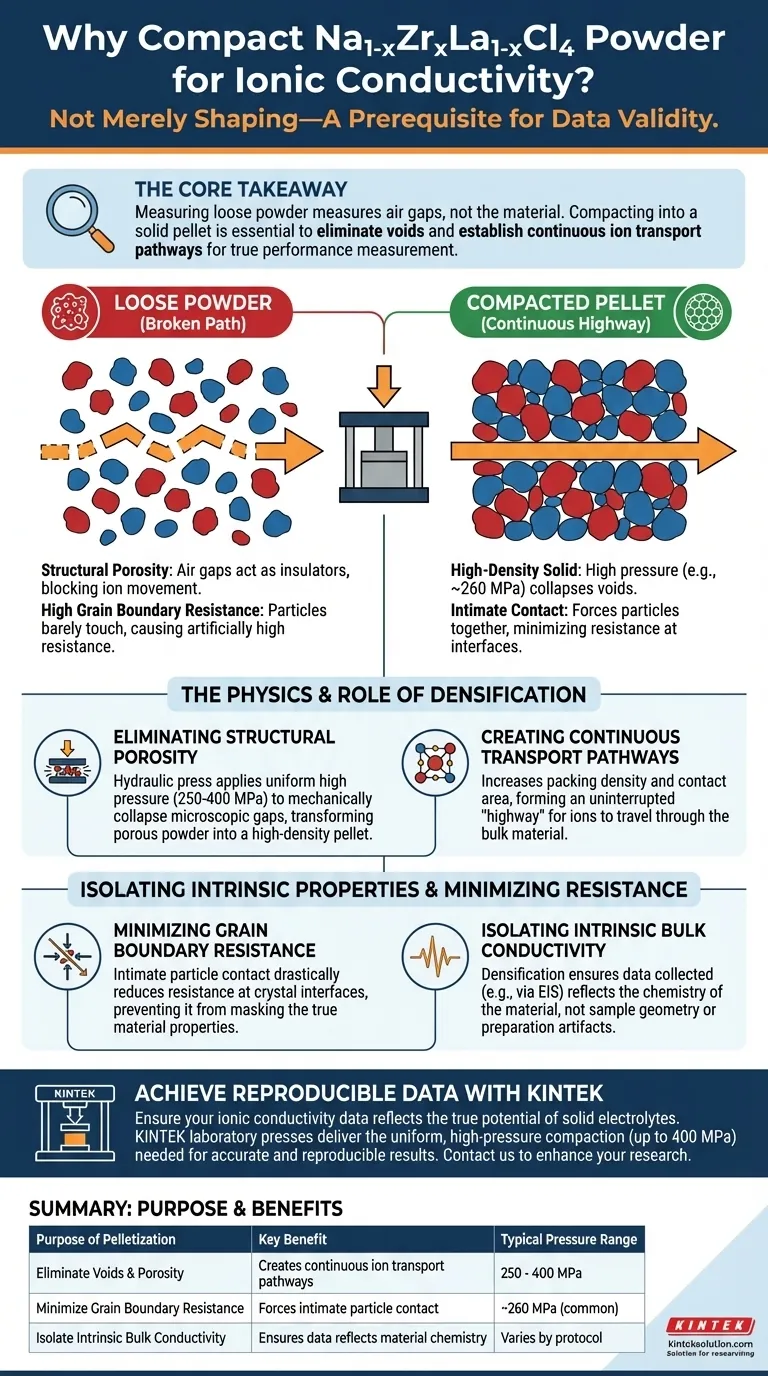
Compacting $Na_{1-x}Zr_xLa_{1-x}Cl_4$ powder is not merely a shaping step; it is a fundamental prerequisite for data validity. The primary reason for compressing this electrolyte powder into a pellet using a laboratory hydraulic press is to eliminate voids and minimize grain boundary resistance. By applying high pressure (typically around 260 MPa), you force the particles into intimate physical contact, ensuring that the measurement reflects the material's intrinsic bulk ionic conductivity rather than the resistance caused by air gaps and poor particle connectivity.
The Core Takeaway Measuring loose powder measures the resistance of air gaps, not the material. You must density the sample into a solid pellet to create continuous ion transport pathways, effectively isolating the material's true performance from the interference of structural porosity.
The Physics of Densification
Eliminating Structural Porosity
In its raw state, electrolyte powder is filled with microscopic gaps, voids, and pores. These air gaps act as electrical insulators that block the movement of ions.
If you attempt to measure conductivity without compaction, the ions cannot travel efficiently from one side of the sample to the other.
The hydraulic press applies uniform, high pressure—often between 250 MPa and 400 MPa—to mechanically collapse these voids. This transforms a porous collection of particles into a high-density solid pellet.
Creating Continuous Transport Pathways
For ionic conductivity to be measured accurately, ions need a continuous "highway" to travel through.
Loose powder represents a broken road; ions hit dead ends where particles do not touch.
Compaction increases the packing density and contact area between particles. This creates effective, uninterrupted pathways for ion transport, allowing the measurement current to travel through the bulk of the material.
The Role of Resistance Types
Minimizing Grain Boundary Resistance
Total resistance in a solid electrolyte is a combination of bulk resistance (inside the crystal) and grain boundary resistance (the interface between crystals).
In a loose or strictly lightly pressed sample, the grain boundary resistance is artificially high because the particles barely touch.
High-pressure compaction forces intimate physical contact at these interfaces. This drastically reduces the grain boundary resistance, preventing it from overwhelming or masking the true properties of the material.
Isolating Intrinsic Bulk Conductivity
The ultimate goal of the experiment is to determine the intrinsic ionic conductivity of the $Na_{1-x}Zr_xLa_{1-x}Cl_4$ chemistry itself.
If the sample remains porous, the obstruction of ion pathways leads to inaccurately low measurement results.
By densifying the pellet, you ensure the data collected via methods like Electrochemical Impedance Spectroscopy (EIS) reflects the chemistry of the material, not the geometry of the sample preparation.
Understanding the Trade-offs
The Risk of Insufficient Pressure
While high pressure is necessary, it introduces a critical variable: consistency. The "trade-off" here is between sample integrity and measurement reality.
If the pressure applied is too low (e.g., hand-pressing), the sample remains porous. The resulting data will show a conductivity value that is lower than reality, leading to false negative conclusions about the material's potential.
The Necessity of Uniformity
Using a hydraulic press ensures the pressure is uniaxial and uniform.
Uneven compaction can lead to density gradients within the pellet. This forces the current to take the path of least resistance, potentially skewing results. A laboratory press is required to ensure the entire cross-section of the pellet has a uniform density for reliable data.
Making the Right Choice for Your Goal
To ensure your conductivity measurements are reproducible and accurate, consider the following approach regarding sample preparation:
- If your primary focus is determining Intrinsic Material Potential: Apply high pressure (e.g., 260–400 MPa) to maximize density and eliminate porosity as a variable.
- If your primary focus is Standardization: Use a fixed pressure protocol (e.g., exactly 2 tons on a 10mm die) for every sample to ensure that differences in conductivity are due to chemical composition, not inconsistent pressing.
True conductivity data is only possible when physical continuity is established through rigorous densification.
Summary Table:
| Purpose of Pelletization | Key Benefit | Typical Pressure Range |
|---|---|---|
| Eliminate Voids & Porosity | Creates continuous ion transport pathways | 250 - 400 MPa |
| Minimize Grain Boundary Resistance | Forces intimate particle contact | ~260 MPa (common) |
| Isolate Intrinsic Bulk Conductivity | Ensures data reflects material chemistry, not sample geometry | Varies by protocol |
Achieve Reproducible and Accurate Solid Electrolyte Testing with KINTEK
Are you researching next-generation solid electrolytes like Na1-xZrxLa1-xCl4? Ensure your ionic conductivity data reflects the true potential of your materials by using a reliable laboratory press for sample preparation.
KINTEK specializes in laboratory press machines—including automatic, isostatic, and heated lab presses—designed to meet the precise demands of materials science and battery research. Our equipment delivers the uniform, high-pressure compaction (up to 400 MPa) necessary to create dense, void-free pellets, minimizing grain boundary resistance and isolating intrinsic bulk properties.
Contact us today using the form below to discuss how our lab presses can enhance the accuracy and reproducibility of your research. Let KINTEK be your partner in advancing energy storage technology.
Visual Guide
Related Products
- Laboratory Hydraulic Press Lab Pellet Press Button Battery Press
- Laboratory Hydraulic Press 2T Lab Pellet Press for KBR FTIR
- Laboratory Hydraulic Press Lab Pellet Press Machine for Glove Box
- 24T 30T 60T Heated Hydraulic Lab Press Machine with Hot Plates for Laboratory
- Automatic Laboratory Hydraulic Press Lab Pellet Press Machine
People Also Ask
- How is a laboratory hydraulic press used for HAP composite gels? Master Mineral Substrate Standardization
- What role does a laboratory hydraulic press play in the preparation of piezoelectric ceramic discs for DC-PG? | KINTEK
- What role does a laboratory hydraulic press play in reaction pellets? Optimizing Lunar Soil and Metal Fuel Density
- Why is a laboratory hydraulic press required for PBAT and PLA sample preparation? Achieve Flawless Characterization
- What role does a laboratory hydraulic press play in the assembly of all-solid-state battery test cells? Expert Guide



















