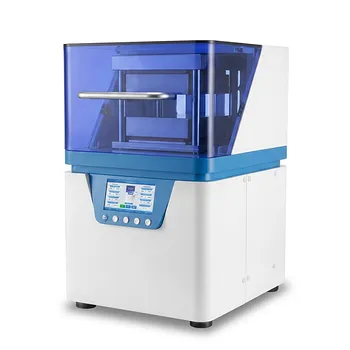
Hydraulic presses prepare spectroscopic samples by compressing powdered mixtures into solid, uniform pellets using immense, controlled force. This physical transformation converts loose, irregular powders into a flat, homogenous medium suitable for accurate transmission or reflection of analytical signals.
The hydraulic press is essential for converting loose powder samples into uniform, high-density pellets. By applying controlled pressure—and occasionally heat—these presses ensure the sample homogeneity and optical quality required for accurate molecular or elemental analysis.
The Mechanics of Sample Preparation
The Standard Procedure
The fundamental process for preparing a sample is consistent across most spectroscopic techniques. First, the sample is ground into a fine powder and mixed with a specific binder or matrix material.
This mixture is placed into a pressing die, which acts as a mold. The hydraulic press then applies significant pressure to the die, compacting the loose powder into a solid, cohesive disc or pellet.
Achieving Homogeneity
The primary goal of using a hydraulic press is homogeneity. Loose powders have irregular spacing and density, which can scatter light or radiation unpredictably.
By compressing the material, the press eliminates air gaps and creates a uniform density throughout the sample. This ensures that the data collected represents the true composition of the material, rather than artifacts caused by physical inconsistencies.
Specific Applications by Technique
FTIR Analysis (KBr Pellets)
For Fourier Transform Infrared Spectroscopy (FTIR), the press is used to create potassium bromide (KBr) pellets. The sample powder is diluted within transparent KBr, which acts as the suspension matrix.
When compressed, the KBr becomes optically transparent in the infrared spectrum. This allows the instrument to analyze the molecular structure of the suspended sample without interference from the matrix itself.
X-Ray Fluorescence (XRF)
For XRF analysis, the press creates general sample pellets using a binder to hold the material together. Unlike the delicate transparency required for FTIR, XRF pellets must be robust and perfectly flat.
Presses built for XRF are often high-throughput machines. They frequently feature integrated dies and automation systems to quickly extract finished pellets, accommodating the repetitive nature of XRF testing workflows.
The Role of Heat and Precision
Precision Force Control
Modern hydraulic presses allow researchers to apply exact pressure settings. This is critical because applying too much force can fracture the pellet or damage the molecular structure of sensitive samples.
Heated Compression
Some applications utilize heated hydraulic presses. The combination of heat and pressure helps materials flow and compact more uniformly. This is particularly vital when testing the durability of materials or ensuring that a binder distributes evenly throughout the pellet.
Understanding the Trade-offs
Risk of Contamination
The high pressure involved can cause the sample to adhere to the die surfaces. If the die is not meticulously cleaned between uses, cross-contamination can occur, leading to inaccurate spectral readings.
Sample Alteration
While pressure is necessary, excessive force or heat can physically or chemically alter certain sensitive materials. Users must balance the need for a solid pellet against the risk of changing the sample's fundamental properties before analysis.
Equipment Limitations
Hydraulic presses are powerful, but they require regular maintenance. The seals and hydraulic fluid levels must be monitored to ensure the force applied matches the readout, otherwise, reproducibility between samples may suffer.
Making the Right Choice for Your Goal
To ensure the best analytical results, tailor your pressing technique to your specific instrument.
- If your primary focus is FTIR Analysis: Prioritize the transparency of the pellet by using high-quality KBr and ensuring the die faces are perfectly polished to reduce scattering.
- If your primary focus is XRF Analysis: Prioritize throughput and flatness; consider a press with automated ejection features to streamline the creation of robust, flat pellets.
- If your primary focus is Delicate Materials: Use a press with adjustable pressure controls to ramp up force slowly, preventing fracture or molecular damage.
Ultimately, the quality of your spectroscopic data is only as good as the physical consistency of the pellet you create.
Summary Table:
| Feature | FTIR (KBr Pellets) | XRF Analysis |
|---|---|---|
| Primary Goal | Optical transparency | Robustness & flatness |
| Matrix Material | Potassium Bromide (KBr) | Binder/Sample mixture |
| Key Requirement | High-polish die surfaces | High-throughput automation |
| Mechanism | Dilution in IR-transparent matrix | Compression into solid discs |
Elevate Your Analytical Precision with KINTEK
Maximize the accuracy of your spectroscopic data with KINTEK’s industry-leading laboratory pressing solutions. Whether you are performing delicate FTIR KBr pelletizing or high-throughput XRF sample preparation, our diverse range of equipment—including manual, automatic, heated, and multifunctional presses—is designed to meet the rigorous demands of battery research and material science.
Why choose KINTEK?
- Versatility: Solutions ranging from compact manual presses to advanced isostatic (CIP/WIP) systems.
- Precision: Exact force and heat control to protect sensitive molecular structures.
- Reliability: Durable, glovebox-compatible designs built for consistent, repeatable results.
Contact our experts today to find the perfect press for your laboratory workflow!
Related Products
- Automatic Hydraulic Hot Press with Large Plate and Precision Temperature Control for Advanced Material Sample Preparation and Industrial Research
- Automatic Hydraulic Heat Press Machine with Multi Stage Programmable Control and Integrated Water Cooling Plate Size 180x180mm
- Automatic High Temperature Heated Hydraulic Press Machine with Heated Plates for Lab
- Automatic Heated Hydraulic Lab Press with Programmable Touch Screen Controls and Precision Temperature Regulation
- Manual Heated Hydraulic Lab Press with Integrated Hot Plates Hydraulic Press Machine
People Also Ask
- What are the specific features and applications of hydraulic hot press machines? Precision Solutions for Modern Labs
- How does an automatic hydraulic press operate? Achieve Precision and Consistency in Lab Pelleting
- What are the advantages and common applications of an automatic hydraulic press? Elevate Your Lab's Precision
- What is the technical significance of setting a precise dwell time? Achieve Peak Material Density and Stability
- When is an automatic hydraulic press more suitable than a manual press? Scale Your Lab with Precision & Speed