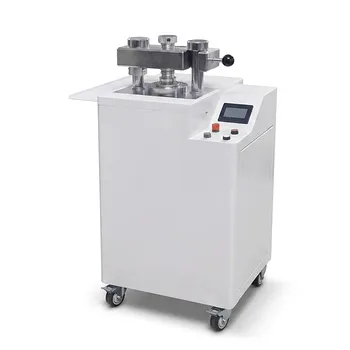
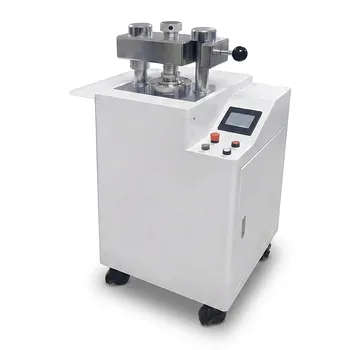
Lab pellet presses are the critical preparation mechanism for ensuring accuracy in spectrographic operations. By compressing powdered materials into solid, uniform discs, these devices standardize samples for techniques such as Infrared Spectroscopy (IR), X-ray Fluorescence (XRF), and emission spectroscopy, directly influencing the quality of the resulting data.
The Core Insight Spectrographic analysis relies on the consistent interaction between light and matter; irregular sample surfaces scatter signals unpredictably. A lab pellet press eliminates this physical variability, maximizing the signal-to-noise ratio to ensure your data reflects true chemical composition rather than sample preparation errors.
The Mechanics of Spectral Quality
Creating Optical Transparency for IR
In Infrared Spectroscopy (IR), the physical state of the sample is paramount. Lab presses are used to fuse powdered samples with potassium bromide (KBr) under high pressure.
This process transforms the opaque powder mixture into a transparent pellet. This transparency allows infrared light to pass through with minimal scattering, resulting in sharp, readable peaks in the resulting spectra.
Surface Uniformity in XRF and Emission
For X-ray Fluorescence (XRF) and emission spectroscopy, the focus shifts from transparency to surface consistency.
The press compacts the sample to create a perfectly flat, dense surface. This uniformity ensures that the detector receives a stable signal, which is essential for precise quantitative chemical analysis.
Applications in Biological Research
Standardizing Organic Materials
Beyond inorganic chemistry, lab pellet presses play a vital role in biological research. They are used to compress tissues, cells, and microbial cultures into uniform units.
Techniques like X-ray diffraction require these materials to be compact and physically stable. Without this compression, the natural irregularity of biological matter would make reproducible analysis nearly impossible.
High-Throughput Drug Discovery
In pharmaceutical workflows, specifically high-throughput screening, speed and consistency are competing goals.
Pellet presses allow researchers to rapidly prepare large numbers of samples with identical physical characteristics. This consistency is vital for reliability when screening thousands of compounds for potential drug candidacy.
Common Pitfalls and Requirements
The Necessity of Homogeneity
The press effectively reveals the quality of the mixture; it cannot fix a poorly mixed sample.
If the sample (such as the KBr mix in IR) is not chemically homogeneous before pressing, the resulting pellet will yield inconsistent data. The press ensures physical uniformity, but the user must ensure chemical uniformity.
Signal-to-Noise Dependencies
The primary "trade-off" in using a pellet press is the rigorous requirement for pressure precision.
Insufficient pressure results in a loose pellet that introduces noise into the spectrum. Conversely, proper compression is the single most effective method for improving the signal-to-noise ratio, making it a non-negotiable step for high-precision work.
Integrating This into Your Workflow
To ensure you are utilizing your lab pellet press effectively, consider your specific analytical goals:
- If your primary focus is Infrared Spectroscopy (IR): Prioritize the creation of transparent KBr pellets to minimize light scattering and maximize spectral clarity.
- If your primary focus is Biological Research: Focus on the reproducibility of compaction pressure to maintain consistency across variable organic samples like tissues or cultures.
- If your primary focus is Quantitative Analysis (XRF): Ensure the press generates a perfectly flat, dense surface to guarantee precise chemical quantification.
The pellet press is not just a molding tool; it is a data fidelity device that transforms raw material into a readable analytical standard.
Summary Table:
| Spectroscopy Technique | Sample Preparation Requirement | Role of Lab Pellet Press |
|---|---|---|
| Infrared (IR) | Optical transparency with KBr | Fuses powder into transparent discs to minimize light scattering. |
| XRF / Emission | Flat, dense surface uniformity | Creates a stable, smooth surface for precise quantitative signals. |
| Biological Research | Physical stability of organic matter | Compresses tissues and cultures for reproducible diffraction analysis. |
| Pharmaceuticals | High-throughput consistency | Rapidly prepares identical samples for reliable drug screening. |
Elevate Your Spectrographic Accuracy with KINTEK
Maximize your signal-to-noise ratio and eliminate sample preparation errors with KINTEK’s precision engineering. We specialize in comprehensive laboratory pressing solutions tailored for demanding analytical workflows. Whether you require manual, automatic, heated, multifunctional, or glovebox-compatible models, our equipment ensures the physical uniformity essential for battery research, chemical analysis, and material science.
Our Value to You:
- Versatility: Solutions ranging from compact manual presses to advanced cold and warm isostatic systems.
- Precision: Achieve the exact compaction pressure needed for optical transparency and surface density.
- Expertise: Trusted by researchers to provide stable, reproducible results in high-throughput environments.
Ready to transform your raw materials into high-fidelity analytical standards? Contact KINTEK today to find the perfect press for your lab!
Related Products
- Automatic XRF Pellet Press for Laboratory Spectrometry Sample Preparation
- Manual Laboratory Hydraulic Pellet Press Lab Hydraulic Press
- Automatic Fluorescence Sample Preparation Press 40 Ton Lab Pellet Press for XRF Analysis
- Laboratory Hydraulic Pellet Press for XRF KBR FTIR Lab Press
- Automatic Laboratory Hydraulic Press for XRF and KBR Pellet Pressing
People Also Ask
- How can contamination occur during the preparation of pressed pellets for XRF analysis? Expert Prevention Guide
- How does the sample material influence the required pressing load for making an XRF pellet? Find the Optimal Pressure
- What are the different methods for preparing a sample pellet for XRF analysis? Expert Guide to Superior XRF Results
- What are the advantages of preparing a sample as a dense pellet for XRF? Unlock High-Precision Trace Element Analysis
- What is the primary purpose of using an automatic pellet press? Achieve Precise Geopolymer Analysis Results