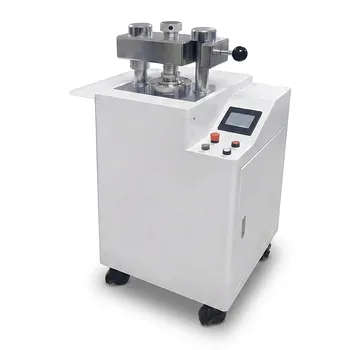
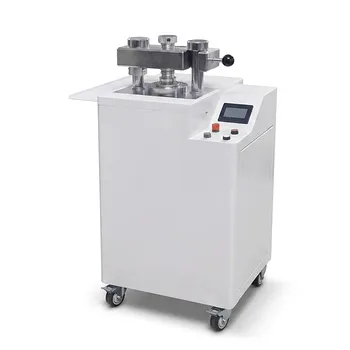
In the precise world of bomb calorimetry, laboratory press pellets serve as the standardized vehicle for combustion. They transform loose, unpredictable powders into compact forms that ensure a steady, controlled burn, which is vital for calculating the exact heat of combustion.
While loose powders introduce variables that skew data, pellets provide the physical uniformity necessary to accurately measure the energy content of substances in the food and fuel industries.
The Critical Role of Consistency
Controlling the Burn Rate
The primary function of a pellet in bomb calorimetry is to regulate how a sample burns. Loose powders often contain air pockets or uneven surface areas, leading to erratic combustion.
By compressing the sample into a pellet, you create a solid mass with a uniform density. This ensures the sample burns at a consistent and controlled rate, eliminating spikes or lags in heat release that could invalidate the test.
Achieving High-Precision Measurements
Accuracy is the ultimate goal when determining the energy content of materials like fuels or food products. A consistent burn allows the calorimeter to measure the heat of combustion with minimal error.
If the sample form varies, the results will vary. Pellets standardize the physical state of the sample, making the data reproducible and reliable for industrial quality control.
The Fabrication Process
Utilizing Hydraulic Force
To create these pellets, technicians employ a laboratory press equipped with a specific die or mold. The sample powder is loaded into this mold before the press is activated.
The press uses a hydraulic system to generate significant force. This pressure is transferred directly to the powder, compacting it until it binds together into a solid unit.
Ensuring Physical Uniformity
For the calorimetric data to be valid, the pellets must be identical in size and shape. Any variation in the pellet's dimensions can alter the surface area exposed to oxygen during combustion.
The hydraulic press ensures that the applied force is uniform for every batch. This mechanical consistency guarantees that every pellet meets the strict geometric requirements needed for successful analysis.
Common Pitfalls to Avoid
Inconsistent Compaction Density
One major trade-off in pellet preparation is the risk of variable density. If the hydraulic pressure is not applied consistently between samples, some pellets may be denser than others.
A denser pellet burns differently than a loosely packed one. This discrepancy introduces a variable that can skew the final heat of combustion reading, even if the samples are the same weight.
Material Binding Issues
Not all powders compress easily. Some materials may lack the natural cohesion to hold their shape after being pressed.
If a pellet crumbles or cracks before it enters the calorimeter, the surface area changes immediately. This negates the benefit of pressing the pellet and returns the user to the problems associated with loose powders.
Optimizing Your Calorimetric Workflow
To ensure your energy content measurements are as accurate as possible, focus on the repeatability of your sample preparation.
- If your primary focus is Data Precision: Ensure your laboratory press settings are locked in to produce pellets of identical size, shape, and density for every test run.
- If your primary focus is Sample Management: Verify that your die and hydraulic force are appropriate for the specific powder type to prevent crumbling or structural failure.
Standardizing your fuel source is the single most effective step toward guaranteeing the reliability of your caloric data.
Summary Table:
| Feature | Impact on Bomb Calorimetry |
|---|---|
| Physical Form | Transforms loose powder into compact, solid units |
| Burn Control | Eliminates erratic combustion spikes for steady heat release |
| Consistency | Standardizes surface area and density for reproducible data |
| Accuracy | Minimizes measurement errors in energy content (BTU/Joules) |
| Mechanism | Uses hydraulic force and precision dies for geometric uniformity |
Elevate Your Lab's Precision with KINTEK Pressing Solutions
Consistency is the foundation of accurate bomb calorimetry. At KINTEK, we specialize in comprehensive laboratory pressing solutions designed to meet the rigorous demands of material and battery research. Whether you require manual, automatic, heated, or multifunctional models, our equipment ensures your pellets achieve the perfect density and structural integrity every time.
From glovebox-compatible units to advanced cold and warm isostatic presses, our technology empowers researchers to eliminate variables and secure reliable data.
Ready to standardize your sample preparation? Contact KINTEK experts today to find your perfect press solution!
Related Products
- Laboratory Hydraulic Split Electric Lab Pellet Press
- Automatic Laboratory Hydraulic Press Lab Pellet Press Machine
- Manual Laboratory Hydraulic Pellet Press Lab Hydraulic Press
- Laboratory Hydraulic Pellet Press for XRF KBR FTIR Lab Press
- Laboratory Hydraulic Press 2T Lab Pellet Press for KBR FTIR
People Also Ask
- What are the emerging trends in the design and materials of lab pellet presses? Modernize Your Lab Efficiency
- How do lab pellet presses support customization and flexibility? Optimize Your Sample Prep for Any Material
- What are common lab pellet press issues? Expert Troubleshooting Guide for Reliable Material Research
- What are the common operational types of lab pellet presses? Choosing the Right Manual, Automatic, or Hydraulic System
- Why use a laboratory pellet press for solid-state battery evaluation? Ensure Accuracy in Interface Stability Testing