
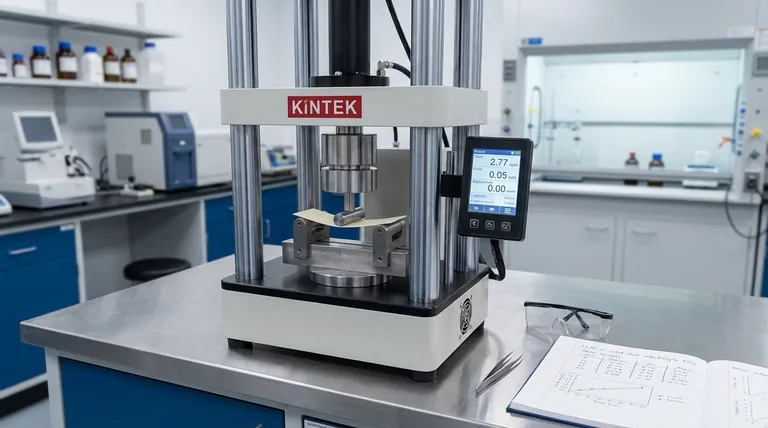
The primary method for assessing the mechanical properties of Li₇La₃Zr₂O₁₂ (LLZO) films using a laboratory press is by equipping it with specialized fixtures to perform a three-point bending test.
This configuration transforms the press from a fabrication tool into a testing instrument, allowing for the quantitative measurement of mechanical strength, fracture resistance, and the material's ability to withstand the bending forces it will encounter during battery assembly and long-term cycling.
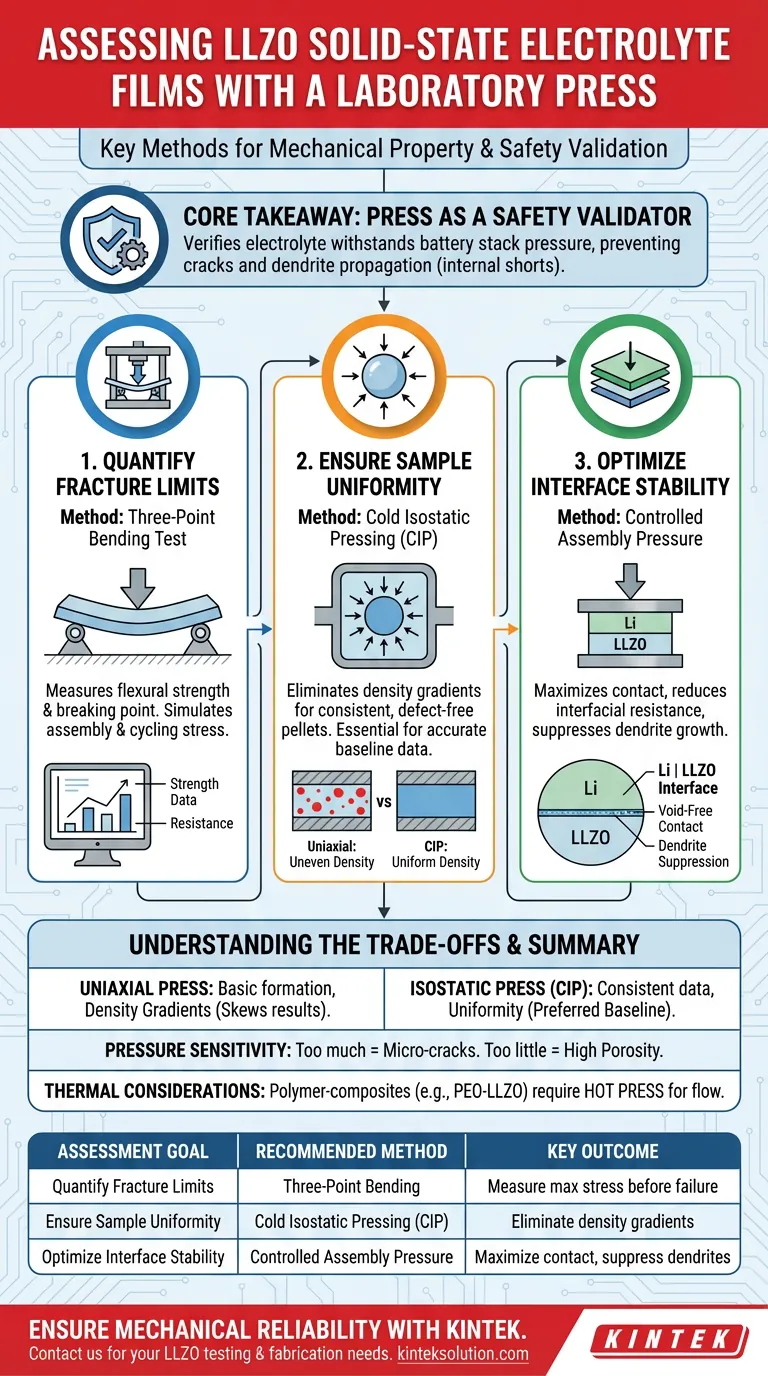
Core Takeaway While a laboratory press is standard for fabricating dense LLZO pellets, its role in assessment is critical for safety validation. By conducting fracture and bending tests, the press verifies that the electrolyte can withstand the physical pressure of the battery stack without cracking—a failure mode that leads directly to dendrite propagation and internal short circuits.
Mechanical Evaluation Techniques
Three-Point Bending Test
To assess the structural integrity of LLZO films, the laboratory press is fitted with a three-point bending fixture. This test applies a specific load to the center of the film while it rests on two outer supports.
Quantifying Fracture Resistance
The data gathered from this test reveals the flexural strength of the ceramic. This quantitative measure is essential because LLZO is brittle; knowing the exact breaking point helps engineers design assembly processes that do not exceed the material's mechanical limits.
Predicting Long-Term Reliability
The assessment is not just about initial strength. It simulates the stress the film must endure over thousands of cycles. Ensuring the LLZO film maintains integrity under pressure is vital for preventing cracks that allow lithium dendrites to penetrate the electrolyte.
Establishing Mechanical Properties via Fabrication
To accurately assess LLZO, one must first fabricate samples with uniform density. The press plays a definitive role in establishing the baseline mechanical properties of the material.
Cold Pressing and Green Body Formation
For pure LLZO ceramic processing, a precision press compacts powder into a "green body" (unsintered pellet). The pressure must be strictly controlled to pack particles tightly, reducing internal porosity.
The Role of Density Gradients
A critical aspect of mechanical quality is uniformity. Standard uniaxial pressing can create uneven density. This leads to stress concentrations where cracks can initiate during sintering or testing, compromising the mechanical assessment.
Cold Isostatic Pressing (CIP)
To overcome the limitations of uniaxial pressing, Cold Isostatic Pressing (CIP) is used. By applying uniform hydrostatic pressure (e.g., 60 MPa), CIP produces pellets with exceptional density uniformity. This minimizes internal stress concentrations, providing a high-quality, defect-free sample for accurate mechanical testing.
Interface and Assembly Assessment
Optimizing Lithium-Electrolyte Contact
Beyond destructive testing, the press is used to assess and optimize the assembly mechanics. It applies external pressure to force soft lithium metal against the hard LLZO surface.
Reducing Interfacial Resistance
This application of pressure is critical for creating a void-free interface. Intimate contact improves wettability and reduces interfacial resistance.
Suppressing Dendrite Growth
Mechanically, this pressure helps suppress the growth of lithium dendrites. If the press establishes sufficient contact pressure, the likelihood of dendrite penetration—and subsequent mechanical failure of the electrolyte—is significantly reduced.
Understanding the Trade-offs
Uniaxial vs. Isostatic Pressing
While a standard uniaxial press is sufficient for basic pellet formation, it often results in density gradients. For rigorous mechanical assessment, this inhomogeneity can skew results, making the material appear weaker than it is. CIP is preferred for generating consistent baseline data.
Pressure Sensitivity
There is a fine line between optimization and destruction. Applying too much pressure during the assembly or green body formation can induce micro-cracks in the brittle LLZO ceramic. Conversely, insufficient pressure leads to high porosity and poor ionic conductivity.
Thermal Considerations
When working with polymer-composite electrolytes (like PEO-LLZO), a hot press is required. Cold pressing is ineffective here; heat is necessary to melt the polymer matrix so it can flow into voids. Using a cold press on these materials will result in poor adhesion and inaccurate mechanical data.
Making the Right Choice for Your Goal
To ensure the reliability of your all-solid-state battery, select the pressing method that aligns with your specific stage of development:
- If your primary focus is quantifying fracture limits: Use a press equipped with three-point bending fixtures to determine the maximum stress the LLZO film can handle before failure.
- If your primary focus is sample uniformity: Utilize Cold Isostatic Pressing (CIP) to eliminate density gradients and internal stresses, ensuring your test data reflects the material's true properties.
- If your primary focus is interface stability: Use a press to apply controlled assembly pressure to maximize contact between the Lithium anode and LLZO electrolyte, thereby reducing resistance.
Ultimately, the laboratory press serves as both the creator of structural integrity and the judge of its limits, ensuring the safety of the final energy storage system.
Summary Table:
| Assessment Goal | Recommended Press Method | Key Outcome |
|---|---|---|
| Quantify Fracture Limits | Press with Three-Point Bending Fixtures | Measure maximum stress before failure |
| Ensure Sample Uniformity | Cold Isostatic Pressing (CIP) | Eliminate density gradients for accurate data |
| Optimize Interface Stability | Controlled Assembly Pressure | Maximize lithium-LLZO contact, suppress dendrites |
Ensure the mechanical reliability of your solid-state battery components.
Accurate mechanical assessment is critical for preventing electrolyte failure and ensuring battery safety. KINTEK specializes in laboratory press machines—including automatic lab presses, isostatic presses, and heated lab presses—designed to meet the precise needs of battery research and development.
Our equipment helps you:
- Quantify Fracture Strength: Perform accurate three-point bending tests to determine LLZO film limits.
- Achieve Sample Uniformity: Utilize Cold Isostatic Pressing (CIP) for defect-free, consistent pellets.
- Optimize Assembly Interfaces: Apply controlled pressure for superior lithium-electrolyte contact.
Let us provide the right press for your specific development stage. Contact KINTEK today to discuss your LLZO testing and fabrication requirements!
Visual Guide
Related Products
- Special Shape Lab Press Mold for Laboratory Applications
- Square Lab Press Mold for Laboratory Use
- Lab Cylindrical Press Mold for Laboratory Use
- Automatic Laboratory Hydraulic Press Lab Pellet Press Machine
- Laboratory Hydraulic Split Electric Lab Pellet Press
People Also Ask
- What is the purpose of incorporating cartridge heaters into a lab press mold for MLCC block compression? Optimize Results
- Why is a high-performance laboratory molding press critical for in-situ electrolyte formation? Unlock Battery Success
- Why are high-precision laboratory molds and specific compaction processes required? Ensure Data Integrity in Soil Research
- Why are precision laboratory molds essential for forming basalt-reinforced lightweight concrete specimens?
- How does the geometry of laboratory molds influence mycelium-based composites? Optimize Density and Strength



















