
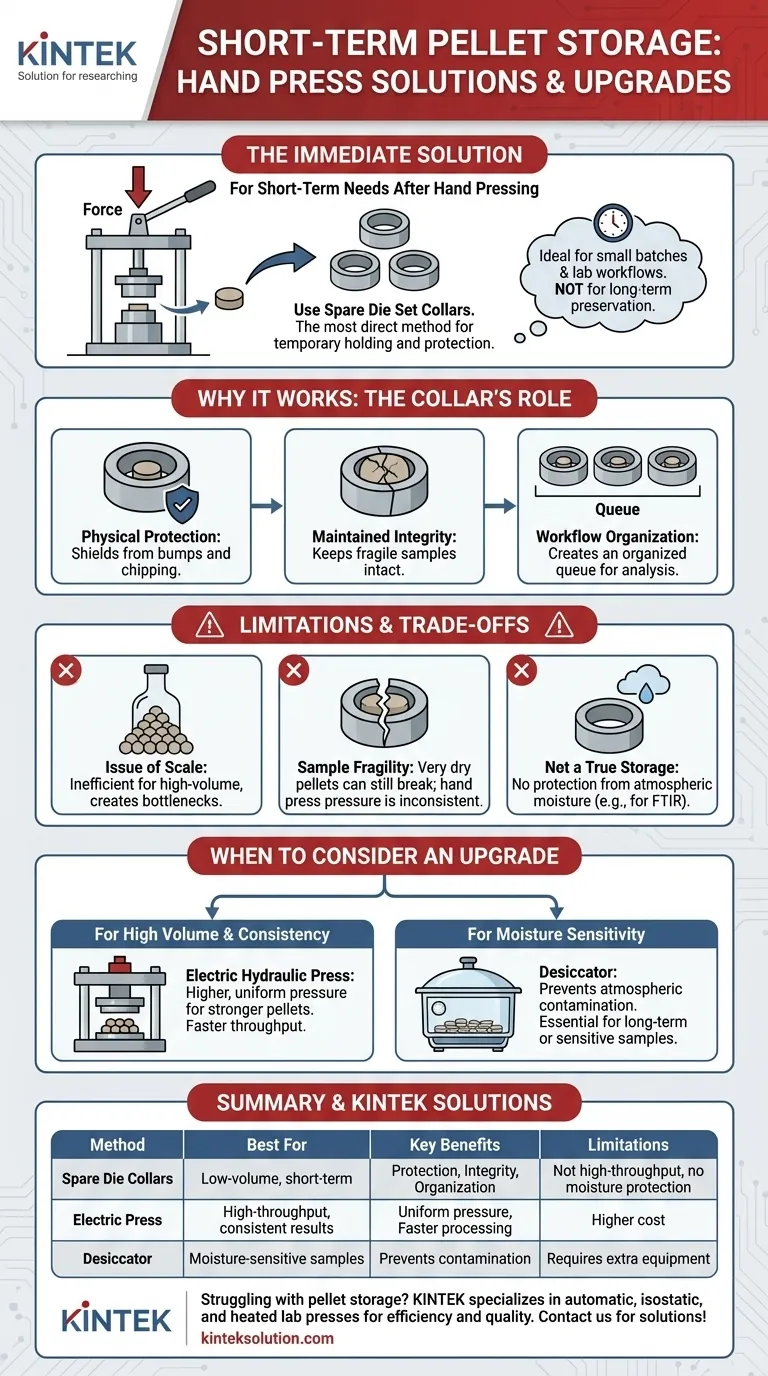
For immediate, short-term storage of pellets made with a hand press, the most direct and practical solution is to use extra collars from the die set. These collars serve as protective holders for the finished pellets, keeping them safe and intact until you are ready for analysis or disposal. This method is ideal for managing a small batch of samples within a typical lab workflow.
While using spare die set collars is an effective solution for temporary pellet storage, it is crucial to recognize this as a workflow management technique, not a long-term preservation method. The limitations of this approach become clear when dealing with high sample volumes or exceptionally fragile materials.
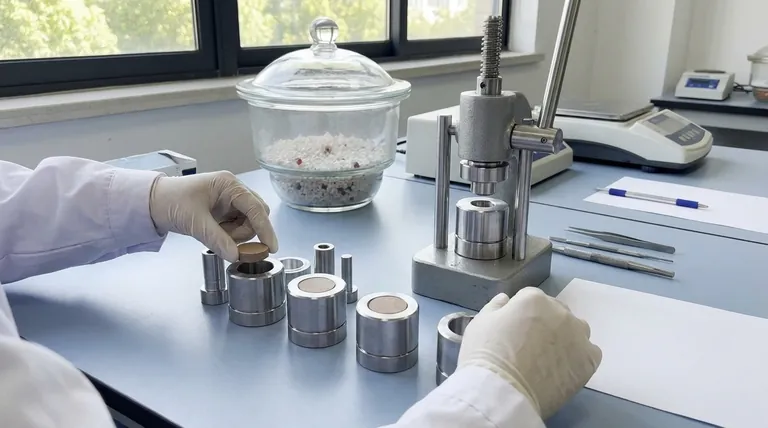
The Role of the Die Set Collar in Sample Handling
Understanding your equipment's function is key to optimizing its use. A die set collar, while designed for pressing, has a valuable secondary application for temporary sample management.
What is a Die Set Collar?
The collar is the cylindrical part of a pellet die set that contains the powder sample during compaction. Its primary job is to form the sides of the pellet and withstand the pressure exerted by the press.
Why Use a Collar for Storage?
Using a spare collar as a temporary holder is a common practice because it offers several distinct advantages:
- Physical Protection: The collar acts as a rigid wall, shielding the fragile pellet from accidental bumps, chipping, or shattering on the lab bench.
- Maintained Integrity: It keeps the pellet securely contained, which is especially important for brittle samples (like those made from very dry powders) that can easily crumble at the edges.
- Workflow Organization: By placing each finished pellet in its own collar, you can create an organized queue for analysis. This prevents mix-ups and streamlines your process when preparing multiple samples.
Understanding the Trade-offs and Limitations
This method, while practical, is not a universal solution. Its effectiveness depends on your specific throughput and sample characteristics.
The Issue of Scale and Throughput
This technique is best suited for low-volume work. If you need to prepare large quantities of pellets, dedicating a collar to each one becomes inefficient and can create a bottleneck. You would need a large inventory of expensive spare collars to manage the queue.
Challenges with Sample Fragility
The reference to very dry pellets highlights a potential point of failure. While a collar provides protection, the initial creation of a durable pellet is paramount. Hand presses rely on user-applied force, which can be inconsistent. If a pellet is extremely fragile from the start, even the collar may not prevent it from breaking during handling.
Not a True Storage Environment
A die collar is not a sealed container. It offers no protection from atmospheric moisture. For techniques sensitive to water, like FTIR spectroscopy, leaving a sample in an open collar for an extended period can compromise the results.
When to Consider an Upgrade
Recognizing the limits of your current setup is critical for maintaining analytical quality. The limitations of hand press storage often point to a need for more capable equipment.
The Electric Hydraulic Press Advantage
For labs handling large quantities or requiring highly consistent results, an electric hydraulic press is the logical next step. It delivers higher, more uniform pressure, which typically creates stronger, more durable pellets that are easier to handle and store. Its speed and automation also directly solve the throughput problem.
The Need for a Desiccator
For any storage longer than a few minutes, or for highly moisture-sensitive samples, the pellet (whether in a collar or not) should be placed in a desiccator. This dry environment is the correct tool for preventing atmospheric contamination and preserving sample integrity prior to analysis.
Making the Right Choice for Your Workflow
Your storage strategy should align directly with your analytical demands and sample volume.
- If your primary focus is low-volume, routine analysis: Using spare die set collars is a highly effective and cost-efficient method for short-term pellet queuing.
- If your primary focus is high-throughput or sample consistency: Investing in an electric hydraulic press is necessary to avoid bottlenecks and improve the quality of your pellets.
- If your primary focus is analytical accuracy with sensitive materials: Immediately place finished pellets inside a desiccator to protect them from atmospheric moisture, regardless of your press type.
Ultimately, effective sample management is about matching your tools and techniques to the specific goals of your analysis.
Summary Table:
| Method | Best For | Key Benefits | Limitations |
|---|---|---|---|
| Use spare die collars | Low-volume, short-term storage | Physical protection, maintained integrity, workflow organization | Not for high throughput, no moisture protection, fragile samples may break |
| Upgrade to electric hydraulic press | High-throughput, consistent results | Higher pressure, uniform pellets, faster processing | Higher cost, not necessary for small batches |
| Use a desiccator | Moisture-sensitive samples | Prevents atmospheric contamination, preserves sample integrity | Requires additional equipment, not for immediate use |
Struggling with pellet storage in your lab? KINTEK specializes in lab press machines, including automatic lab presses, isostatic presses, and heated lab presses, designed to enhance efficiency and sample quality for laboratories. Whether you need durable pellets for high-throughput workflows or consistent results, our solutions can help. Contact us today to discuss how we can support your lab's needs!
Visual Guide
Related Products
- Lab Ring Press Mold for Sample Preparation
- Lab Infrared Press Mold for No Demolding
- Lab Cylindrical Press Mold with Scale
- Lab Heat Press Special Mold
- Laboratory Hydraulic Split Electric Lab Pellet Press
People Also Ask
- What is the purpose of incorporating cartridge heaters into a lab press mold for MLCC block compression? Optimize Results
- What is the role of a laboratory press in COF electrolyte prep? Achieving High-Performance Pellet Densification
- Why is precise cooling management of the lab press mold necessary? Protect Core Integrity in Thermoforming
- What is the function of a pressing tool in thermoplastic panels? Master Precision Shaping & Fusion Bonding
- What impact does a sample preparation press have on testing results when researching MXene as an electrolyte additive?





