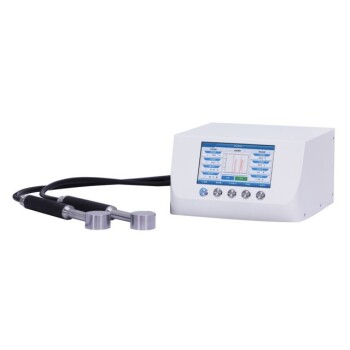
Electric heating tapes and PID control systems operate as a unified thermal management unit to maintain rigorous environmental conditions during hydraulic fracturing experiments. The heating tapes provide the necessary thermal energy to both the test specimen and the injection fluid, while the PID (Proportional-Integral-Derivative) controller actively modulates the power output to lock the system at a precise target temperature, such as 40 °C.
Core Insight: These systems are not merely heaters; they are precision instruments essential for simulating deep geothermal gradients. By eliminating thermal fluctuations, they allow researchers to isolate exactly how heat-induced weakening impacts the tensile strength and fatigue life of temperature-sensitive materials like PMMA.
Simulating Deep Geothermal Environments
Replicating Subsurface Conditions
To generate valid data, experiments must mimic the reality of deep-earth environments. This requires a comprehensive heating strategy.
You cannot simply heat the sample in isolation. The system uses electric heating tapes to simultaneously raise the temperature of the injection fluid and the sample material to the desired set point.
The Role of PID Algorithms
Standard on/off thermostats are too imprecise for this application. A PID controller continuously calculates the difference between the current temperature and the target.
It makes micro-adjustments to the energy supplied to the heating tapes. This prevents the temperature from "overshooting" the target or dropping too low, ensuring a stable thermal baseline throughout the fracturing process.
The Critical Link to Material Properties
Sensitivity of Polymers (PMMA)
The precision of this system is dictated by the materials being tested. Polymers like Poly(methyl methacrylate) (PMMA) are used as rock analogues, but they are highly reactive to heat.
The tensile strength and elastic modulus of PMMA change significantly with temperature. Even minor deviations from the target temperature can alter the material's stiffness and strength, skewing results.
Ensuring Data Repeatability
Scientific validity relies on the ability to repeat results under identical conditions.
By strictly regulating the thermal environment, the PID system removes temperature as a variable. This ensures that any observed changes in the material are due to the hydraulic pressure and fracturing mechanics, not random thermal drift.
Revealing Fatigue Mechanisms
The ultimate goal of this setup is to understand failure.
By maintaining a constant 40 °C (or other targets), researchers can accurately observe how temperature-induced weakening accelerates fatigue failure. This is critical for understanding how materials break down under cyclic pressure in geothermal environments.
Understanding the Challenges
The Cost of Precision
Implementing a PID control loop adds complexity to the experimental setup. It requires careful tuning of the controller's parameters to match the thermal mass of the sample and fluid.
Material Constraints
While the control system can maintain high temperatures, the sample material has physical limits. Researchers must be aware that pushing PMMA to temperatures that significantly degrade its elastic modulus may shift the failure mode from brittle fracture to ductile deformation, potentially altering the applicability of the data.
Making the Right Choice for Your Experiment
To maximize the value of your hydraulic fracturing data, align your thermal control strategy with your specific research goals:
- If your primary focus is material characterization: Prioritize aggressive PID tuning to minimize thermal oscillation, as PMMA's mechanical properties (elastic modulus) are highly sensitive to even transient temperature shifts.
- If your primary focus is environmental simulation: Ensure your heating tapes are configured to provide uniform coverage for both the fluid and the sample to accurately replicate the deep geothermal gradient.
Precise thermal management is the baseline requirement for distinguishing between true material behavior and experimental artifact.
Summary Table:
| Component | Primary Function | Impact on Experiment |
|---|---|---|
| Electric Heating Tapes | Delivers thermal energy to injection fluid & sample | Replicates subsurface geothermal gradients |
| PID Controller | Modulates power output via feedback loop | Prevents temperature overshoot & ensures stability |
| Target Material (PMMA) | Acts as a rock analogue for testing | Reveals temperature-induced weakening & fatigue |
| Fluid Heating | Pre-heats the fracturing medium | Ensures uniform thermal environment during injection |
Elevate Your Research Precision with KINTEK
Precise thermal control is non-negotiable for accurate material characterization and battery research. KINTEK specializes in comprehensive laboratory pressing and thermal solutions, offering manual, automatic, heated, and multifunctional models designed for the most demanding environments. Whether you are performing isostatic pressing or simulating deep geothermal gradients, our equipment ensures your data is defined by material behavior, not experimental artifacts.
Ready to optimize your laboratory workflow? Contact KINTEK today for a consultation and discover how our advanced solutions can enhance your research repeatability and performance.
References
- Julien Mouli‐Castillo, Zoe K. Shipton. Cyclical hydraulic pressure pulses reduce breakdown pressure and initiate staged fracture growth in PMMA. DOI: 10.1007/s40948-024-00739-z
This article is also based on technical information from Kintek Solution Knowledge Base .
Related Products
- Cylindrical Lab Electric Heating Press Mold for Laboratory Use
- Infrared Heating Quantitative Flat Plate Mold for Precise Temperature Control
- Lab Double Plate Heating Mold for Laboratory Use
- Automatic Heated Hydraulic Press Machine with Heated Plates for Laboratory
People Also Ask
- How does a laboratory electric heated press ensure sample quality? Optimize SiR-EPDM vulcanization and molding.
- What role does a laboratory electric heated press play in polymer composite fabrication? Key for Standardized Specimens
- What role does a laboratory electric heating press play in NBR molding? Master Vulcanization & Material Density
- Why is a laboratory electric heating press required for PP/EPDM molding? Achieve Superior Specimen Integrity
- What is the purpose of incorporating cartridge heaters into a lab press mold for MLCC block compression? Optimize Results