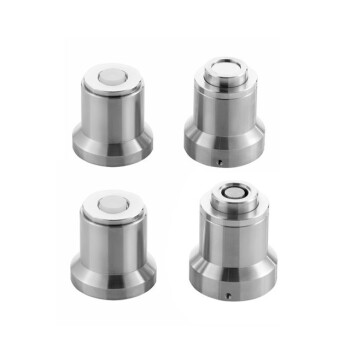
High-purity alumina spacers serve as the primary containment mechanism in laboratory high-pressure devices, acting as physical seals that are chemically inert. By utilizing their low permeability and high chemical stability, these spacers effectively trap generated melt within a rock sample, preventing the material from migrating or escaping during the experiment.
By acting as a robust barrier against melt loss, alumina spacers enable the precise study of in-situ crystallization and the analysis of how confined fluids influence the anisotropy of magnetic susceptibility (AMS).
The Mechanics of Melt Confinement
Creating an Impermeable Barrier
The fundamental function of the alumina spacer is to act as a physical seal. High-pressure experiments often generate melt that, without containment, would flow away from the sample site.
Alumina spacers possess low permeability, which blocks the pathways that fluids would naturally take to escape. This ensures the sample retains its mass and composition throughout the heating process.
Leveraging Chemical Stability
Beyond physical containment, the "high-purity" aspect of the alumina is critical for maintaining a neutral environment.
Due to their high chemical stability, these spacers do not react with the molten rock. This prevents contamination of the sample and ensures that observed behaviors are intrinsic to the rock, not artifacts of the experimental apparatus.
Enabling Advanced Petrological Analysis
Observing In-Situ Crystallization
Because the melt is successfully trapped, researchers can study crystallization behavior as it happens within the sample.
This allows for the observation of textures and mineral formations that occur when melt solidifies under pressure, rather than studying a depleted sample that has lost its fluid components.
Analyzing Magnetic Fabric (AMS)
The presence of confined melt significantly influences the rock's physical structure. The reference specifically highlights the impact on anisotropy of magnetic susceptibility (AMS).
By restricting melt movement, the spacers allow scientists to measure how the pressure of the melt affects the orientation and alignment of magnetic minerals within the rock fabric.
Critical Considerations for Data Integrity
The Risk of Melt Migration
The validity of these experiments hinges entirely on the effectiveness of the seal. If the spacer fails to act as a barrier, melt migration occurs.
Loss of melt alters the chemical composition of the remaining solid, potentially leading to inaccurate conclusions regarding crystallization textures.
Impact on Anisotropy Data
The study of AMS relies on the melt exerting influence on the rock fabric while confined.
If the seal is permeable, the internal pressure dynamics change. This would compromise the AMS analysis, as the magnetic fabric would no longer reflect the conditions of restricted melt flow.
Making the Right Choice for Your Experiment
To ensure accurate results in high-pressure melt studies, consider how the spacer's function aligns with your specific analytical goals:
- If your primary focus is crystallization textures: Ensure the spacer provides a complete seal to prevent melt loss, allowing you to observe true in-situ solidification.
- If your primary focus is magnetic anisotropy (AMS): Rely on the low permeability of the spacer to maintain the internal melt pressure required to influence the rock's magnetic fabric.
High-purity alumina spacers are not just accessories; they are the defining control variable that makes the study of confined melt behavior possible.
Summary Table:
| Feature | Function in High-Pressure Studies | Impact on Research |
|---|---|---|
| Low Permeability | Creates a physical seal/impermeable barrier | Prevents melt migration and mass loss |
| Chemical Stability | Ensures a chemically inert environment | Prevents sample contamination for pure data |
| Melt Containment | Traps fluid within the rock sample | Enables observation of in-situ crystallization |
| Pressure Retention | Maintains internal fluid dynamics | Facilitates accurate magnetic fabric (AMS) analysis |
Elevate Your Geochemical Research with KINTEK Precision
Maximize the integrity of your high-pressure experiments with KINTEK’s premium laboratory solutions. Whether you are investigating in-situ crystallization or the complexities of magnetic anisotropy, our high-purity components ensure the reliable melt containment your data demands.
KINTEK specializes in comprehensive laboratory pressing solutions, offering:
- Manual, automatic, and heated press models.
- Multifunctional and glovebox-compatible systems.
- Cold and warm isostatic presses optimized for battery research and advanced material science.
Don't let melt migration compromise your results. Contact KINTEK today to find the perfect high-pressure apparatus for your specific analytical goals!
References
- Bjarne Almqvist, Santanu Misra. Petrofabric development during experimental partial melting and recrystallization of a mica‐schist analog. DOI: 10.1002/2015gc005962
This article is also based on technical information from Kintek Solution Knowledge Base .
Related Products
- Lab Round Bidirectional Press Mold
- Warm Isostatic Press for Solid State Battery Research Warm Isostatic Press
- Lab Double Plate Heating Mold for Laboratory Use
- Lab Cylindrical Press Mold for Laboratory Use
- Automatic High Temperature Heated Hydraulic Press Machine with Heated Plates for Lab
People Also Ask
- What is the purpose of incorporating cartridge heaters into a lab press mold for MLCC block compression? Optimize Results
- What is the function of a pressing tool in thermoplastic panels? Master Precision Shaping & Fusion Bonding
- Why is precise cooling management of the lab press mold necessary? Protect Core Integrity in Thermoforming
- Why is a high-performance laboratory molding press critical for in-situ electrolyte formation? Unlock Battery Success
- How do the design and geometric precision of pressing molds and mandrels affect the quality of PTFE composite samples?