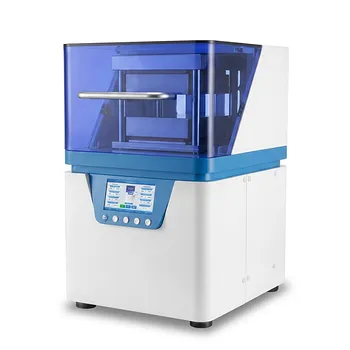
Hydraulic mini presses enhance repeatability primarily through the integration of a precise pressure gauge. This component allows operators to visually confirm and replicate the exact amount of force applied to every sample, eliminating the variability inherent in unmeasured manual techniques. By standardizing the pressure, you ensure that every sample produced has consistent density and physical properties.
Core Insight: In analytical chemistry and materials testing, the reliability of your data is often limited by the quality of your sample preparation. Hydraulic mini presses solve this by removing "human feel" from the equation, using verifiable pressure metrics to guarantee that sample A is physically identical to sample B.
The Mechanics of Consistency
The Role of the Pressure Gauge
The primary driver of repeatability is the built-in pressure gauge. Without this metric, applying force is a guessing game.
The gauge provides a quantitative readout, allowing the operator to dial in a specific load—often up to 2 tons—for every single cycle. This ensures that the internal structure of the sample is compressed to the exact same degree every time.
Uniformity in Small Form Factors
These presses are specifically engineered to produce smaller pellets, such as 7 mm diameter discs.
Because the force is concentrated on a small surface area, the press can achieve high density and uniformity within the pellet. This capability is critical for lab applications where even minor deviations in sample thickness or density can skew test results.
Why Uniformity Matters for Analysis
Impact on Spectroscopy (FTIR and XRF)
Repeatability in pressing is directly linked to the accuracy of analytical techniques like Fourier Transform Infrared Spectroscopy (FTIR) and X-ray Fluorescence (XRF).
For techniques like FTIR (using KBr discs), the path length of the light through the sample must be consistent. A hydraulic mini press ensures that powder mixtures are compressed into discs of uniform thickness and transparency, preventing data artifacts caused by irregular sample preparation.
Homogeneity of Components
When preparing powder mixtures for compositional analysis, how the material is pressed affects component distribution.
Hydraulic pressure ensures a uniform distribution of components within the matrix. This prevents "hot spots" or segregation within the sample, ensuring that the portion analyzed is truly representative of the whole material.
Operational Advantages
Reduced Physical Effort
Unlike standard manual presses which can be physically taxing, hydraulic mini presses use a hydraulic oil pump mechanism.
This design requires significantly less physical effort from the operator. By reducing operator fatigue, the press minimizes the likelihood of human error that typically occurs during repetitive sample preparation tasks.
Compact Accessibility
Weighing approximately 4 kilograms, these devices are portable and space-efficient.
This allows them to be placed directly on a workbench in crowded environments like pharmaceutical or polymer testing labs. Immediate access to the press streamlines the workflow, further encouraging consistent protocol adherence compared to sharing a large, remote facility press.
Understanding the Trade-offs
Pressure Limitations
While effective for sample preparation, the 2-ton limit is a constraint.
If your application requires mimicking extreme industrial conditions or pressing large, high-strength ceramic components, this force may be insufficient. These presses are optimized for analytical sample prep, not heavy-duty industrial manufacturing.
Manual Monitoring
Despite having a gauge, these are typically manually operated devices.
True repeatability still relies on the operator diligently reading the gauge and stopping at the precise mark. Unlike fully automated electric presses, a hydraulic mini press does not automatically "cut off" at a set pressure, meaning user attention is still required.
Making the Right Choice for Your Goal
- If your primary focus is FTIR or XRF Analysis: A hydraulic mini press is ideal for creating transparent, uniform 7 mm KBr discs that yield clean, comparable spectra.
- If your primary focus is Lab Space Efficiency: The compact, lightweight design allows you to bring high-pressure capabilities to any workbench without sacrificing counter space.
- If your primary focus is High-Force Industrial Simulation: You should look beyond mini presses, as the 2-ton limit will not suffice for simulating heavy industrial loads or manufacturing large components.
By strictly controlling the variable of pressure, hydraulic mini presses transform sample preparation from a manual art into a repeatable science.
Summary Table:
| Feature | Benefit for Repeatability |
|---|---|
| Integrated Pressure Gauge | Allows for precise, verifiable force replication up to 2 tons |
| Small Form Factor (7mm) | Concentrates force for high density and uniform pellet thickness |
| Hydraulic Oil Pump | Reduces operator fatigue to minimize human error during cycles |
| Consistent Compression | Ensures uniform component distribution and eliminates 'hot spots' |
Elevate Your Lab's Analytical Precision with KINTEK
Consistency is the foundation of reliable data. At KINTEK, we specialize in comprehensive laboratory pressing solutions designed to turn sample preparation into a repeatable science. Whether you are conducting cutting-edge battery research or routine spectroscopy, our diverse range—including manual, automatic, heated, multifunctional, and glovebox-compatible models, as well as cold and warm isostatic presses—ensures you have the perfect tool for your specific application.
Don't let manual variability compromise your results. Contact our specialists today to find the ideal press for your workflow.
Related Products
- Automatic Hydraulic Hot Press with Large Plate and Precision Temperature Control for Advanced Material Sample Preparation and Industrial Research
- Automatic Laboratory Hydraulic Press Lab Pellet Press Machine
- Laboratory Hydraulic Press Lab Pellet Press Machine for Glove Box
- Automatic Hydraulic Heat Press Machine with Multi Stage Programmable Control and Integrated Water Cooling Plate Size 180x180mm
- Laboratory Hydraulic Press Lab Pellet Press Button Battery Press
People Also Ask
- What are the specific features and applications of hydraulic hot press machines? Precision Solutions for Modern Labs
- How does an automatic hydraulic press operate? Achieve Precision and Consistency in Lab Pelleting
- What are the advantages and common applications of an automatic hydraulic press? Elevate Your Lab's Precision
- What is the technical significance of setting a precise dwell time? Achieve Peak Material Density and Stability
- When is an automatic hydraulic press more suitable than a manual press? Scale Your Lab with Precision & Speed