
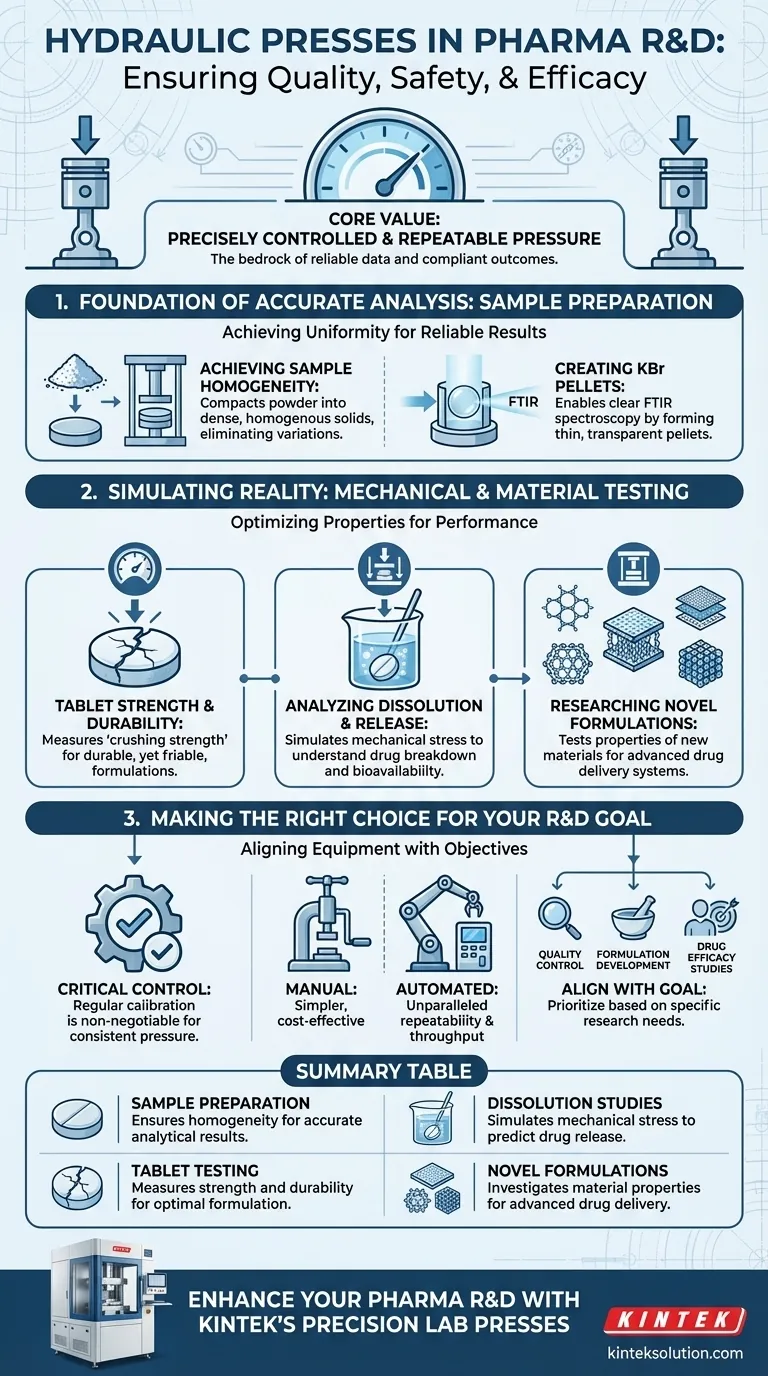
In pharmaceutical research and development, hydraulic presses serve as indispensable tools for ensuring the quality, safety, and efficacy of medicinal products. Their primary contributions lie in three key areas: preparing highly uniform samples for analytical testing, determining the physical characteristics of solid dosage forms like tablets, and simulating mechanical stress for dissolution studies.
The core value of a hydraulic press in a pharmaceutical lab is not simply its ability to apply force. It is the capacity to deliver precisely controlled and repeatable pressure, which is the bedrock of reliable data, consistent product quality, and compliant research outcomes.
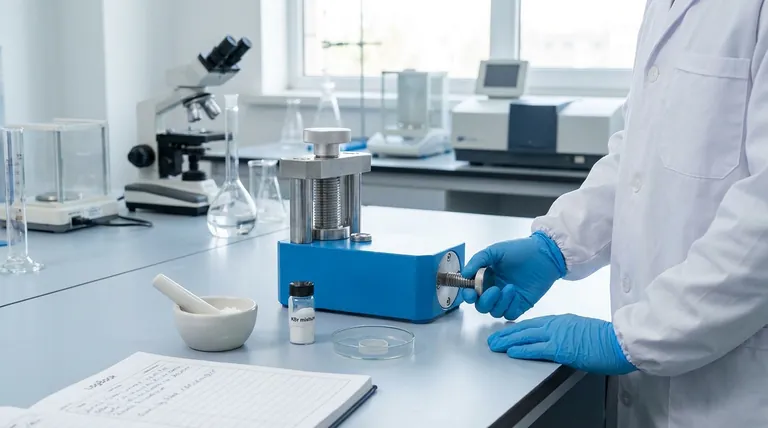
The Foundation of Accurate Analysis: Sample Preparation
In pharmaceutical analysis, the quality of your result is entirely dependent on the quality of your sample. Hydraulic presses are fundamental in preparing samples for a range of analytical techniques.
Achieving Sample Homogeneity
Inconsistent or non-uniform samples lead to inaccurate and unreliable analytical results. A hydraulic press compacts powdered materials, such as a drug substance mixed with excipients, into a dense, homogenous solid.
This process eliminates variations in density and particle distribution within the sample, ensuring that any subsequent measurement is truly representative of the entire mixture.
Creating Pellets for Spectroscopic Analysis
Techniques like Fourier-transform infrared spectroscopy (FTIR) are used to identify chemical compounds and verify the purity of a drug. For this analysis, a powder is often mixed with potassium bromide (KBr) and pressed into a thin, semi-transparent pellet.
The high, evenly distributed pressure from a hydraulic press is critical for creating a pellet that allows the spectrometer's light beam to pass through uniformly, yielding a clear and accurate spectrum.
Simulating Reality: Mechanical and Material Testing
A drug tablet is a complex material that must withstand the rigors of manufacturing and shipping, yet break down predictably in the body. Hydraulic presses allow researchers to test and perfect these mechanical properties.
Determining Tablet Strength and Durability
Researchers use hydraulic presses to conduct "crushing strength" or hardness tests. By measuring the force required to fracture a tablet, formulators can optimize its composition to be durable enough for handling but friable enough for proper dissolution.
This data is crucial for ensuring that tablets do not chip or break in the bottle but will perform as expected when ingested.
Analyzing Dissolution and Drug Release
Dissolution testing measures how long it takes for a drug to dissolve in a solution, simulating its release into the body. A hydraulic press can be used to apply a specific, repeatable mechanical stress to a dosage form within a dissolution vessel.
This controlled stress helps researchers understand how the drug matrix breaks down and releases its active pharmaceutical ingredient (API), providing key insights into the drug's bioavailability and overall efficacy.
Researching Novel Formulations
Beyond standard tablets, presses are used to investigate the properties of new materials for drug delivery. This includes developing advanced composites, polymer matrices, or super alloys for medical implants and devices, where understanding material behavior under pressure is paramount.
Understanding the Trade-offs and Limitations
While powerful, a hydraulic press is a tool whose effectiveness depends on its proper use and selection.
The Critical Need for Control
The primary advantage of a hydraulic press—precision—is also its main requirement. Uncalibrated or poorly maintained equipment will deliver inconsistent pressure, invalidating test results and compromising research data. Regular calibration and maintenance are non-negotiable.
Manual vs. Automated Presses
Manual presses are simpler and more cost-effective, making them suitable for low-throughput R&D or educational settings. However, they are subject to operator-dependent variability.
Automated presses offer unparalleled repeatability and higher throughput, which is essential for quality control environments and large-scale studies where eliminating human error is critical. The trade-off is higher initial cost and complexity.
Not a One-Size-Fits-All Solution
Different applications require different levels of force and specific die sets. A press designed for creating small KBr pellets for spectroscopy may be unsuitable for testing the crushing strength of a large, robust tablet. Choosing a press must be a deliberate decision based on the specific research goal.
Making the Right Choice for Your R&D Goal
The application of a hydraulic press should align directly with your research objective.
- If your primary focus is quality control and analysis: Prioritize a press that ensures the highest level of sample uniformity for consistent spectroscopic or compositional results.
- If your primary focus is formulation development: Use the press to rigorously test the mechanical properties (hardness, friability) of different tablet prototypes under controlled conditions.
- If your primary focus is drug efficacy studies: Employ the press to create standardized conditions for dissolution testing to reliably predict how the drug will behave in the body.
Ultimately, the hydraulic press is a foundational tool that transforms raw materials into reliable data, driving innovation and ensuring safety in pharmaceutical development.
Summary Table:
| Application | Key Benefits |
|---|---|
| Sample Preparation | Ensures homogeneity for accurate analytical results |
| Tablet Testing | Measures strength and durability for optimal formulation |
| Dissolution Studies | Simulates mechanical stress to predict drug release |
| Novel Formulations | Investigates material properties for advanced drug delivery |
Enhance your pharmaceutical R&D with KINTEK's precision lab press machines! From automatic lab presses to isostatic and heated models, our equipment delivers the exact control and repeatability you need for reliable sample preparation, tablet testing, and dissolution studies. Ensure consistent results and accelerate your drug development—contact us today to find the perfect solution for your laboratory needs!
Visual Guide
Related Products
- Automatic High Temperature Heated Hydraulic Press Machine with Heated Plates for Lab
- Manual Heated Hydraulic Lab Press with Integrated Hot Plates Hydraulic Press Machine
- Heated Hydraulic Press Machine with Heated Plates for Vacuum Box Laboratory Hot Press
- Laboratory Hydraulic Press 2T Lab Pellet Press for KBR FTIR
- Laboratory Hydraulic Press Lab Pellet Press Machine for Glove Box
People Also Ask
- Function of a Laboratory Hydraulic Press with Heated Platens in SSE? Enhance Battery Density & Conductivity
- What are the requirements for electrode pressing with high-viscosity ionic liquids like EMIM TFSI? Optimize Performance
- How does a laboratory heated hydraulic press facilitate PBN sample prep for WAXS? Achieve Precise X-Ray Scattering
- What are the industrial applications of heated hydraulic presses? Master Heat & Force for Precision Manufacturing
- Why is a laboratory hydraulic press with heating plates required for PLA/TEC films? Achieve Precise Sample Integrity



















