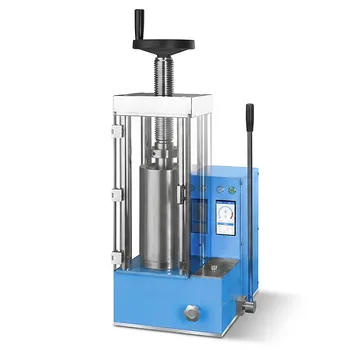
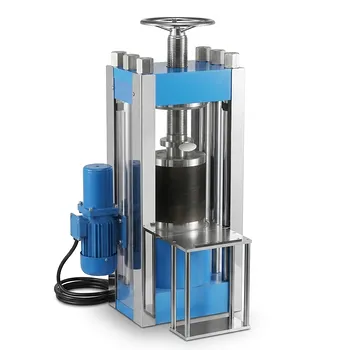
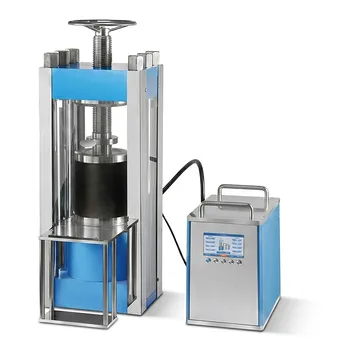
Cold Isostatic Pressing (CIP) optimizes SiC/YAG green bodies by applying equal pressure from all directions. Unlike standard axial pressing, which creates density gradients due to friction between the powder and the rigid die walls, CIP ensures isotropic compaction at high pressures (typically 250 MPa). This results in a green body with higher relative density, a uniform internal structure, and significantly reduced risk of deformation or cracking during the sintering phase.
Core Takeaway: CIP transforms ceramic powder into a high-performance green body by eliminating the internal stresses and density non-uniformity inherent in axial pressing. This uniform foundation is critical for achieving high mechanical strength and dimensional precision in the final SiC/YAG product.
Eliminating the Limitations of Axial Pressing
Overcoming Die Wall Friction
In standard axial pressing, the force is applied in a single direction against a rigid metal mold. Friction between the powder and the die walls prevents the pressure from distributing evenly, leading to "dead zones" of lower density.
Uniform Omnidirectional Compaction
A Cold Isostatic Press utilizes a flexible mold submerged in a liquid medium to apply omnidirectional pressure. This ensures that every surface of the SiC/YAG powder receives identical force, effectively eliminating internal density gradients.
Preventing Anisotropic Shrinkage
Because axial pressing creates non-uniform density, the green body often shrinks unevenly (anisotropically) during sintering. CIP creates isotropic samples that shrink predictably and uniformly, which is vital for maintaining the desired final geometry.
Enhancing Green Body Microstructure
Achieving High Relative Density
Applying pressures up to 250–300 MPa forces the SiC/YAG particles into a tighter arrangement than axial pressing can achieve. This process can increase the relative density of the green body to approximately 53%, providing a more solid foundation for subsequent heat treatment.
Increasing Green Strength for Handling
The high-pressure environment of CIP improves green strength, which refers to the material's ability to resist breaking before it is fully hardened. This allows the SiC/YAG green bodies to be handled, moved, or even machined without the risk of crumbling or edge-chipping.
Elimination of Micro-voids and Internal Pores
CIP effectively collapses micro-voids and large internal pores that are often trapped during initial forming stages. By removing these structural defects at the green stage, the likelihood of crack initiation and propagation in the final ceramic is greatly reduced.
Impact on Post-Processing and Final Quality
Reducing Sintering Deformation and Cracking
Uniform density is the primary defense against warping or cracking during high-temperature sintering (e.g., 1700°C). Because the internal stresses are minimized, the SiC/YAG material can withstand rapid heating or fast-firing processes with higher integrity.
Accelerating the Diffusion Process
The tighter particle-to-particle contact achieved through CIP accelerates the atomic diffusion process during sintering or hot-pressing. This leads to faster densification and a higher relative density in the final ceramic product.
Improving Mechanical and Optical Properties
For specialized ceramics like RE:YAG, the uniformity provided by CIP directly translates to better mechanical strength and optical uniformity. By ensuring a consistent microstructure, the final product exhibits fewer defects and more predictable performance characteristics.
Understanding the Trade-offs
Equipment Complexity and Cost
While CIP provides superior material properties, it requires more complex equipment, including high-pressure vessels and flexible tooling. This increases the initial capital investment compared to simple mechanical or hydraulic axial presses.
Cycle Time and Throughput
Isostatic pressing is generally a slower process than high-speed axial pressing. The need to seal parts in flexible molds, submerge them in a pressure medium, and decompress the system makes it less suitable for high-volume, low-cost mass production.
Final Shape Limitations
While CIP is excellent for complex shapes, the use of flexible molds means that the external dimensions of the green body may not be as precise as those formed in a rigid steel die. Post-compaction machining or grinding is often required to achieve tight dimensional tolerances.
How to Apply CIP to Your Project
Making the Right Choice for Your Goal
- If your primary focus is Dimensional Precision: Use axial pressing for simple geometries where tool-steel precision is required, but remain aware of potential warping during sintering.
- If your primary focus is Mechanical Integrity: Prioritize CIP to eliminate internal density gradients and micro-voids, as this will significantly reduce the risk of structural failure in the final SiC/YAG ceramic.
- If your primary focus is Optical or Structural Uniformity: Choose CIP at pressures of at least 250 MPa to ensure a consistent microstructure that supports uniform light transmission and even material wear.
- If your primary focus is Faster Sintering Cycles: Utilize CIP as a secondary compaction step to maximize particle contact, which lowers the energy required for densification.
Cold Isostatic Pressing serves as a critical safeguard for ceramic integrity, transforming powder into a high-density green body capable of withstanding the rigors of high-temperature processing.
Summary Table:
| Feature | Standard Axial Pressing | Cold Isostatic Pressing (CIP) |
|---|---|---|
| Pressure Direction | Unidirectional (Single axis) | Omnidirectional (All directions) |
| Density Uniformity | High gradients (dead zones) | Highly uniform (isotropic) |
| Wall Friction | Significant (rigid die) | Eliminated (flexible mold) |
| Sintering Result | High risk of warping/cracking | Minimal deformation; uniform shrinkage |
| Relative Density | Moderate | High (up to 53%+) |
| Green Strength | Lower | Significantly higher |
Elevate Your Material Integrity with KINTEK Solutions
Maximize the performance of your ceramic and battery research with KINTEK’s comprehensive laboratory pressing solutions. From eliminating internal defects with our Cold and Warm Isostatic Presses to providing precision with manual, automatic, heated, multifunctional, and glovebox-compatible models, we offer the exact technology needed for high-performance material development.
Ready to achieve superior density and dimensional precision? Contact our experts today to find the perfect pressing solution for your lab!
References
- Xingzhong Guo, Hui Yang. Sintering and microstructure of silicon carbide ceramic with Y3Al5O12 added by sol-gel method. DOI: 10.1631/jzus.2005.b0213
This article is also based on technical information from Kintek Solution Knowledge Base .
Related Products
- Electric Lab Cold Isostatic Press CIP Machine
- Electric Split Lab Cold Isostatic Pressing CIP Machine
- Automatic Lab Cold Isostatic Pressing CIP Machine
- Manual Cold Isostatic Pressing CIP Machine Pellet Press
- Electric Isostatic Pressing Machine 40 Tons Automatic Laboratory Powder Compacting Press
People Also Ask
- What role do electric lab cold isostatic presses play in industrial contexts? Bridge R&D and Manufacturing with Precision
- What are the applications of electric lab cold isostatic presses in research settings? Advance Material R&D with High-Pressure CIPs
- How does electrical Cold Isostatic Pressing (CIP) contribute to cost savings? Unlock Efficiency and Reduce Expenses
- What are some research applications of electric lab CIPs? Unlock Uniform Powder Densification for Advanced Materials
- What are the characteristics of standard off-the-shelf electric lab CIP solutions? Achieve Immediate, Cost-Effective Processing