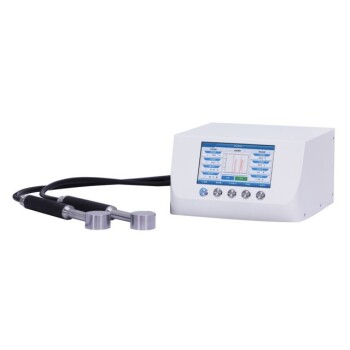
A constant temperature circulation system with an external fluid jacket ensures reliability by enveloping the measurement cell in a precisely controlled thermal environment. This mechanism guarantees that the sample achieves complete thermal equilibrium at each specific test point, particularly within the 10 °C to 60 °C range. By stabilizing the environment, the system prevents impedance spectrum drift, thereby securing the accuracy of derived thermodynamic parameters.
Thermal stability is the absolute foundation of accurate Arrhenius plots. By ensuring complete equilibrium and eliminating temperature-induced drift, this system validates the integrity of calculated activation energy ($E_a$) and ensures the data reflects true material properties.
The Mechanism of Reliability
Achieving Complete Thermal Equilibrium
The primary function of the external fluid jacket is to isolate the measurement cell from ambient fluctuations.
By circulating fluid at a constant temperature, the system forces the sample to reach complete thermal equilibrium.
This ensures that the temperature recorded by the sensor is identical to the actual temperature of the sample undergoing testing.
Eliminating Impedance Spectrum Drift
In ionic conductivity testing, even minor temperature changes can cause significant variance in impedance.
Without a stable thermal jacket, the impedance spectrum is prone to drift, creating artifacts in the data that look like material responses but are actually environmental noise.
The circulation system locks the temperature in place, ensuring the impedance reading remains stable and reproducible at every step.
Impact on Thermodynamic Analysis
Ensuring Accuracy of Activation Energy ($E_a$)
The ultimate goal of Arrhenius curve testing is to extract thermodynamic parameters, specifically activation energy ($E_a$).
Calculating $E_a$ requires plotting the natural logarithm of conductivity against the inverse of temperature ($1/T$).
If the sample has not reached equilibrium, or if the temperature fluctuates, the slope of this plot changes, leading to erroneous $E_a$ calculations.
Reducing Experimental Error
This system minimizes the variables that the researcher must control manually.
By automating the thermal environment, the system removes the "human error" element associated with timing temperature stabilization.
This leads to a dataset where the extracted parameters are statistically significant and highly reliable.
Understanding the Trade-offs
The Temperature Range Constraint
While highly effective, this specific circulation system is optimized for a defined window of 10 °C to 60 °C.
This range covers many standard aqueous and polymer electrolyte applications but is insufficient for high-temperature solid-state testing or cryogenic applications.
Users must verify that their target material's phase transitions or operating limits fall strictly within this moderate thermal band.
The Necessity of Time
The requirement for "complete thermal equilibrium" imposes a constraint on testing speed.
You cannot rush the circulation process; the system requires sufficient dwell time at each setpoint to ensure the entire sample mass stabilizes.
Prioritizing speed over this stabilization period negates the benefits of the system and reintroduces the drift the jacket was designed to prevent.
Making the Right Choice for Your Experiment
To maximize the reliability of your Arrhenius curve testing, match your experimental protocol to the system's capabilities.
- If your primary focus is high-precision $E_a$ calculation: Ensure you program sufficient dwell time at each step to allow the external jacket to bring the sample to total equilibrium.
- If your primary focus is testing outside ambient conditions: Verify that your testing protocol remains strictly within the 10 °C to 60 °C capability of the fluid circulation system to avoid thermal gradients.
Reliable ionic conductivity data is not just about the quality of the sensor, but the stability of the thermal environment that surrounds it.
Summary Table:
| Feature | Function in Arrhenius Testing | Benefit to Researcher |
|---|---|---|
| External Fluid Jacket | Envelops measurement cell in stable thermal environment | Guarantees complete sample thermal equilibrium |
| Circulation Control | Prevents ambient temperature fluctuations | Eliminates impedance spectrum drift and artifacts |
| Temperature Range | Optimized for 10 °C to 60 °C window | Ideal for aqueous and polymer electrolyte studies |
| Parameter Accuracy | Stabilizes $1/T$ vs. $\ln(\sigma)$ plots | Ensures reliable Activation Energy ($E_a$) derivation |
Precision Lab Solutions for Reliable Material Research
Unlock the full potential of your battery research and material science experiments with KINTEK. We specialize in comprehensive laboratory pressing and thermal solutions designed to eliminate experimental variables and deliver high-fidelity data.
Our extensive range includes:
- Manual & Automatic Presses: For consistent sample preparation.
- Heated & Multifunctional Models: Tailored for complex thermal requirements.
- Glovebox-Compatible Systems: Ideal for sensitive battery research environments.
- Cold & Warm Isostatic Presses (CIP/WIP): Ensuring uniform density for advanced material testing.
Whether you are refining Arrhenius curve protocols or developing next-generation electrolytes, KINTEK provides the tools necessary for precision and repeatability. Contact us today to find the perfect laboratory pressing solution for your needs.
References
- Fariza Kalyk, Nella M. Vargas‐Barbosa. Toward Robust Ionic Conductivity Determination of Sulfide‐Based Solid Electrolytes for Solid‐State Batteries. DOI: 10.1002/adfm.202509479
This article is also based on technical information from Kintek Solution Knowledge Base .
Related Products
- Lab Double Plate Heating Mold for Laboratory Use
- Automatic High Temperature Heated Hydraulic Press Machine with Heated Plates for Lab
- Split Automatic Heated Hydraulic Press Machine with Heated Plates
- Electric Lab Cold Isostatic Press CIP Machine
- Automatic Heated Hydraulic Press Machine with Hot Plates for Laboratory
People Also Ask
- How does the geometry of laboratory molds influence mycelium-based composites? Optimize Density and Strength
- Why are precision laboratory molds essential for forming basalt-reinforced lightweight concrete specimens?
- Why are high-precision laboratory molds and specific compaction processes required? Ensure Data Integrity in Soil Research
- Why is low-temperature pre-drying on a laboratory hot plate necessary? Stabilize Silver Ink for Better Conductivity
- How is a laboratory hot plate utilized in Li-Si alloy electrode preparation? Achieve High-Activity Battery Materials