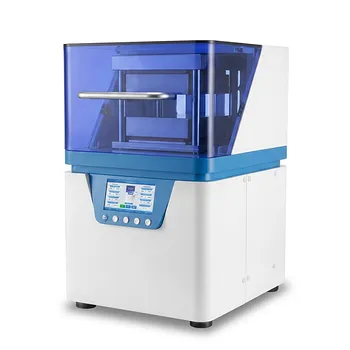
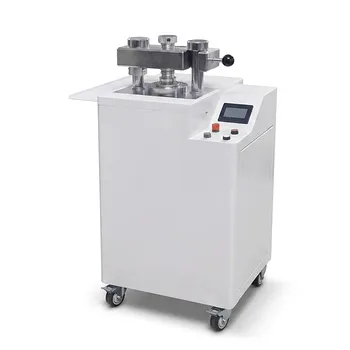
A hand press functions on the principle of simple mechanical leverage, operating in a manner very similar to a standard nutcracker. By manually bringing two arms together, the user applies force to a die positioned near the hinge of the device. However, its primary drawback is the absence of any mechanism to regulate or standardize the pressure load, which inevitably leads to inconsistent results across different samples.
The simplicity of the hand press comes at the cost of precision; without a way to lock in a specific pressure load, it is impossible to apply the exact same force twice, resulting in samples that lack uniformity.
The Mechanics of Operation
The Leverage Principle
The device utilizes a basic hinge mechanism to multiply force. This design mimics a nutcracker, where the mechanical advantage is gained by placing the resistance close to the pivot point.
Manual Application
To operate the press, the user squeezes two lever arms together. This manual action translates human effort into compressive force directed at the sample.
Positioning the Die
The die—the component holding the sample material—is situated near the hinge. This placement ensures that the manual force applied to the ends of the arms is maximized at the point of contact with the sample.
The Core Limitation: Lack of Standardization
Unregulated Pressure
The most significant disadvantage of a hand press is that it has no built-in system to standardize the pressure load. There is no gauge or stop mechanism to ensure a specific force is reached.
The Human Variable
Because the operation is entirely manual, the amount of pressure applied depends heavily on the operator. It is highly likely that a different amount of force will be used for every single pressing.
Inconsistent Output
This variability in pressure creates inconsistent samples. For applications requiring identical sample density or thickness, the hand press introduces a margin of error that is difficult to control.
Assessing the Hand Press for Your Needs
If your primary focus is simple, qualitative preparation: The hand press offers a straightforward, mechanical method that requires no complex setup or power source.
If your primary focus is analytical precision or reproducibility: You must avoid this tool, as the inability to standardize pressure implies that your data will suffer from variability caused by inconsistent sample preparation.
For scientific or industrial workflows where consistency is paramount, the lack of pressure regulation makes the hand press a liability rather than an asset.
Summary Table:
| Feature | Hand Press Mechanism | Impact on Quality |
|---|---|---|
| Operating Principle | Mechanical Leverage (Nutcracker style) | Simple manual force application |
| Pressure Control | None (Manual only) | High risk of inconsistent results |
| Standardization | No gauge or stop mechanism | Impossible to replicate exact force |
| Sample Uniformity | Dependent on operator strength | Low reproducibility across batches |
| Best Use Case | Basic qualitative preparation | Not suitable for analytical precision |
Elevate Your Sample Precision with KINTEK Solutions
Don't let manual inconsistency compromise your research data. KINTEK specializes in comprehensive laboratory pressing solutions designed for repeatable accuracy. Whether you need manual precision or high-throughput automation, we offer:
- Manual & Automatic Pellet Presses with integrated pressure gauges.
- Heated & Multifunctional Models for complex material synthesis.
- Glovebox-Compatible & Isostatic Presses (CIP/WIP) optimized for advanced battery research.
Ensure every sample meets your exact specifications. Contact KINTEK today to find your perfect pressing solution!
Related Products
- Laboratory Manual Heated Hydraulic Press Machine with Hot Plates
- Manual Laboratory Hydraulic Press Lab Pellet Press
- Automatic Hydraulic Hot Press with Large Plate and Precision Temperature Control for Advanced Material Sample Preparation and Industrial Research
- Manual Heated Hydraulic Lab Press with Integrated Hot Plates Hydraulic Press Machine
- Automatic Hydraulic Heat Press Machine with Multi Stage Programmable Control and Integrated Water Cooling Plate Size 180x180mm
People Also Ask
- Why is a laboratory hydraulic press with heating plates required for PLA/TEC films? Achieve Precise Sample Integrity
- Function of a Laboratory Hydraulic Press with Heated Platens in SSE? Enhance Battery Density & Conductivity
- Why is a manual hydraulic heated lab press essential for compleximer materials? Unlock Advanced Material Synthesis
- What is the primary objective of using a laboratory manual hydraulic press at 20 MPa? Achieve Perfect Green Body Shaping
- How does a laboratory manual hydraulic press assist in powder canning? Maximize Density and Structural Integrity