
Temperature is the decisive factor in determining the final microstructure of a PVDF film during hydraulic hot pressing.
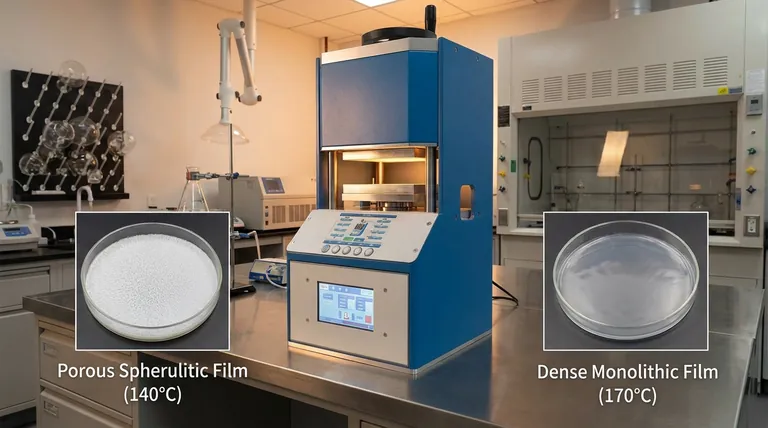
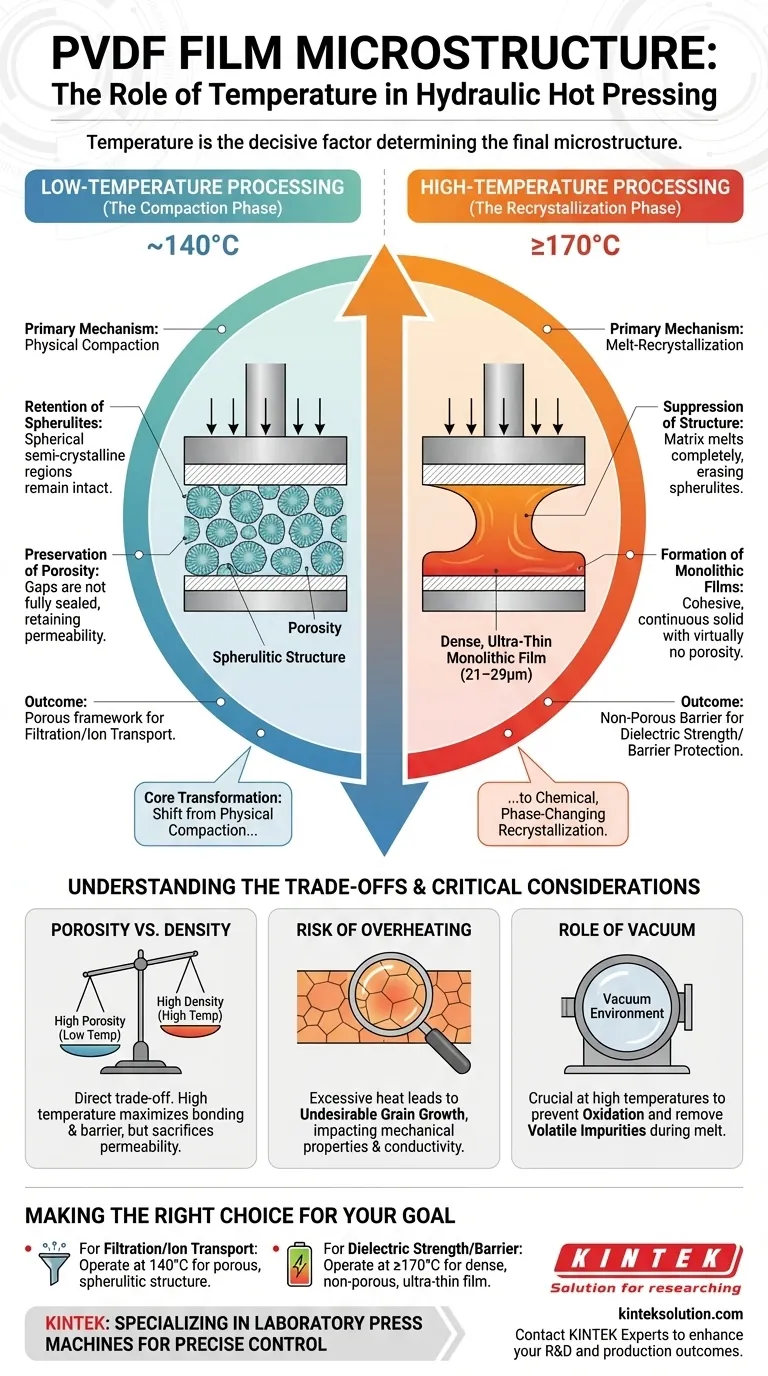
At lower temperatures (around 140°C), the process acts as a compaction mechanism, preserving the original spherulitic structure and retaining porosity. Conversely, raising the temperature to 170°C or above triggers a melt-recrystallization process, effectively erasing the spherulitic structure to create a dense, ultra-thin, monolithic film.
The Core Transformation The transition from 140°C to 170°C represents a shift from physical compaction to chemical, phase-changing recrystallization. You are effectively choosing between a porous, structured membrane and a dense, non-porous barrier by crossing this thermal threshold.
Low-Temperature Processing (The Compaction Phase)
When operating the hydraulic hot press at lower temperatures, specifically around 140°C, you are primarily affecting the physical arrangement of the material rather than its chemical phase.
Retention of Spherulites
At this temperature, the thermal energy is insufficient to fully melt the PVDF matrix. Consequently, the original spherulitic structure—the spherical semi-crystalline regions—remains intact.
Preservation of Porosity
Because the material does not undergo a complete melt flow, the gaps between structures are not fully sealed. The pressing action compacts the film to increase density, but it deliberately allows a degree of porosity to remain.
Mechanical Bonding
The pressure facilitates contact between particles, enhancing bonding strength. However, this bonding relies on physical proximity and partial diffusion rather than a total coalescence of the melt.
High-Temperature Processing (The Recrystallization Phase)
Increasing the temperature to 170°C and above fundamentally alters the processing mechanism from compaction to melting.
Suppression of Structure
At these elevated temperatures, the PVDF matrix melts completely. This phase change suppresses the formation of the spherulitic structure that characterizes lower-temperature films.
Formation of Monolithic Films
As the material recrystallizes from the melt, it forms a cohesive, continuous solid. The result is a dense, monolithic film with virtually no porosity, as the molten polymer fills all available voids.
Drastic Reduction in Thickness
The transition to a melt state allows the hydraulic pressure to compress the material much more efficiently. This results in an ultra-thin profile, typically reducing the film thickness to the 21–29µm range.
Understanding the Trade-offs
While hot pressing offers precise control over microstructure, grain size, and distribution, selecting the wrong temperature can compromise the material's intended function.
Porosity vs. Density
There is a direct trade-off between porosity and density. High temperatures maximize atomic diffusion and bonding strength, creating a robust barrier, but this comes at the cost of the porosity required for applications like filtration or ion transport.
The Risk of Overheating
While higher temperatures generally improve bonding, excessive heat can lead to undesirable grain growth. This can negatively impact mechanical properties, making the material brittle or altering its thermal and electrical conductivity in unintended ways.
The Role of Vacuum
It is critical to note that high-temperature processing is best conducted in a vacuum environment. This prevents oxidation that would otherwise weaken the material at these heat levels and ensures volatile impurities are removed during the melt phase.
Making the Right Choice for Your Goal
The correct temperature setting depends entirely on whether your application requires a permeable framework or a solid, thin dielectric layer.
- If your primary focus is filtration or ion transport: Operate at 140°C to compact the film while retaining the porous, spherulitic structure necessary for permeability.
- If your primary focus is high dielectric strength or barrier protection: Operate at 170°C or above to melt the matrix, creating a dense, ultra-thin, and non-porous monolithic film.
By manipulating the temperature relative to the PVDF melting point, you move from simply shaping the material to fundamentally engineering its internal architecture.
Summary Table:
| Temperature | Primary Mechanism | Final Microstructure | Key Outcome |
|---|---|---|---|
| ~140°C | Physical Compaction | Porous, Spherulitic Structure | Retained Porosity for Filtration/Ion Transport |
| ≥170°C | Melt-Recrystallization | Dense, Monolithic Film | Ultra-Thin, Non-Porous Barrier for Dielectric Strength |
Ready to Engineer Your PVDF Film's Microstructure with Precision?
Choosing the right hydraulic hot press temperature is critical for achieving your desired film properties, whether for filtration, battery separators, or high-performance dielectric layers. KINTEK specializes in laboratory press machines, including automatic lab presses, isostatic presses, and heated lab presses designed for exact temperature and pressure control.
Our equipment helps researchers and lab professionals like you consistently produce high-quality PVDF films with tailored porosity and density. Contact us today via the form below to discuss your specific application and discover how our reliable lab presses can enhance your R&D and production outcomes.
Visual Guide
Related Products
- Heated Hydraulic Press Machine with Heated Plates for Vacuum Box Laboratory Hot Press
- Automatic High Temperature Heated Hydraulic Press Machine with Heated Plates for Lab
- 24T 30T 60T Heated Hydraulic Lab Press Machine with Hot Plates for Laboratory
- Heated Hydraulic Press Machine With Heated Plates For Vacuum Box Laboratory Hot Press
- Automatic Heated Hydraulic Press Machine with Hot Plates for Laboratory
People Also Ask
- What are the requirements for electrode pressing with high-viscosity ionic liquids like EMIM TFSI? Optimize Performance
- How does a laboratory heated hydraulic press facilitate PBN sample prep for WAXS? Achieve Precise X-Ray Scattering
- What are the industrial applications of heated hydraulic presses? Master Heat & Force for Precision Manufacturing
- Function of a Laboratory Hydraulic Press with Heated Platens in SSE? Enhance Battery Density & Conductivity
- How are heated hydraulic presses utilized in the preparation of thin films? Key Mechanisms and Applications



















