A hydraulic press achieves force magnification by leveraging Pascal's Law to transform a small input force into a massive output force. By using a pump to pressurize a confined fluid within a narrow channel, the system transmits this pressure evenly against the much larger surface area of a main piston. This difference in surface area is what allows the machine to multiply the initial mechanical effort into multi-ton compressive power.
The Core Insight: The total force generated is not created from nothing; it is the result of applying a consistent internal pressure across a significantly larger surface area at the output.
The Physics of Magnification
To understand how a modest pump can crush metal, you must look at the relationship between pressure, force, and area.
The Role of Pascal's Law
The fundamental principle driving a hydraulic press is Pascal’s Law. This law states that pressure exerted anywhere on a confined fluid is transmitted evenly and undiminished in all directions throughout that fluid.
Turning Pressure into Power
Because the pressure is constant throughout the system, the variable that changes the outcome is surface area.
The total force exerted by the press is proportional to the area of the piston multiplied by the applied pressure. Therefore, if you apply pressure to a large piston, the resulting force is magnified significantly compared to the force originally applied to the fluid.
The Mechanical Execution
The hydraulic press relies on a specific arrangement of components to execute this physical principle effectively.
The Input: The Pump and Narrow Channel
The process begins with a pump acting on a reservoir of fluid (typically oil). This pump applies a relatively small mechanical force to the fluid through a narrow channel.
Because the input area is small, even a modest force creates significant internal pressure within the fluid.
The Output: The Cylinder and Piston
This pressurized fluid is forced into a hydraulic cylinder containing a large, moveable piston.
As the fluid pushes against this large surface area, the accumulated force becomes immense. This allows the piston to drive downward (or upward) with enough compressive force to shape, crush, or mold heavy materials.
Operational Considerations and Trade-offs
While hydraulic presses offer immense power, understanding their operational context is critical for effective use.
The Necessity of Confinement
For Pascal’s law to work, the fluid must be strictly confined. Any breach in the cylinder, seals, or narrow channels results in a loss of pressure.
The system relies entirely on the integrity of the closed loop; without it, the transmission of force drops to zero.
Consistency vs. Complexity
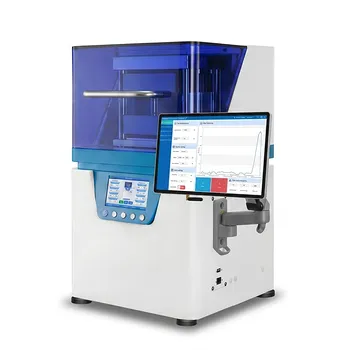
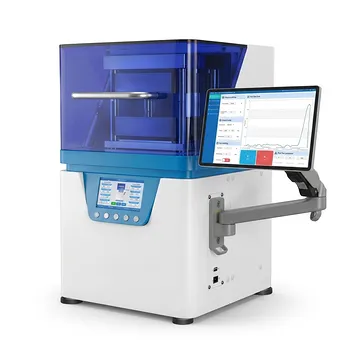
Manual pumps are simple but rely on user consistency. However, modern automatic presses introduce a trade-off: they offer higher precision but require more complex control systems.
These automated systems use switches or controllers to elevate the piston and release pressure. This ensures highly accurate, repeatable force application, but increases the complexity of the machine compared to simple manual variants.
Making the Right Choice for Your Goal
When evaluating hydraulic press technology for your specific application, consider how the force is applied and controlled.
- If your primary focus is raw power generation: Look for systems with the largest possible piston surface area to maximize the multiplication of pump pressure.
- If your primary focus is precision and repeatability: Prioritize automatic presses with electronic controllers that regulate the pressure release and piston movement for consistent results.
By manipulating the ratio between the input channel and the output piston, a hydraulic press turns fluid physics into a mechanical advantage capable of moving tons.
Summary Table:
| Component | Role in Force Magnification | Mechanical Impact |
|---|---|---|
| Input Pump | Applies initial force to fluid | Creates high pressure in narrow channels |
| Hydraulic Fluid | Transmits pressure undiminished | Ensures consistent energy transfer via Pascal’s Law |
| Large Piston | Receives pressure over wide area | Multiplies input force into multi-ton output |
| Closed System | Maintains fluid confinement | Prevents pressure loss for peak efficiency |
Elevate Your Research with KINTEK Pressing Solutions
Precision and power are the cornerstones of successful laboratory results. KINTEK specializes in comprehensive laboratory pressing solutions designed to harness the full potential of hydraulic physics. Whether you are performing delicate battery research or heavy-duty material testing, our diverse range of equipment offers the perfect mechanical advantage:
- Manual & Automatic Presses: For both simplicity and high-precision repeatability.
- Heated & Multifunctional Models: Tailored for complex thermal processing.
- Specialized Systems: Glovebox-compatible models and Cold/Warm Isostatic Presses (CIP/WIP).
Ready to optimize your lab’s compressive power? Contact KINTEK today to find the ideal pressing solution for your specific application.
Related Products
- Automatic Hydraulic Hot Press with Large Plate and Precision Temperature Control for Advanced Material Sample Preparation and Industrial Research
- Automatic Hydraulic Heat Press Machine with Multi Stage Programmable Control and Integrated Water Cooling Plate Size 180x180mm
- Automatic High Temperature Heated Hydraulic Press Machine with Heated Plates for Lab
- Automatic Heated Hydraulic Lab Press with Programmable Touch Screen Controls and Precision Temperature Regulation
- Manual Heated Hydraulic Lab Press with Integrated Hot Plates Hydraulic Press Machine
People Also Ask
- What are the specific features and applications of hydraulic hot press machines? Precision Solutions for Modern Labs
- How does an automatic hydraulic press operate? Achieve Precision and Consistency in Lab Pelleting
- What are the advantages and common applications of an automatic hydraulic press? Elevate Your Lab's Precision
- What is the technical significance of setting a precise dwell time? Achieve Peak Material Density and Stability
- When is an automatic hydraulic press more suitable than a manual press? Scale Your Lab with Precision & Speed