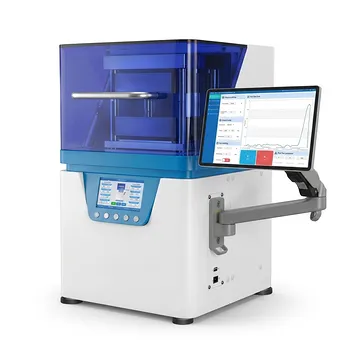
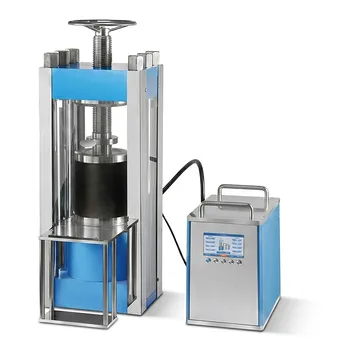
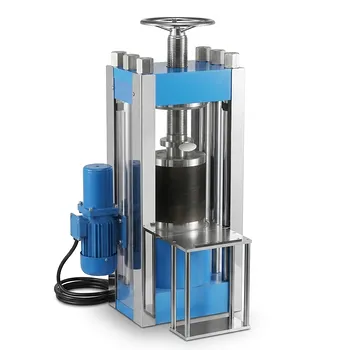
A laboratory ambient temperature press serves as the foundational tool for cold molding and initial dehydration in the production of all-cellulose fiberboards. By applying high mechanical pressure—often reaching 16 MPa—the press effectively filters water out of the fiber suspension while inducing the initial physical cross-linking required to transform a fluid mixture into a stable, pre-formed board.
This equipment bridges the gap between a liquid fiber suspension and a solid composite by using mechanical force to achieve structural stability and uniform material distribution. It provides the necessary "green strength" required for the material to survive subsequent high-temperature processing.
The Mechanics of Pressure-Driven Dehydration
Efficient Water Removal through Filtration
The primary function of the ambient press is the rapid extraction of water from the fiber slurry. Under high pressure, the press acts as a mechanical filter, forcing liquid out of the fiber matrix to significantly reduce moisture content before the board reaches the drying or hot-pressing stages.
Achieving High Initial Density
Applying pressures like 16 MPa compresses the fiber network into a dense, compact structure. This densification is critical because it brings cellulose fibers and lignin particles into intimate physical contact, which is a prerequisite for any further chemical or thermal bonding.
Structural Formation and Material Distribution
Cold Molding and Shape Stability
The ambient press performs cold molding, which defines the initial dimensions and geometry of the fiberboard. This process creates a pre-formed board that possesses sufficient mechanical strength and stability to be handled and moved into a heated press without disintegrating.
Lignin Redeposition and Radial Flow
Beyond water removal, vertical pressure forces lignin powder deeper into the handsheet structure. This pressure induces a radial flow, which ensures that lignin is distributed uniformly across the entire paper surface, preventing "weak spots" in the final composite.
Establishing Initial Cross-Linking
While the strongest chemical bonds form later, the ambient press induces initial cross-linking between fiber particles. This is largely a result of mechanical interlocking and the close proximity of surfaces, providing the board with its preliminary structural integrity.
Understanding the Trade-offs
The Absence of Chemical Self-Bonding
While the ambient press provides stability, it cannot induce the plasticization of lignin. Without heat (typically around 205 °C), the board lacks the permanent chemical cross-linking and condensation reactions between lignin and polysaccharides required for final durability.
Risks of Pressure Imbalance
If the pressure is applied too rapidly or unevenly, it can lead to internal structural defects or uneven density. Over-reliance on ambient pressing without a subsequent thermal stage will result in a board that is highly susceptible to moisture and lacks the "self-bonded" properties of high-performance fiberboards.
How to Optimize Your Pressing Strategy
Applying This to Your Research or Project
The success of an all-cellulose fiberboard depends on how well the ambient pressing stage prepares the material for the hot-pressing phase.
- If your primary focus is maximizing board density: Use the ambient press at its maximum rated pressure (e.g., 16 MPa) to ensure the highest degree of initial fiber contact and water removal.
- If your primary focus is uniform lignin distribution: Pay close attention to the radial flow during the ambient stage, ensuring pressure is even across the entire surface to avoid lignin clumping.
- If your primary focus is reducing total processing time: Use the ambient press to remove as much bulk water as possible, which reduces the energy and time required during the high-temperature consolidation phase.
The laboratory ambient temperature press is the essential first step in transforming raw fiber into a high-strength, sustainable composite by establishing the board's initial physical and structural framework.
Summary Table:
| Process Component | Primary Function | Key Benefit |
|---|---|---|
| Dehydration | Mechanical Filtration | Rapid water removal via high pressure (up to 16 MPa) |
| Cold Molding | Shape Stabilization | Creates "green strength" for handling and geometry |
| Radial Flow | Lignin Distribution | Ensures uniform lignin redeposition across the matrix |
| Densification | Physical Cross-linking | Intimate fiber contact for future thermal bonding |
Elevate your material science research with KINTEK’s comprehensive laboratory pressing solutions. Whether you are developing advanced all-cellulose fiberboards or conducting cutting-edge battery research, our expertise ensures superior results. We offer a versatile range of manual, automatic, heated, multifunctional, and glovebox-compatible models, as well as cold and warm isostatic presses designed for precision and durability. Contact KINTEK today to find the perfect press for your initial dehydration and structural molding needs!
References
- Diego Ramos, Joan Salvadó. All-lignocellulosic Fiberboard from Steam Exploded Arundo Donax L.. DOI: 10.3390/molecules23092088
This article is also based on technical information from Kintek Solution Knowledge Base .
Related Products
- Automatic High Temperature Heated Hydraulic Press Machine with Heated Plates for Lab
- Automatic Heated Hydraulic Lab Press with Programmable Touch Screen Controls and Precision Temperature Regulation
- Automatic Hydraulic Hot Press with Large Plate and Precision Temperature Control for Advanced Material Sample Preparation and Industrial Research
- Lab Heat Press Special Mold
- Cylindrical Lab Electric Heating Press Mold for Laboratory Use
People Also Ask
- Function of a Laboratory Hydraulic Press with Heated Platens in SSE? Enhance Battery Density & Conductivity
- What are the requirements for electrode pressing with high-viscosity ionic liquids like EMIM TFSI? Optimize Performance
- How does a laboratory heated hydraulic press facilitate PBN sample prep for WAXS? Achieve Precise X-Ray Scattering
- What are the industrial applications of heated hydraulic presses? Master Heat & Force for Precision Manufacturing
- Why is a laboratory hydraulic press with heating plates required for PLA/TEC films? Achieve Precise Sample Integrity