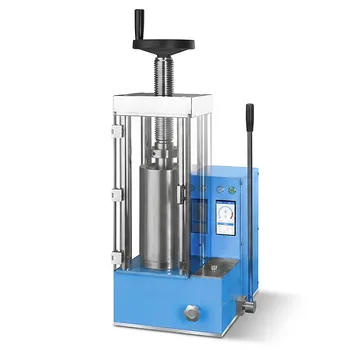
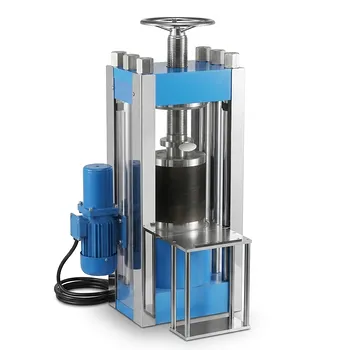
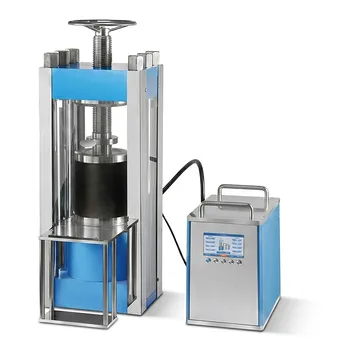
Thermal compression molding is the primary mechanism by which a laboratory pressing machine transforms raw Styrene-Butadiene Rubber (SBR) and filler mixtures into high-performance composites. By simultaneously applying precise levels of heat (often between 160°C and 175°C) and high pressure (such as 210 kgf·cm⁻²), the machine triggers the chemical vulcanization process while forcing the rubber matrix into intimate contact with the filler particles within a precision mold.
Core Takeaway: The laboratory press acts as a controlled environment that facilitates the chemical cross-linking of SBR and the physical densification of the composite, ensuring a defect-free, standardized specimen with stable mechanical properties.
The Dual Role of Heat and Pressure
Triggering the Vulcanization Reaction
The integrated heating system provides a constant high-temperature environment necessary to initiate the vulcanization system. This thermal energy allows the rubber molecular chains to undergo cross-linking, transforming the soft compound into a durable, elastic solid-state network.
Facilitating Material Flow
High temperature reduces the viscosity of the SBR, allowing the compound to flow fully into every corner of the precision steel mold. This ensures that the final specimen captures the exact dimensions of the mold cavity, which is essential for consistent testing results.
High-Pressure Densification
The machine applies substantial closing pressure, often reaching 150 kN, to eliminate porosity and discharge residual air. This pressure ensures that the rubber molecular chains wrap tightly around the filler particles, creating the necessary contact conditions for a strong interfacial bond.
Structural Homogeneity and Specimen Quality
Eliminating Internal Voids
By extruding excess resin or air and maintaining continuous pressure, the press reduces the distance between particles, known as densification. This process is critical for producing a "green body" or a finished plate that is free of internal defects and cracks.
Achieving Uniform Thickness
Precision molds provide a fixed geometric constraint, while the press ensures the uniform transmission of force. This synergy allows researchers to achieve a preset volume content and a uniform thickness across the entire surface of the composite plate.
Stress Management and Cooling
High-precision hydraulic presses often include a controlled cooling phase to follow the pressure-holding stage. This prevents the buildup of internal stresses that can occur during rapid temperature changes, ensuring the specimen does not warp or deform after being removed from the mold.
Understanding the Trade-offs
The Risk of Improper Cure Time
Establishing the optimum cure time is a delicate balance. Under-pressing leads to incomplete cross-linking and poor mechanical strength, while over-pressing can cause thermal degradation of the SBR matrix or the organic fillers.
Pressure vs. Material Integrity
While high pressure (up to 240 MPa in some applications) increases density, excessive force can damage fragile fillers or cause "flash"—where material is forced out of the mold seams. This results in inconsistent fiber-to-matrix ratios and dimensionally inaccurate samples.
Thermal Distribution Inconsistency
If the heating plates do not provide a perfectly uniform temperature distribution, different sections of the composite may reach different levels of crystallization or cross-linking. This inconsistency can lead to "soft spots" in the material, rendering the test data unreliable.
How to Optimize Your Molding Process
To achieve the best results with SBR/OLW composites, your pressing strategy should align with your specific research or production goals.
- If your primary focus is Maximum Tensile Strength: Prioritize the vulcanization temperature and pressure-holding duration to ensure a dense, fully cross-linked molecular network.
- If your primary focus is Geometric Precision: Focus on the cooling rate and mold tolerance, ensuring that internal stresses are eliminated before the specimen is released.
- If your primary focus is Porosity Reduction: Utilize a multi-stage pressing cycle that includes a pre-heating phase to allow air to escape before the final high-pressure clamp is applied.
Mastering the interaction between thermal triggers and mechanical pressure is the only way to ensure your SBR composites reflect their true material potential.
Summary Table:
| Process Component | Key Function | Desired Outcome |
|---|---|---|
| Thermal Regulation | Triggers vulcanization (160-175°C) | Chemical cross-linking & reduced viscosity |
| High Pressure | Eliminates air & resin voids (150 kN) | Material densification & interfacial bonding |
| Precision Molds | Provides geometric constraints | Uniform thickness & standardized dimensions |
| Controlled Cooling | Prevents internal stress buildup | Dimensional stability & no warping |
Optimize Your SBR/OLW Composite Research with KINTEK
Achieve unmatched precision and repeatability in your material testing with KINTEK’s advanced laboratory pressing solutions. Whether you require manual control for small-scale trials or fully automated, heated systems for high-throughput production, our equipment is engineered to eliminate defects and ensure perfect vulcanization.
Our Comprehensive Solutions Include:
- Manual & Automatic Presses: High-precision thermal and pressure control.
- Heated & Isostatic Models: Ideal for battery research and complex composite molding.
- Glovebox-Compatible Units: Specialized solutions for sensitive material environments.
Don't let inconsistent molding compromise your data. Contact KINTEK today to find the perfect press for your lab!
References
- Carlos Toshiyuki Hiranobe, Renivaldo José dos Santos. Green Rubber Technology: The Potential of Ophthalmic Lens Waste as a Filler in Styrene–Butadiene Rubber-Based Composites. DOI: 10.3390/ma18081842
This article is also based on technical information from Kintek Solution Knowledge Base .
Related Products
- Laboratory Hydraulic Press Lab Pellet Press Machine for Glove Box
- Electric Isostatic Pressing Machine 40 Tons Automatic Laboratory Powder Compacting Press
- Warm Isostatic Press for Solid State Battery Research Warm Isostatic Press
- Split Warm Isostatic Lab Press 200 Ton Powder Compaction Chamber for Battery Research and Material Science
- Automatic Heated Hydraulic Press Machine with Hot Plates for Laboratory
People Also Ask
- How does a laboratory hydraulic press contribute to the preparation of Li3-3xScxSb samples? Optimize Ionic Conductivity
- What is the function of a laboratory hydraulic press in FT-IR of curcumin-coated MWCNTs? Achieve Optical Clarity.
- Why is a laboratory hydraulic press required for compression molding boron-siloxane? Solve High-Loading Density Challenges
- What role does a laboratory hydraulic press play in reaction pellets? Optimizing Lunar Soil and Metal Fuel Density
- What role does a laboratory hydraulic press play in the preparation of piezoelectric ceramic discs for DC-PG? | KINTEK