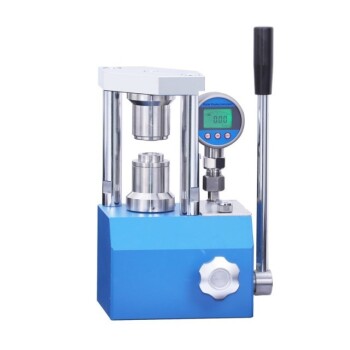
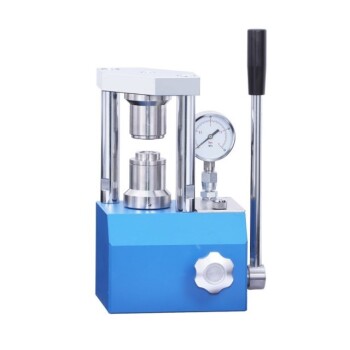
A laboratory sealing press directly dictates the reliability of LNMO battery data by applying precise, constant mechanical pressure to the coin cell assembly. This process ensures the integrity of the seal to prevent electrolyte leakage and minimizes contact resistance between internal components, which is essential for capturing accurate rate performance and cycle life metrics at high voltages.
The sealing press is not merely a packaging tool; it is a critical control variable in your experiment. By guaranteeing uniform internal compression and a hermetic seal, it stabilizes the electrochemical environment, allowing for reproducible results in high-voltage LNMO applications.
The Mechanics of Data Reliability
Controlling Internal Contact Resistance
The primary function of the sealing press is to compress the battery case, spring, gasket, and electrodes into a unified stack.
By applying constant mechanical pressure, the press ensures tight physical contact between the active materials, the current collector, and the separator.
This compression drastically reduces the contact resistance (impedance) within the cell. Without this tight contact, the internal resistance would be artificially high, skewing your data.
Preserving Electrochemical Stability
LNMO materials operate at high voltages, specifically above 4.7 V. This high-voltage environment makes the cell highly sensitive to contaminants and electrolyte instability.
A high-precision sealing process guarantees a hermetic seal, preventing the ingress of external air or moisture.
Simultaneously, it prevents the leakage of the electrolyte, maintaining a stable chemical environment necessary for valid long-term testing.
Ensuring Uniform Wetting
The pressure applied during sealing influences how well the electrolyte permeates the porous structure of the electrodes and separator.
Proper compression facilitates uniform wetting of the pore framework.
This uniformity is vital for consistent ion transmission rates, ensuring that the performance data reflects the material's true capability rather than a manufacturing defect.
Impact on Specific Performance Metrics
Rate Performance Accuracy
Rate performance testing measures a battery's ability to charge and discharge at different speeds. This is heavily dependent on low internal resistance.
A sealing press that delivers stable, uniform pressure ensures that the conductive path is optimized.
This allows the LNMO material to demonstrate its true rate capability without being bottlenecked by poor physical contact between the electrode and the casing.
Cycle Life Reproducibility
Cycle life testing requires the cell to maintain its structural and chemical integrity over hundreds of charge-discharge cycles.
If the sealing pressure is inconsistent, the internal components may shift, or the seal may relax over time.
A high-quality sealing press ensures the cell remains mechanically stable throughout the testing period, resulting in reproducible degradation curves that accurately represent the material's lifespan.
Understanding the Trade-offs
The Risk of Over-Compression
While pressure is necessary to lower resistance, "more" is not always "better."
Excessive sealing force can deform the coin cell casing or crush the internal separator. This can lead to internal short circuits or inconsistent pressure distribution, rendering the test cell useless.
The Consequence of Under-Compression
Conversely, insufficient pressure fails to establish the necessary solid-to-solid interface.
This leads to high interfacial resistance and potential gaps where the electrolyte does not fully wet the active material.
Furthermore, a loose crimp is the primary cause of electrolyte leakage, which poses a safety hazard and invalidates the experiment immediately.
Making the Right Choice for Your Goal
To maximize the value of your LNMO testing, align your sealing parameters with your specific research objectives.
- If your primary focus is High-Rate Capability: Prioritize a crimper that offers high-precision pressure control to minimize contact impedance without crushing the separator.
- If your primary focus is Long-Term Cycling: Ensure your sealing press delivers exceptional radial uniformity to maintain a hermetic seal against electrolyte evaporation over weeks of testing.
- If your primary focus is Data Reproducibility: Use an automated or hydraulic press rather than a manual one to remove operator variability from the crimping force.
The quality of your sealing press establishes the baseline for your data integrity; precision here is the prerequisite for accurate discovery.
Summary Table:
| Parameter | Impact on LNMO Testing | Result of Improper Setting |
|---|---|---|
| Mechanical Pressure | Lowers internal contact resistance | High impedance/skewed rate data |
| Seal Integrity | Prevents electrolyte leakage & moisture ingress | Chemical instability/safety hazards |
| Internal Compression | Ensures uniform electrolyte wetting | Inconsistent ion transmission |
| Force Consistency | Guarantees reproducible cycle life curves | Premature cell failure/data variance |
Maximize Your Battery Research Precision with KINTEK
Don't let inconsistent sealing compromise your high-voltage LNMO discoveries. KINTEK specializes in comprehensive laboratory pressing solutions, offering manual, automatic, heated, multifunctional, and glovebox-compatible models, as well as cold and warm isostatic presses tailored for advanced battery research.
Our equipment ensures the uniform pressure and hermetic seals necessary for reproducible results. Contact us today to find the perfect press for your lab!
References
- Xingqi Chang, Andreu Cabot. Mitigating the Rock‐Salt Phase Transformation in Disordered LNMO Through Synergetic Solid‐State AlF <sub>3</sub> /LiF Modifications. DOI: 10.1002/advs.202515962
This article is also based on technical information from Kintek Solution Knowledge Base .
Related Products
- Button Battery Sealing Press Machine for Lab
- Lab Button Battery Tablet Press Sealing Mold
- Button Battery Sealing Machine for Button Batteries
- Lab Button Battery Disassembly and Sealing Mold
- Manual Button Battery Sealing Machine for Battery Sealing
People Also Ask
- Why use standardized CR2032 components & high-precision presses? Ensure reliability in lithium metal battery research.
- Why is a laboratory battery sealing press essential for desolvation energy testing? Ensure Reliable Kinetic Data
- Why is a laboratory hydraulic press or battery sealing machine essential? Ensure Coin Cell Data Integrity
- How do laboratory battery sealing machines ensure performance consistency? Master Your Lithium and LFP Battery Assembly
- What role does a laboratory sealing press play in thermal analysis of solid dispersion films? Ensure Data Integrity