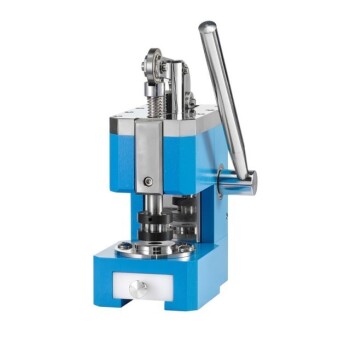
A precision disc cutter ensures electrode consistency by mechanically isolating coated electrode sheets into discs of an exact, fixed diameter. By eliminating manual variation, it guarantees that every electrode has the same geometric footprint—typically ranging from 13 mm to 15 mm—which is the absolute prerequisite for calculating accurate electrochemical metrics.
The reliability of your test data depends entirely on the physical uniformity of your samples. A precision disc cutter ensures that the active area is a constant variable, allowing you to attribute performance changes to chemistry rather than inconsistent sample sizes.
The Mechanics of Consistency
Establishing a Fixed Active Area
To analyze battery performance, you must calculate metrics like current density and specific capacity. These calculations require the exact surface area of the electrode to be a known constant.
A precision disc cutter uses a machined die to cut discs with strict dimensional tolerances. This ensures that the active area of the positive and negative electrodes remains identical across every sample you prepare.
Achieving Geometric Uniformity
Beyond simple diameter, the cutter ensures the electrode maintains a regular circular profile. Unlike manual cutting, which can distort the shape, a precision cutter applies uniform pressure to create a perfect circle.
This geometric consistency ensures the electrode aligns perfectly within the coin cell case, maximizing the contact area with the current collector and separator.
The Impact on Data Reliability
Enabling Repeatable Test Data
In battery research, you often need to assemble multiple cells to verify a hypothesis. If the physical size of the electrodes varies, your data will scatter, making it impossible to distinguish between experimental error and actual chemical phenomena.
By standardizing the electrode size, the disc cutter ensures that electrochemical test data is repeatable. This allows for valid comparisons between different batches of materials.
Preventing Edge Defects
A critical aspect of precision cutting is the quality of the edge. High-precision cutters are designed to produce clean, burr-free edges.
Rough or ragged edges can alter the local current density at the perimeter of the electrode. This leads to inconsistent performance and can skew the results of long-term cycling tests.
Why Precision Prevents Failure
Avoiding Internal Short Circuits
The most common mode of failure in coin cell assembly is an internal short circuit. This often occurs when a rough edge or a metal "burr" on the electrode pierces through the delicate separator.
Precision cutters mitigate this risk by delivering a clean shear. This protection is vital when sizing components, such as cutting electrodes to 15 mm and separators to 19 mm, to ensure the separator fully isolates the anode from the cathode.
Understanding the Trade-offs
Fixed Dimensions vs. Flexibility
Precision disc cutters are typically designed for a single, specific diameter (e.g., 13 mm). While this guarantees consistency, it lacks flexibility; if you need to test a different cell geometry, you generally require a different die or cutter.
Maintenance of Cutting Edges
To maintain the "burr-free" quality mentioned in the supplementary notes, the cutting die requires maintenance. Over time, the blades can dull, leading to the very edge defects the tool is designed to prevent. Regular inspection of the cutter is necessary to ensure it continues to provide precise dimensional control.
Making the Right Choice for Your Research
To maximize the reliability of your coin cell assembly, select your tools based on your specific data requirements:
- If your primary focus is precise electrochemical calculation: Ensure your cutter provides a guaranteed fixed diameter to stabilize current density and specific capacity variables.
- If your primary focus is preventing cell failure: Prioritize high-precision cutters that explicitly guarantee clean, burr-free edges to protect against separator puncture and short circuits.
Consistency in sample preparation is the invisible variable that defines the quality of your final research output.
Summary Table:
| Feature | Impact on Electrode Consistency | Benefit to Battery Research |
|---|---|---|
| Fixed Diameter Die | Ensures exact active surface area for every sample. | Enables accurate calculation of current density and capacity. |
| Clean Shear Action | Produces burr-free edges without material distortion. | Prevents internal short circuits and separator punctures. |
| Mechanical Isolation | Eliminates human error and manual cutting variations. | Ensures high repeatability across multiple test batches. |
| Geometric Uniformity | Maintains a perfect circular profile for optimal alignment. | Maximizes contact area with current collectors and separators. |
Elevate Your Battery Research with KINTEK Precision Solutions
In the competitive world of energy storage, your research data is only as good as your sample preparation. KINTEK specializes in comprehensive laboratory pressing and preparation solutions, offering manual and automatic equipment designed for high-precision battery research.
Our precision disc cutters and isostatic presses ensure your electrodes meet the strictest dimensional tolerances, eliminating the 'invisible variables' that lead to inconsistent test results. Whether you are working with manual coin cell assembly or advanced battery chemistry, KINTEK provides the tools needed for clean, burr-free, and repeatable electrode production.
Ready to stabilize your electrochemical metrics?
Contact KINTEK Experts Today to find the perfect precision tools for your laboratory.
References
- Hee Bin Jeong, John Hong. Hierarchical Ag Coating on Active Zinc Metal Powder Anodes via Galvanic Replacement for High‐Performance Aqueous Zn‐Ion Batteries. DOI: 10.1002/sstr.202500111
This article is also based on technical information from Kintek Solution Knowledge Base .
Related Products
People Also Ask
- Why is a precision disc cutter used to process samples? Ensure Accuracy in Gel Content and Swelling Ratio Testing
- Why is it necessary to use a high-precision disc cutter for coin cells? Ensure Data Accuracy and Prevent Shorts
- How does a precision disc puncher ensure experimental accuracy? Standardize Your Battery Research Samples
- How do chemical etchants assist in Micro EDM microstructure analysis? Reveal Heat-Affected Zones and Recast Layers
- Why is a blade grinder necessary for PLA composites? Master Pretreatment for Perfect Hot-Press Molding