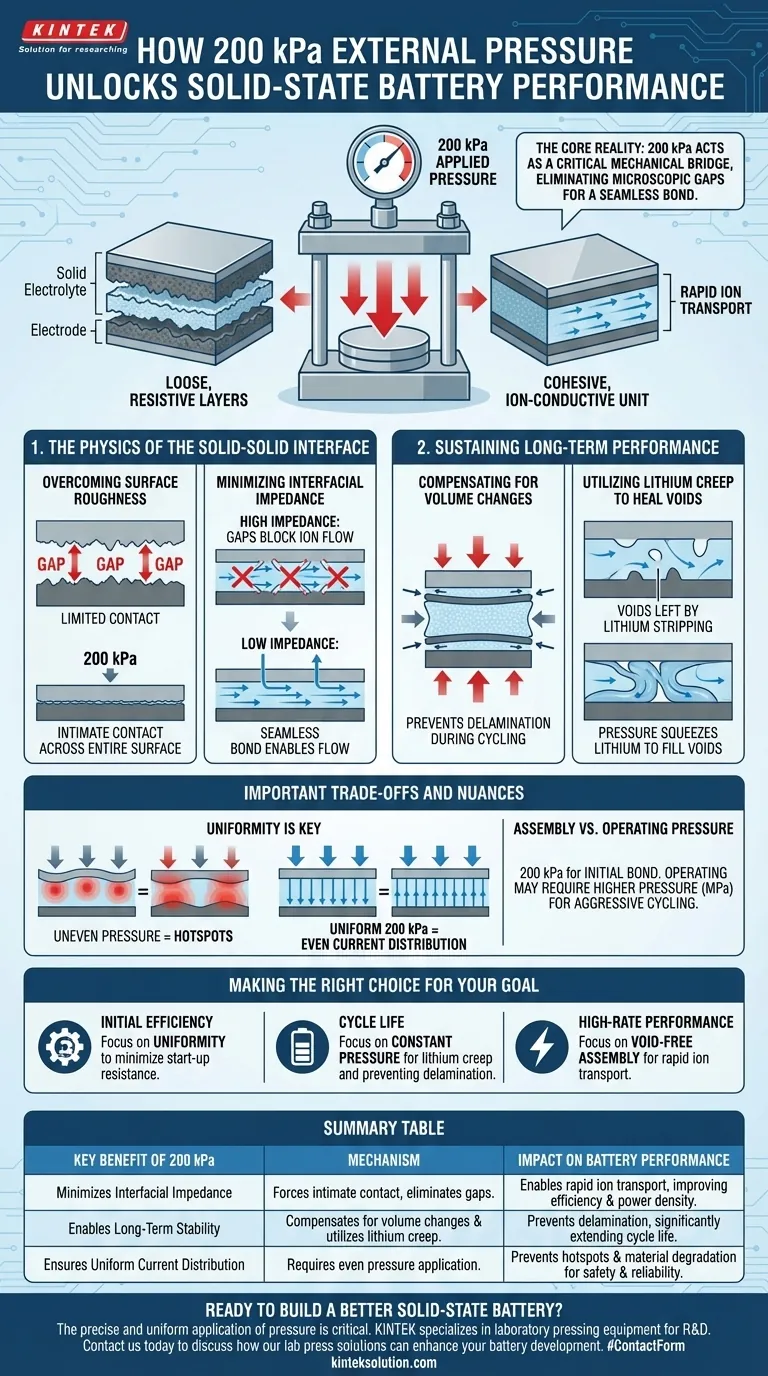
Applying an external pressure of 200 kPa acts as a critical mechanical bridge that unifies the separate layers of a solid-state battery. By mechanically forcing the electrode and electrolyte layers together, this pressure creates a physically seamless bond that eliminates microscopic gaps. This direct contact drastically minimizes interfacial impedance, opening a stable, low-resistance highway for the rapid transport of ions.
The Core Reality: Unlike liquid electrolytes, which naturally flow into pores to create contact, solid-state components are rigid and rough. External pressure is the only way to overcome this physical limitation, transforming loose, resistive layers into a cohesive, ion-conductive unit.
The Physics of the Solid-Solid Interface
Overcoming Surface Roughness
On a microscopic level, the surfaces of solid electrolytes and electrodes are rough and uneven. Without external pressure, these layers only touch at a few discrete points.
200 kPa of pressure flattens these irregularities. It forces the materials into intimate contact, ensuring the active material physically touches the electrolyte across the entire surface area.
Minimizing Interfacial Impedance
The primary enemy of battery performance is impedance (resistance). Any gap between layers acts as an insulator, blocking ion flow.
By creating a "seamless bond," the applied pressure removes these insulating gaps. This establishes a low-impedance interface, which is a fundamental prerequisite for the battery to function efficiently.
Sustaining Long-Term Performance
Compensating for Volume Changes
Batteries "breathe" during operation. As they charge and discharge, the internal materials expand and contract.
Without constant pressure, this movement would cause the layers to separate (delaminate), breaking the electrical connection. Continuous pressure compensates for these volume changes, keeping the interface intact through hundreds of cycles.
Utilizing Lithium Creep to Heal Voids
During the discharge cycle, lithium is stripped away from the anode, which can leave behind empty voids. These voids lead to contact loss and increased resistance.
Pressure utilizes the creep properties of lithium metal. Because lithium is malleable, the external pressure effectively "squeezes" the metal to fill these newly created voids, maintaining the continuous contact required for long-term stability.
Important Trade-offs and Nuances
The Necessity of Uniformity
The references emphasize that the pressure must be uniform. Uneven pressure leads to uneven current distribution.
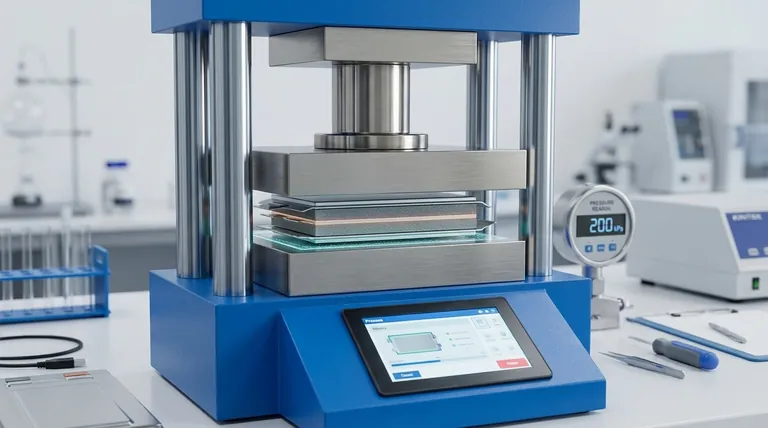
If pressure is applied incorrectly, it can create localized hotspots of high activity, potentially degrading the material faster in specific zones. The pressing device or mold must ensure the 200 kPa is distributed exactly evenly across the cell surface.
Assembly vs. Operating Pressure
It is important to distinguish between assembly pressure and operating pressure. While 200 kPa aids in establishing the initial bond, different chemistries may require varying pressures (sometimes significantly higher, up to the MPa range) to maintain contact during aggressive cycling.
Making the Right Choice for Your Goal
To maximize the benefit of applying external pressure, align your approach with your specific performance metrics:
- If your primary focus is Initial Efficiency: Ensure your pressing device delivers pressure with absolute uniformity to eliminate surface roughness and minimize start-up resistance.
- If your primary focus is Cycle Life: Design your system to maintain constant pressure throughout operation to utilize lithium creep and prevent delamination caused by volume expansion.
- If your primary focus is High-Rate Performance: Prioritize establishing a void-free interface during assembly, as minimized impedance is the key enabler for rapid ion transport.
Summary: Applying 200 kPa is not just about holding the battery together; it is an active functional requirement that lowers resistance and enables the material self-healing necessary for a viable solid-state battery.
Summary Table:
| Key Benefit of 200 kPa Pressure | Mechanism | Impact on Battery Performance |
|---|---|---|
| Minimizes Interfacial Impedance | Forces intimate contact between rigid solid layers, eliminating microscopic gaps. | Enables rapid ion transport, improving efficiency and power density. |
| Enables Long-Term Stability | Compensates for volume changes during cycling and utilizes lithium creep to heal voids. | Prevents delamination, significantly extending cycle life. |
| Ensures Uniform Current Distribution | Requires a pressing device that applies pressure evenly across the cell surface. | Prevents localized hotspots and material degradation, ensuring safety and reliability. |
Ready to build a better solid-state battery? The precise and uniform application of pressure is critical to your success. KINTEK specializes in laboratory pressing equipment, including automatic lab presses and isostatic presses, designed to deliver the exact, controlled pressure your R&D requires. Our machines help researchers like you achieve the seamless interfaces necessary for high-performance cells. Contact us today to discuss how our lab press solutions can enhance your battery development process.
Visual Guide
Related Products
- Warm Isostatic Press for Solid State Battery Research Warm Isostatic Press
- Button Battery Sealing Press Machine for Lab
- Laboratory Hydraulic Press Lab Pellet Press Button Battery Press
- Lab Button Battery Tablet Press Sealing Mold
- Lab Infrared Press Mold for Laboratory Applications
People Also Ask
- Why must composite cathodes be sealed in vacuum lamination bags for WIP? Ensure Battery Stability and Density
- How do sacrificial volume materials (SVM) maintain microchannels in isostatic pressing? Ensure Structural Integrity
- What is the function of elastic molds in warm isostatic pressing? Achieve Uniform Density in Composite Particles
- What is the process involved in warm isostatic pressing? Mastering Uniform Density with WIP Technology
- What is the mechanism of a Warm Isostatic Press (WIP) on cheese? Master Cold Pasteurization for Superior Safety