
Cold Isostatic Pressing (CIP) significantly optimizes the sintering process by creating a "green" body with exceptionally uniform density. Because the material is compressed equally from all directions prior to heating, the subsequent sintering phase becomes faster, more predictable, and capable of producing superior material properties compared to uniaxial pressing methods.
Core Takeaway The primary value of CIP is the elimination of internal density gradients. By ensuring the powder is compacted uniformly before it enters the furnace, CIP allows for predictable shrinkage, minimized distortion, and the ability to sinter complex or high-aspect-ratio shapes without cracking.

The Mechanics of Uniform Compaction
To understand how CIP affects sintering, you must first understand the state of the material before heat is applied. The "green body" sets the stage for the entire thermal cycle.
Eliminating Density Gradients
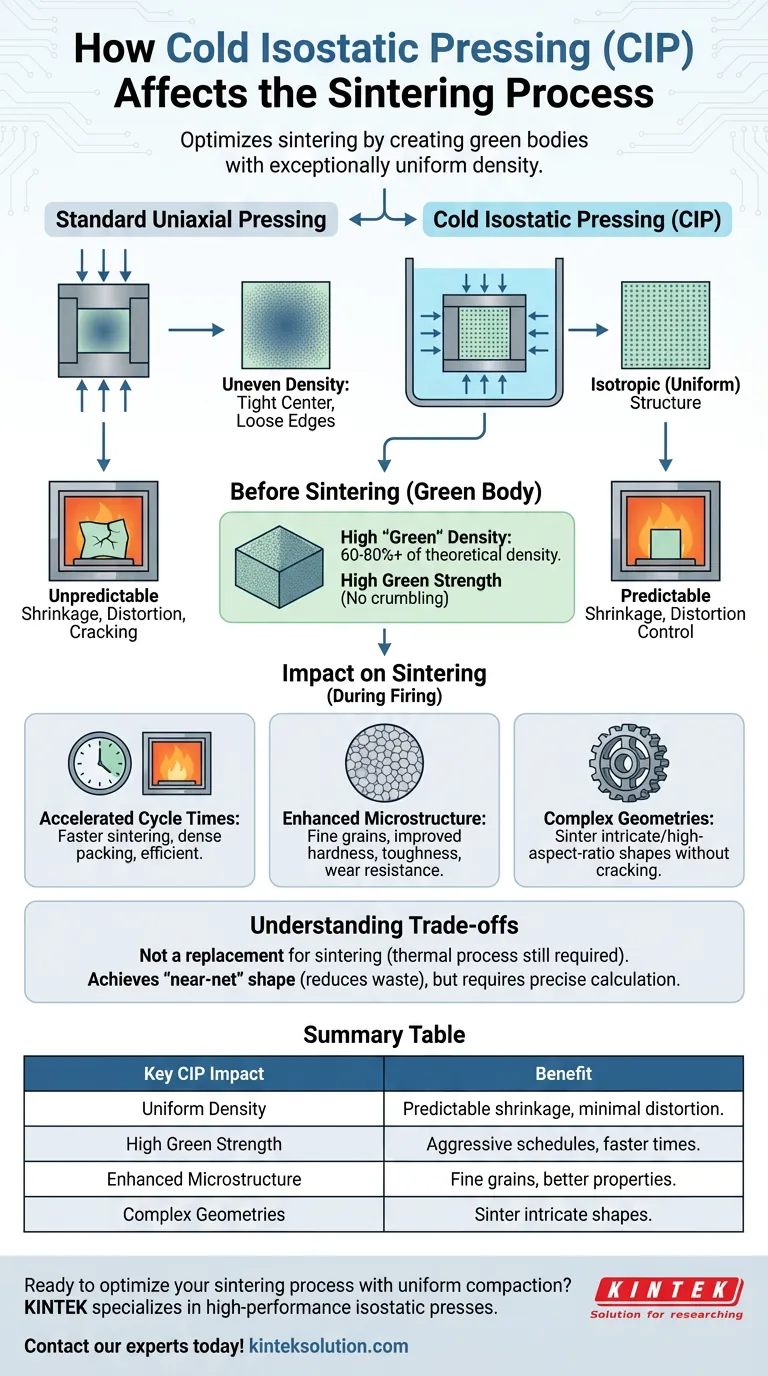
Standard uniaxial pressing applies force from the top and bottom, creating friction that leads to uneven density—tight centers and loose edges.
CIP submerges the mold in a fluid medium, applying high hydraulic pressure from every angle. This creates an isotropic (uniform) structure where the powder density is consistent throughout the entire part, regardless of its geometry.
Achieving High "Green" Density
CIP consolidates powder to reach 60% to 80% of its theoretical density before sintering even begins. In some optimized cases, green bodies can approach even higher densities.
This high initial packing means the particles are already mechanically interlocked. This results in high green strength, allowing the parts to be handled, machined, or moved into the furnace with zero risk of crumbling or deformation.
Impact on Sintering Behavior
Once the CIP-processed part enters the sintering furnace, the benefits of that uniform structure become active.
Predictable Shrinkage and Distortion Control
Sintering inevitably causes material to shrink as pores close. If the green body has uneven density, it will shrink unevenly, leading to warping, "hourglassing," or internal cracking.
Because CIP parts have uniform density, they undergo uniform shrinkage. This allows engineers to predict the final dimensions with high accuracy, ensuring the part retains its intended shape and structural integrity after firing.
Accelerated Cycle Times
The high green strength and density achieved by CIP allow for more aggressive sintering schedules.
Materials processed via CIP can often be sintered faster than those processed by other methods. The dense particle packing reduces the time and energy required to achieve the final bond, improving overall production efficiency and throughput.
Enhanced Microstructure
The pressure applied during CIP induces plastic deformation and recrystallization in the powder.
This results in a final sintered body with fine grains, which directly translates to improved hardness, toughness, and wear resistance. Furthermore, the process significantly lowers the risk of air entrapment and voids, yielding a higher-integrity component.
Understanding the Trade-offs
While CIP improves sintering outcomes, it is vital to understand the operational context to avoid misconceptions.
It Is a Pre-Processing Step
CIP is not a replacement for sintering; it is an enabling technology. While it creates a very dense green body, the material generally still requires thermal processing to achieve its final metallurgical or ceramic strength.
Near-Net vs. Net Shape
CIP allows for the creation of "near-net" shapes, which reduces material waste and machining costs. However, because shrinkage still occurs (albeit predictably), precise calculations are required to ensure the green mold size correlates to the desired final dimensions.
Making the Right Choice for Your Goal
Deciding to integrate CIP into your manufacturing flow depends on your specific production targets.
- If your primary focus is Geometric Complexity: CIP is essential for producing intricate shapes or parts with large aspect ratios (long and thin) that would crack under uniaxial pressure.
- If your primary focus is Dimensional Accuracy: CIP provides the uniform density required to prevent warping and distortion during the firing process.
- If your primary focus is Material Performance: CIP creates the fine-grain microstructure and high density necessary for parts requiring maximum wear resistance and strength.
Summary: By neutralizing density gradients before heating, Cold Isostatic Pressing transforms sintering from a risk-prone consolidation step into a predictable, high-speed process for creating high-performance materials.
Summary Table:
| Key CIP Impact on Sintering | Benefit |
|---|---|
| Uniform Density | Eliminates internal gradients for predictable shrinkage and minimal distortion. |
| High Green Strength | Allows for aggressive sintering schedules and faster cycle times. |
| Enhanced Microstructure | Results in fine grains, improving hardness, toughness, and wear resistance. |
| Complex Geometries | Enables sintering of intricate or high-aspect-ratio shapes without cracking. |
Ready to optimize your sintering process with uniform compaction?
KINTEK specializes in high-performance isostatic presses and lab press machines designed to create the uniform green bodies essential for predictable, high-quality sintering outcomes. Whether you are developing complex geometries or require maximum material performance, our expertise ensures you achieve superior results.
Contact our experts today to discuss how our CIP solutions can enhance your laboratory or production line!
Visual Guide
Related Products
- Automatic Lab Cold Isostatic Pressing CIP Machine
- Electric Split Lab Cold Isostatic Pressing CIP Machine
- Electric Lab Cold Isostatic Press CIP Machine
- Manual Cold Isostatic Pressing CIP Machine Pellet Press
- Lab Isostatic Pressing Molds for Isostatic Molding
People Also Ask
- What are the key features of automated laboratory Cold Isostatic Press (CIP) systems? Achieve Precise, High-Pressure Powder Consolidation
- Why is an Isostatic Press (CIP) Necessary After Uniaxial Pressing? Achieve Transparency in Nd:Y2O3 Ceramics
- How does a Cold Isostatic Press (CIP) increase Bi-2223/Ag current density? Boost Superconductivity with Uniform Pressure
- How does a Cold Isostatic Press (CIP) facilitate the preparation of CaO-doped silicon carbide (SiC) green bodies?
- What is the primary function of a Cold Isostatic Press (CIP) in NASICON preparation? Achieve 96% Theoretical Density










