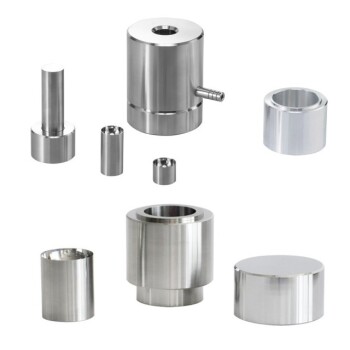
Lab pressure molding equipment serves as the foundational tool for grain boundary engineering by applying uniform axial pressure to compress nano-ceramic powders into high-density green bodies. This precise mechanical compaction minimizes internal voids and density gradients, creating the necessary microstructural conditions to control grain growth and refine grain boundaries during the subsequent sintering phase.
The quality of the final ceramic microstructure is determined before the heat treatment begins. Precise pressure application ensures the high initial density and uniform particle arrangement necessary to achieve near-theoretical density and optimized grain orientation.
Establishing the Microstructural Foundation
Creating High-Density Green Bodies
The primary function of lab pressure molding is to convert loose nano-ceramic powder into a solid, cohesive mass known as a green body. By applying highly uniform axial pressure, the equipment forces particles to pack tightly at the microscopic level.
Minimizing Internal Defects
High-pressure compaction effectively reduces the volume of pores and voids between particles. This minimizes density gradients, which are inconsistencies in how tightly the material is packed. eliminating these gradients is critical for preventing uneven shrinkage or warping later in the process.
Refining Grain Boundaries
The state of the green body directly dictates the behavior of the material during sintering. By ensuring tight particle contact, the equipment enables controlled grain growth. This leads to refined grain boundaries, which ultimately enhances the fracture toughness and structural stability of the ceramic.
Advanced Mechanisms of Control
Reducing Sintering Requirements
High laboratory pressing pressures, such as 1.0 GPa, can significantly increase the initial packing density. When particles are already tightly packed, the material can reach near-theoretical density at lower sintering temperatures.
Minimizing Volume Shrinkage
Because the particles are mechanically forced close together, there is less empty space to eliminate during heating. This minimizes volume shrinkage during the sintering process. This is essential for maintaining dimensional stability in precision components, such as dental restorations.
Facilitating Oriented Growth
For advanced ceramics using anisotropic template particles, pressure molding acts as an alignment tool. The equipment creates the ideal physical environment for the oriented growth of grains. It establishes optimal contact between the matrix powder and the templates, ensuring the microstructure develops in a specific, engineered direction.
Understanding the Trade-offs
The Risk of Over-Pressurization
While high pressure is generally beneficial for density, it requires careful management. If the pressure is excessive or uncontrolled, it can damage the internal structure.
Preserving Template Integrity
In textured ceramics, accurate pressure management is vital to ensure template particles are not crushed. The goal is to align the particles without destroying their geometry. If the templates are compromised during molding, the desired grain orientation will fail during sintering.
Making the Right Choice for Your Goal
To leverage lab pressure molding effectively, you must align your pressure strategy with your specific material objectives:
- If your primary focus is Structural Stability: Maximize the initial packing density to minimize porosity and enhance fracture toughness.
- If your primary focus is Dimensional Accuracy: Utilize higher pressures (e.g., 1.0 GPa) to reduce volume shrinkage and lower the required sintering temperature.
- If your primary focus is Textured Microstructure: Prioritize precise pressure regulation to ensure optimal contact for oriented growth without crushing sensitive template particles.
Success in grain boundary engineering starts with the precision of your initial mechanical compaction.
Summary Table:
| Feature | Impact on Grain Boundary Engineering | Primary Benefit |
|---|---|---|
| High-Density Compaction | Minimizes internal voids and particle gaps | High fracture toughness & structural stability |
| Uniform Pressure (1.0 GPa) | Increases initial packing density | Lower sintering temperatures & reduced shrinkage |
| Precision Control | Maintains template particle integrity | Facilitates oriented growth and textured microstructures |
| Mechanical Alignment | Establishes optimal particle contact | Dimensional accuracy for precision components |
Elevate Your Nano-Ceramic Research with KINTEK
Unlock the full potential of grain boundary engineering with KINTEK’s precision laboratory pressing solutions. Whether you are aiming for near-theoretical density in battery research or structural excellence in dental ceramics, our comprehensive range of manual, automatic, heated, and multifunctional models—including cold and warm isostatic presses—provides the uniform pressure control required for high-density green bodies.
Why choose KINTEK?
- Precision Engineering: Minimize volume shrinkage and achieve superior dimensional stability.
- Versatile Solutions: Glovebox-compatible and heated options for specialized material needs.
- Expert Support: Solutions tailored to both structural stability and oriented grain growth objectives.
Ready to refine your microstructure? Contact KINTEK today to find the ideal press for your laboratory.
References
- Eveliina Korhonen, S. -M. Niemi. Advances in functional materials: Structural, mechanical, and electronic perspectives. DOI: 10.22271/27078221.2025.v6.i2a.79
This article is also based on technical information from Kintek Solution Knowledge Base .
Related Products
- Lab Round Bidirectional Press Mold
- Lab Ball Press Mold
- Square Lab Press Mold for Laboratory Use
- Lab Cylindrical Press Mold for Laboratory Use
- Lab Isostatic Pressing Molds for Isostatic Molding
People Also Ask
- What is the purpose of incorporating cartridge heaters into a lab press mold for MLCC block compression? Optimize Results
- Why is precise cooling management of the lab press mold necessary? Protect Core Integrity in Thermoforming
- What is the function of a pressing tool in thermoplastic panels? Master Precision Shaping & Fusion Bonding
- Why is a high-performance laboratory molding press critical for in-situ electrolyte formation? Unlock Battery Success
- How do the design and geometric precision of pressing molds and mandrels affect the quality of PTFE composite samples?