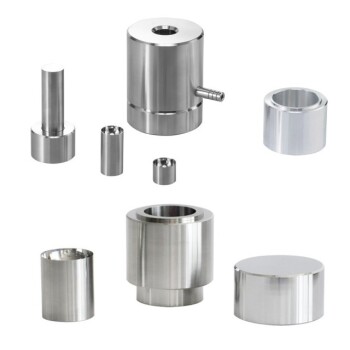
The design of the molding tool acts as the primary mechanical constraint that dictates the geometric accuracy and structural integrity of the final product. During the pressing process, the mold serves a dual purpose: it defines the paving block's shape and provides the necessary rigidity to contain molten plastic under high pressure. This containment is critical for preventing material overflow and geometric deformation, ensuring the block meets specific dimensional specifications even when processing high-viscosity materials like LDPE.
Core Takeaway The molding tool is not merely a shaping container but a pressure vessel that enables necessary densification. Its ability to maintain rigid constraints during the cooling phase is what transforms a loose melt of recycled plastic into a solid, load-bearing unit.
The Mechanics of Constraint and Stability
Defining Geometric Precision
The most immediate impact of the molding tool is the determination of the block's final dimensions.
The mold provides the fixed boundaries that shape the molten waste plastic.
A sturdy design ensures that these boundaries remain static, producing blocks that adhere to strict dimensional tolerances.
Preventing Material Overflow
When a lab press applies pressure to the plastic melt, the material seeks the path of least resistance.
A precisely designed mold seals effectively to prevent "flash" or overflow.
If the mold allows material to escape, internal pressure drops, leading to incomplete filling and defective geometry.
Stabilizing the Cooling Phase
The mold's job is not finished once the pressure is applied; it must maintain constraint during solidification.
The tool holds the plastic in its intended shape while it cools from a melt to a solid state.
This physical constraint prevents warping and deformation that can occur as the plastic shrinks during cooling.
Impact on Structural Density
Eliminating Internal Pores
The quality of a paving block is heavily dependent on its density.
The mold allows the press to exert sufficient force to squeeze out air pockets trapped within the molten plastic.
By resisting the outward force of the plastic, the mold ensures the material is compacted into a void-free structure.
Enhancing Particle Bonding
For recycled plastics like LDPE, HDPE, or PET, mechanical pressure is required to bond the particles tightly.
The mold focuses this pressure, forcing the plastic particles to fuse into a cohesive mass.
This tight bonding is what gives the paving block the compressive strength required for walkways and garden use.
Understanding the Trade-offs
Rigidity vs. Thermal Stress
While a highly rigid mold ensures dimensional stability, it must also withstand thermal cycles.
The mold absorbs heat from the molten plastic; if the tool design does not account for thermal expansion, the mold itself may warp or seize.
This can lead to difficulties in ejecting the block or inconsistent dimensions over repeated cycles.
Pressure Distribution Risks
A mold design that focuses solely on external shape without considering internal pressure flow can lead to weak spots.
If the mold geometry is too complex, pressure may not be transmitted effectively to all corners of the block.
This results in a block that looks correct on the outside but lacks uniform density and strength internally.
Making the Right Choice for Your Goal
To maximize the quality of your recycled plastic paving blocks, align your mold design with your specific performance requirements:
- If your primary focus is Dimensional Consistency: Prioritize a mold with thick walls and tight mating surfaces to prevent any deflection or leakage under load.
- If your primary focus is Compressive Strength: Ensure the mold design allows for a simple, uniform plunger action that maximizes the transfer of pressure into the core of the block to eliminate voids.
Ultimately, the molding tool is the bridge between raw pressure and a finished, durable product; its rigidity is the guarantee of quality.
Summary Table:
| Design Factor | Impact on Quality | Key Benefit |
|---|---|---|
| Rigidity & Sealing | Prevents material overflow and flash | Ensures dimensional accuracy and constant pressure |
| Pressure Distribution | Eliminates internal air pockets (voids) | Increases structural density and compressive strength |
| Thermal Stability | Manages expansion and contraction | Prevents warping and deformation during the cooling phase |
| Surface Tolerance | Defines boundary limits | Ensures blocks meet strict geometric specifications for paving |
Elevate Your Recycled Material Research with KINTEK
Precision in molding starts with the right equipment. KINTEK specializes in comprehensive laboratory pressing solutions, offering a versatile range of manual, automatic, heated, and multifunctional presses, as well as cold and warm isostatic presses designed for high-performance applications like battery research and sustainable material development.
Whether you are refining the density of LDPE paving blocks or engineering new composites, our solutions provide the rigid constraints and uniform pressure your research demands.
Ready to optimize your lab's performance? Contact us today to find the perfect press for your application!
References
- Nur Arinal Khaq, Bobby Damara. Analisa Pemanfaatan Limbah Plastik Sebagai Bahan Baku Pembuatan Paving Block. DOI: 10.33087/jiubj.v24i3.5599
This article is also based on technical information from Kintek Solution Knowledge Base .
Related Products
- XRF KBR Plastic Ring Lab Powder Pellet Pressing Mold for FTIR
- Lab Ball Press Mold
- Lab Isostatic Pressing Molds for Isostatic Molding
- Lab Round Bidirectional Press Mold
- Lab Polygon Press Mold
People Also Ask
- What is the purpose of making KBr pellets for FTIR? Achieve Precise Molecular Analysis with Solid Samples
- What factors should be considered when choosing a lab press for XRF pellet preparation? Ensure Accurate and Consistent Results
- Why are pellets used in XRF analysis, and what is their limitation? Boost Accuracy and Speed in Your Lab
- How are pellets prepared for XRF analysis and what is a potential drawback? Master XRF Sample Prep and Accuracy
- What are the different types of XRF pellet preparation methods available? Manual, Hydraulic, and Automated Presses Explained