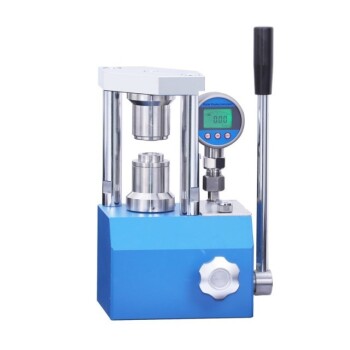
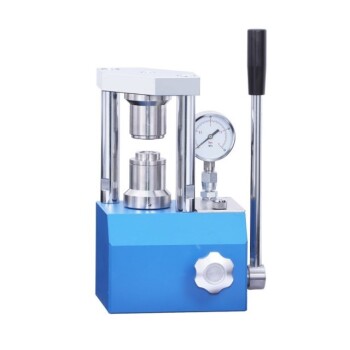
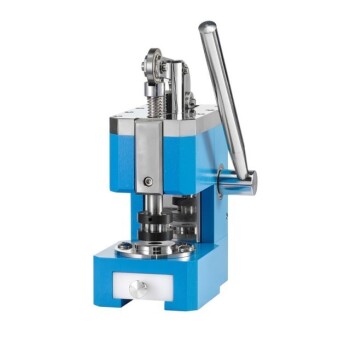
The precision of a coin cell crimper is a fundamental determinant of battery cycle life because it governs the mechanical integrity of the cell's internal environment. By applying a constant and uniform longitudinal pressure, a precise crimper ensures optimal contact between components while establishing a hermetic seal. Without this mechanical consistency, it is impossible to accurately evaluate the electrochemical performance of silicon anodes.
A precision crimper ensures the airtight sealing of the battery case and applies constant, uniform longitudinal pressure to internal components. This mechanical stability prevents electrolyte leakage and maintains stable interfacial impedance, which is critical for observing the true long-term effectiveness of self-healing mechanisms in silicon anodes.
The Mechanics of Longevity
Uniform Longitudinal Pressure
A high-precision crimper applies a consistent vertical force across the entire surface of the coin cell. This ensures that the internal stack—comprising the cathode, separator, and silicon anode—is compressed evenly.
Stabilizing Interfacial Impedance
Uniform compression is essential for establishing stable solid-to-solid physical contact between layers. This minimizes interfacial resistance, which facilitates efficient ion transport. Inconsistent pressure leads to fluctuating impedance, which can mask the true performance capabilities of the battery chemistry.
Supporting Self-Healing Mechanisms
Silicon anodes undergo significant volume expansion during cycling, often requiring self-healing binders or electrolytes to maintain integrity. Precise mechanical pressure helps maintain the physical proximity required for these self-healing mechanisms to function effectively over the long term.
Environmental Isolation and Integrity
Airtight Sealing
The crimper must deform the cell case and gasket with exact tolerances to create a hermetic seal. This prevents the ingress of air and moisture, which would otherwise react with the lithium or silicon to degrade the cell rapidly.
Preventing Electrolyte Leakage
A proper seal ensures the electrolyte remains contained within the active area of the cell. Leakage alters the cell's internal chemistry and reduces ionic conductivity, leading to premature failure unrelated to the anode material itself.
Understanding the Trade-offs
The Risk of Over-Compression
While contact is critical, a crimper that lacks precision may apply excessive force. This can crush the internal separator or damage the delicate structure of the silicon anode, leading to immediate internal short circuits.
The Consequence of Under-Compression
Conversely, insufficient pressure results in poor interfacial contact. This creates artificially high resistance (impedance), causing the cell to perform poorly during high current density testing even if the chemical materials are sound.
Making the Right Choice for Your Goal
To maximize the reliability of your silicon anode research, align your assembly process with your specific objectives:
- If your primary focus is long-term cycle life: Ensure your crimper delivers consistent, uniform pressure to support the self-healing mechanisms of the silicon anode.
- If your primary focus is high-rate performance: Prioritize mechanical precision to minimize interfacial resistance and ensure stable electrochemical reactions at high currents.
Precision in mechanical assembly is the only way to ensure your data reflects the chemistry of the anode, rather than the quality of the casing.
Summary Table:
| Feature | Impact on Silicon Anode Battery Performance |
|---|---|
| Uniform Pressure | Maintains physical contact for self-healing binders and ion transport. |
| Hermetic Sealing | Prevents moisture ingress and electrolyte leakage to protect lithium chemistry. |
| Impedance Control | Minimizes interfacial resistance for accurate electrochemical data. |
| Force Calibration | Prevents internal short circuits from over-compression or separator damage. |
Elevate Your Battery Research with KINTEK Precision
Don't let mechanical inconsistencies mask your chemical breakthroughs. KINTEK specializes in comprehensive laboratory pressing solutions tailored for high-stakes energy research. Whether you need manual, automatic, heated, or glovebox-compatible crimpers, our equipment ensures the constant longitudinal pressure and hermetic sealing required for silicon anode stability.
From cold isostatic presses to advanced coin cell assembly tools, we provide the mechanical integrity your battery research demands. Contact us today to optimize your lab assembly process and ensure every cycle reflects the true potential of your materials.
References
- Ndenga, Barack, Himanshi, sharma. Microcapsule-Enabled Self-Healing Silicon Anodes for Next-Generation Lithium-Ion Batteries: A Conceptual Design, Materials Framework, and Technical Feasibility Study. DOI: 10.5281/zenodo.17981740
This article is also based on technical information from Kintek Solution Knowledge Base .
Related Products
- Lab Button Battery Disassembly and Sealing Mold
- Button Battery Sealing Machine for Button Batteries
- Manual Button Battery Sealing Machine for Battery Sealing
- Lab Button Battery Tablet Press Sealing Mold
- Button Battery Sealing Press Machine for Lab
People Also Ask
- How does a sealed battery mold facilitate the assembly and testing of asymmetric supercapacitors using VO2?
- What is the function of specialized battery molds and sealing consumables? Optimize Your In-situ XRD Testing Today
- How does the geometry of laboratory molds influence mycelium-based composites? Optimize Density and Strength
- Why are specialized battery test molds used? Ensure Peak Performance for All-Solid-State Sodium Batteries (ASSIBs)
- What role do battery testing molds play in electrolyte performance? Exploring Pressure vs. Viscoelasticity