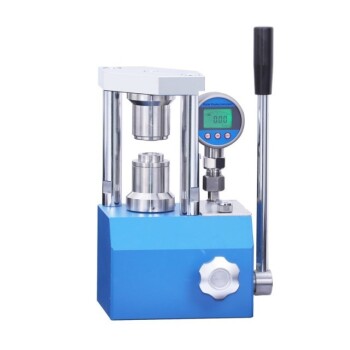
Automated laboratory presses significantly outperform manual methods by providing precise, programmable control over encapsulation pressure and dwell times. While manual pressing introduces inconsistency due to human variation, automated systems ensure tight, uniform physical contact between coin cell components, which is essential for minimizing interfacial resistance and preventing structural damage.
The core advantage of automation lies in the elimination of consistency errors caused by human operation. By delivering constant, repeatable pressure, automated presses ensure accurate data regarding cycle life and rate performance, validating that test results stem from chemical properties rather than assembly flaws.
The Impact of Pressure Precision on Cell Performance
Minimizing Interfacial Resistance
The primary function of the encapsulation process is to establish tight and uniform physical contact between the internal components—specifically the cathode, anode, spacers, and spring plates.
Manual pressing often fails to maintain this contact uniformly across the entire surface area.
Automated presses apply constant pressure control, which minimizes interfacial resistance. This ensures that the electrical pathways remain consistent, allowing the battery to perform at its full electrochemical potential during testing.
Preserving Component Integrity
Applying the correct amount of force is a delicate balance. Excessive force can crush internal structures, while insufficient force leads to high impedance.
Automated systems allow for precise calibration to avoid the destruction of the separator’s microporous structure, a common issue when force is applied unevenly or too aggressively by hand.
Furthermore, smooth pressurization and depressurization cycles prevent the formation of internal density gradients or microscopic cracks. This is particularly critical when processing brittle functional materials or "green bodies" that are sensitive to shock.
Enhancing Data Reproducibility
Removing the Human Variable
Manual pressing is inherently variable; no two operators apply force in the exact same way, and even a single operator varies from sample to sample.
This inconsistency introduces experimental errors that can mask the true effects of chemical modifications, such as sodium-ion substitution.
Automation ensures that pressure magnitude and duration are identical for every sample. This leads to higher repeatability of electrochemical test data, ensuring that observed changes in performance are statistically significant.
Controlling Surface Morphology
Even minor fluctuations in compression pressure can alter a sample's porosity or surface morphology.
Automated hydraulic presses provide constant control over holding times, which is critical when studying dispersed solid surfaces.
By stabilizing these physical parameters, automation prevents variables like porosity changes from skewing data related to battery capacity and cycle stability.
Common Pitfalls in Manual Operation
The Risk of Inconsistent Sealing
A critical trade-off when using manual equipment is the inability to guarantee a hermetic seal every time.
Inconsistent pressure during the crimping or pressing phase can lead to electrolyte leakage or poor contact with current collectors.
This results in "false failures" where a viable battery chemistry appears to fail due to mechanical assembly issues rather than chemical limitations. Automation mitigates this risk by standardizing the sealing process to improve overall yield rates.
Making the Right Choice for Your Goal
To determine whether the upgrade to automation is necessary for your specific workflow, consider the following:
- If your primary focus is accurate cycle life testing: Automation is essential to eliminate human inconsistency and ensure that rate performance data reflects the true chemistry of the cell.
- If your primary focus is working with brittle or advanced materials: The programmable pressurization cycles of an automated press are required to prevent microscopic cracks and improve yield rates.
By removing mechanical variability from the equation, you ensure that your research focuses on the science, not the assembly.
Summary Table:
| Feature | Manual Pressing | Automated Pressing |
|---|---|---|
| Pressure Control | Variable/Human-dependent | Precise & Programmable |
| Consistency | Low (operator variability) | High (repeatable results) |
| Component Safety | High risk of crushing/cracks | Controlled pressure protects structures |
| Data Reliability | Prone to "false failures" | High reproducibility of chemical data |
| Sealing Quality | Inconsistent hermetic seals | Standardized, leak-proof sealing |
Maximize Your Battery Research Accuracy with KINTEK
Don't let assembly variables mask your chemical breakthroughs. KINTEK specializes in comprehensive laboratory pressing solutions designed for the rigorous demands of battery research. Whether you need manual, automatic, heated, or glovebox-compatible models, or advanced cold and warm isostatic presses, we provide the tools to eliminate interfacial resistance and ensure data reproducibility.
Ready to upgrade your lab's precision? Contact our experts today to find the perfect press for your coin cell and functional material applications.
References
- Nazerke Zhumasheva, E. Nurgaziyeva. <i>In Situ</i> Polymer Electrolyte Coating for Lithium–Sulfur Batteries. DOI: 10.18321/cpc23(3)243-251
This article is also based on technical information from Kintek Solution Knowledge Base .
Related Products
- Button Battery Sealing Press Machine for Lab
- Button Battery Sealing Machine for Button Batteries
- Manual Button Battery Sealing Machine for Battery Sealing
- Lab Button Battery Tablet Press Sealing Mold
- Laboratory Hydraulic Press Lab Pellet Press Button Battery Press
People Also Ask
- Why use standardized CR2032 components & high-precision presses? Ensure reliability in lithium metal battery research.
- Why is a laboratory battery sealing press essential for desolvation energy testing? Ensure Reliable Kinetic Data
- Why is a laboratory hydraulic press or battery sealing machine essential? Ensure Coin Cell Data Integrity
- How do laboratory battery sealing machines ensure performance consistency? Master Your Lithium and LFP Battery Assembly
- What role does a laboratory sealing press play in thermal analysis of solid dispersion films? Ensure Data Integrity