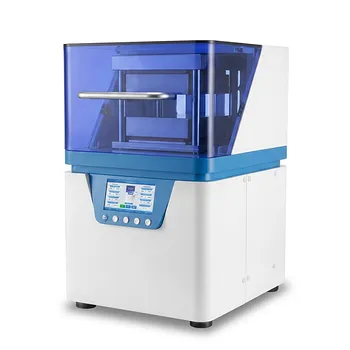
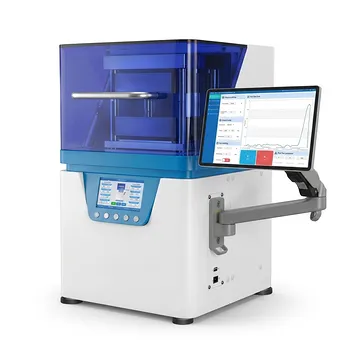
A hydraulic press is the primary instrument used to convert loose powder samples into solid, optical-quality forms for analysis. It functions by applying immense, uniform pressure to a sample mixture—often diluted in a matrix like Potassium Bromide (KBr)—to fuse it into a solid pellet or thin film. This physical transformation is a prerequisite for generating accurate data in spectroscopic techniques like FTIR and XRF.
The Core Utility
Spectroscopy measures how light interacts with matter, but loose powders scatter light unpredictably. By compressing samples under high pressure, a hydraulic press eliminates internal air voids and porosity, transforming opaque powders into transparent, homogenous disks that allow for clear, high-signal data acquisition.
The Mechanics of Sample Transformation
Achieving Homogeneity
The primary role of the hydraulic press is to create a homogenous sample. In spectroscopy, a consistent distribution of particles is vital; if a sample is uneven, the resulting data will be skewed.
The press drives a die or piston to compress the material, forcing disparate powder particles to bind tightly together. This ensures the instrument reads a representative sample rather than an isolated cluster of material.
Eliminating Optical Interference
For accurate readings, the path of the light beam must not be obstructed by air pockets. A laboratory press applies high pressure—often reaching 70 MPa or up to 11 tons per square centimeter.
This intensity rearranges the powder structure and eliminates internal air voids. In applications like analyzing bone or collagen, this process minimizes light scattering, resulting in a significantly higher signal-to-noise ratio.
Application in Specific Techniques
FTIR: Creating the KBr Pellet
In Fourier Transform Infrared Spectroscopy (FTIR), the press is essential for making KBr pellets. The sample is first diluted in Potassium Bromide (KBr) powder.
When compressed, KBr becomes transparent to infrared light, forming a clear "window" that holds the sample in suspension. This transparency allows the infrared beam to pass through effectively, enabling the detection of specific chemical bonds, such as vibration peaks for C=O or C≡N in complex compounds like Iridium(III).
XRF: Ensuring Sample Integrity
For X-ray Fluorescence (XRF), the goal is determining elemental composition. Here, the hydraulic press squeezes the sample between pressure plates to create a robust, general sample pellet.
The press ensures the material is completely compacted and dense. This maintains the physical integrity of the sample during the XRF process, preventing the powder from shifting or contaminating the instrument vacuum.
Understanding the Trade-offs
The Necessity of Uniform Pressure
While high pressure is required, uniformity is equally critical. If the press applies force unevenly, the resulting pellet may have varying densities.
In FTIR, this leads to inconsistent transparency across the disk, which can distort transmission spectrum data. You must ensure the press and die set are aligned perfectly to produce a flat, uniform surface.
Matrix Dependencies
The success of the press relies on the material matrix. For example, creating a transparent disk often requires a binder like KBr.
If the pressure is insufficient (below the 70 MPa threshold, for instance), the KBr will not fuse correctly, leaving pores that scatter light. Conversely, the press serves to bind the matrix and sample so tightly that it essentially mimics a solid crystal.
Making the Right Choice for Your Goal
To get the best results from your hydraulic press sample preparation, consider your analytical target:
- If your primary focus is FTIR (Transmission Data): Prioritize high pressure (up to 11 tons/cm²) to eliminate all air voids and achieve maximum transparency for the highest signal-to-noise ratio.
- If your primary focus is XRF (Elemental Analysis): Focus on consistent compaction to ensure a dense, flat surface that maintains structural integrity during radiation exposure.
The hydraulic press is not just a tool for flattening material; it is a precision instrument for removing optical noise and ensuring the physical stability of your chemical data.
Summary Table:
| Feature | FTIR Spectroscopy (KBr Pellets) | XRF Spectroscopy (Pressed Pellets) |
|---|---|---|
| Primary Goal | Create transparent optical windows | Ensure dense, structural integrity |
| Pressure Needed | Up to 11 tons/cm² (70 MPa) | High compaction for density |
| Key Outcome | Eliminated air voids & light scattering | Flat, homogenous surface for radiation |
| Matrix Used | Potassium Bromide (KBr) | Often uses binders for stability |
| Data Benefit | High signal-to-noise ratio | Accurate elemental composition |
Elevate Your Spectroscopy Precision with KINTEK
Don't let sample inconsistency compromise your research data. KINTEK specializes in comprehensive laboratory pressing solutions designed to eliminate optical noise and ensure sample homogeneity.
Whether you are conducting advanced battery research or routine chemical analysis, our extensive range of manual, automatic, heated, and multifunctional models—including specialized glovebox-compatible and isostatic presses—provides the uniform pressure required for perfect pellets every time.
Ready to optimize your sample preparation? Contact KINTEK today to find the ideal press for your laboratory's unique requirements!
Related Products
- Automatic Hydraulic Hot Press with Large Plate and Precision Temperature Control for Advanced Material Sample Preparation and Industrial Research
- Automatic Hydraulic Heat Press Machine with Multi Stage Programmable Control and Integrated Water Cooling Plate Size 180x180mm
- Automatic High Temperature Heated Hydraulic Press Machine with Heated Plates for Lab
- Automatic Heated Hydraulic Lab Press with Programmable Touch Screen Controls and Precision Temperature Regulation
- Manual Heated Hydraulic Lab Press with Integrated Hot Plates Hydraulic Press Machine
People Also Ask
- What are the specific features and applications of hydraulic hot press machines? Precision Solutions for Modern Labs
- How does an automatic hydraulic press operate? Achieve Precision and Consistency in Lab Pelleting
- What are the advantages and common applications of an automatic hydraulic press? Elevate Your Lab's Precision
- What is the technical significance of setting a precise dwell time? Achieve Peak Material Density and Stability
- When is an automatic hydraulic press more suitable than a manual press? Scale Your Lab with Precision & Speed