
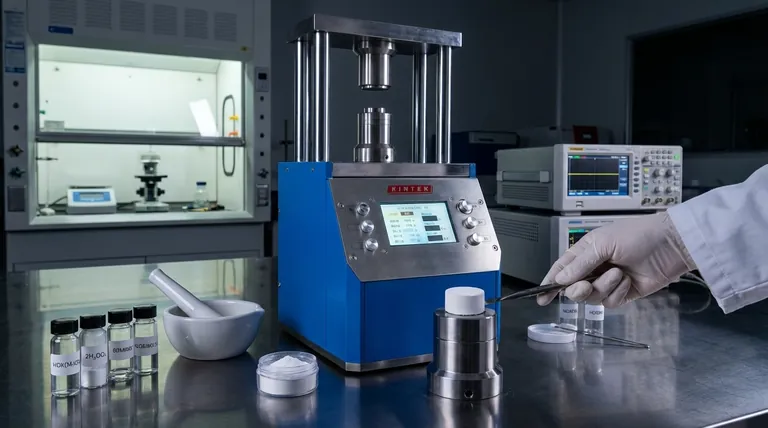
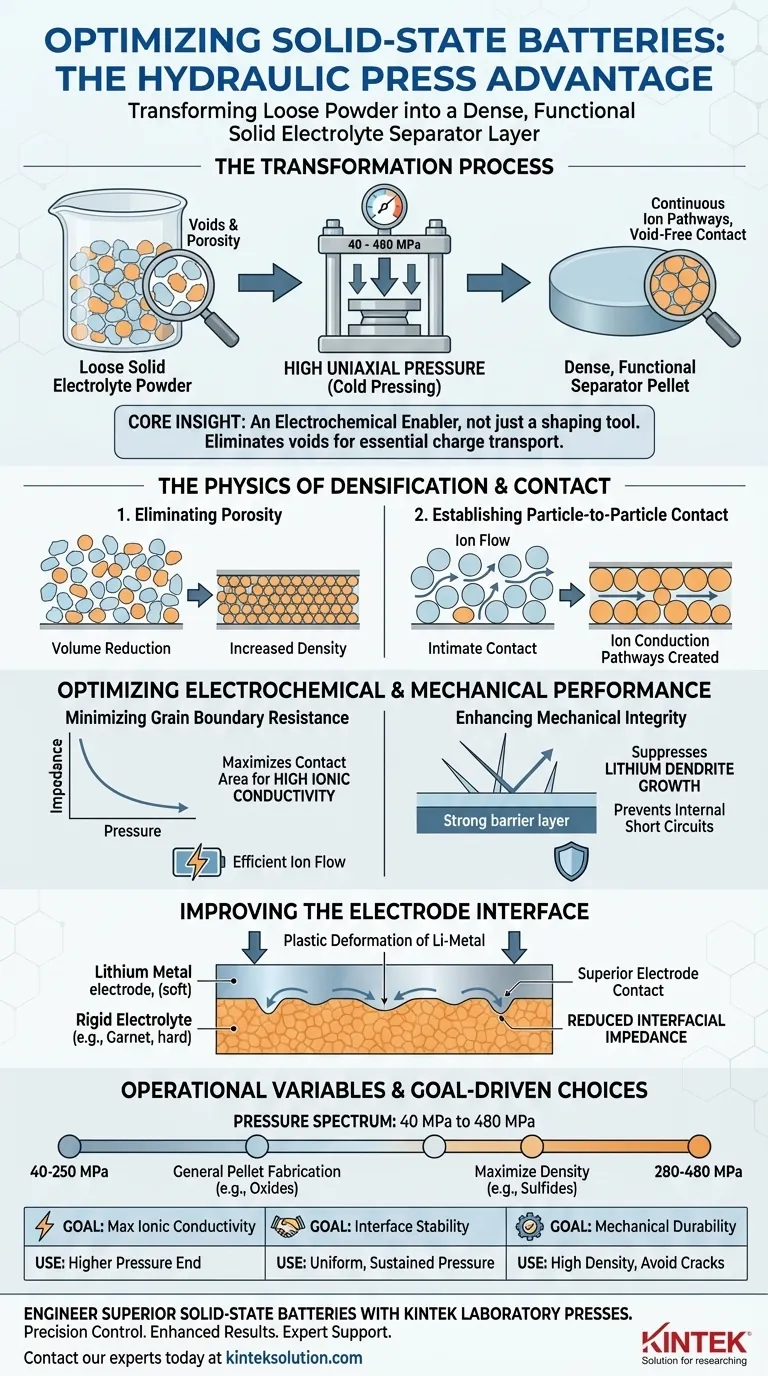
A laboratory hydraulic press is utilized to transform loose solid electrolyte powder into a dense, functional separator layer through the application of high uniaxial pressure. By subjecting materials to pressures ranging from 40 MPa to 480 MPa, the press compacts the powder into a robust, void-free pellet that effectively prevents internal short circuits while maximizing ionic conductivity.
Core Insight: The hydraulic press is not just a shaping tool; it is an electrochemical enabler. Its primary function is to eliminate microscopic voids and force particle-to-particle contact, thereby converting a highly resistive powder into a continuous, conductive pathway essential for charge transport.
The Physics of Densification
Eliminating Porosity through Cold Pressing
The primary role of the press is densification. Solid electrolyte materials, such as sulfides or oxides (like LAGP), begin as powders with significant spacing between particles.
By applying high uniaxial pressure (often called cold-pressing), the hydraulic press physically reduces the volume of the material. This eliminates the voids and air pockets that naturally occur in the bulk powder, increasing the overall density of the resulting green pellet.
Establishing Particle-to-Particle Contact
For ions to move through the battery, they require a continuous physical path. In a loose powder, ions cannot jump across the air gaps between particles.
The high pressure ensures intimate, void-free contact between individual electrolyte particles. This physical proximity is the critical step that allows for the creation of ion conduction pathways throughout the separator layer.
Optimizing Electrochemical Performance
Minimizing Grain Boundary Resistance
A dense pellet is useless if the resistance between particles is too high. The "grain boundary resistance" is the impedance ions face when moving from one particle to another.
The hydraulic press minimizes this resistance by forcing the particles so close together that they behave almost as a single solid mass. This maximization of the contact area is fundamental for achieving high ionic conductivity in the final cell.
Enhancing Mechanical Integrity
Beyond electrical performance, the separator acts as a physical barrier. A loosely packed layer is fragile and prone to crumbling during battery assembly or cycling.
The compaction process creates a mechanically robust separator capable of enduring the stresses of cell fabrication. This strength is vital for suppressing lithium dendrite growth and preventing internal short circuits that lead to battery failure.
Improving the Electrode Interface
Plastic Deformation of Lithium Metal
When working with rigid electrolytes like garnets, the interface with the lithium metal electrode is naturally poor, resulting in limited "point contacts" and high resistance.
The hydraulic press applies pressure to force the soft lithium metal to undergo plastic deformation. This allows the metal to flow into and fill the microscopic depressions on the hard electrolyte surface, significantly increasing the effective contact area.
Reducing Interfacial Impedance
The quality of the contact between the electrode and the solid electrolyte dictates the cell's stability. Poor contact leads to high interfacial impedance.
By maintaining precise and uniform external stack pressure, the press ensures a high-quality interface. This lowers impedance, enables stable electrochemical measurements, and facilitates the efficient transport of both ions and electrons across the boundary.
Understanding the Operational Variables
The Pressure Spectrum
There is no single "correct" pressure; the optimal setting depends on the specific material and the goal of the pressing step.
References indicate a wide operational range, typically from 40 MPa to 480 MPa. Lower pressures (40-250 MPa) are often used for general pellet fabrication, while extremely high pressures (up to 480 MPa) are utilized for maximizing the density of specific sulfide membranes.
Material-Specific Responses
Different electrolytes react differently to hydraulic pressure.
- Sulfides and LAGP: These are typically cold-pressed from powders. The focus here is on compacting the powder to close voids.
- Garnets: These are rigid and often pre-sintered. The press is used here primarily to force the mating material (Lithium) to conform to the garnet's surface, rather than compressing the garnet itself.
Making the Right Choice for Your Goal
To maximize the utility of a laboratory hydraulic press in your solid-state battery research, consider your primary objective:
- If your primary focus is maximizing Ionic Conductivity: Operate at the higher end of the pressure tolerance for your material (e.g., 280–480 MPa for sulfides) to absolutely minimize grain boundary resistance.
- If your primary focus is Interface Stability: Focus on applying uniform, sustained pressure to induce plastic deformation in the lithium metal, ensuring it conforms perfectly to the electrolyte surface.
- If your primary focus is Mechanical Durability: Target a pressure that achieves high density without inducing micro-cracks, ensuring the pellet is robust enough to act as a physical barrier against dendrites.
Success in solid-state fabrication relies on using pressure not just to shape the cell, but to fundamentally engineering its internal microstructure for minimal resistance.
Summary Table:
| Key Function | Benefit in Battery Fabrication | Typical Pressure Range |
|---|---|---|
| Densification | Eliminates porosity, creating a continuous ion conduction pathway. | 40 - 480 MPa |
| Interface Optimization | Forces plastic deformation of lithium metal for superior electrode contact. | Varies by material |
| Mechanical Integrity | Creates a robust pellet that suppresses lithium dendrite growth. | 40 - 480 MPa |
Ready to Engineer Superior Solid-State Batteries?
Your research into high-performance solid electrolytes demands precise and reliable compaction. KINTEK specializes in laboratory press machines, including automatic, isostatic, and heated lab presses, designed to meet the exacting needs of battery development.
By partnering with us, you gain:
- Precision Control: Achieve the specific pressures (from 40 MPa to 480 MPa) required to optimize ionic conductivity and interface stability for your specific electrolyte material.
- Enhanced Results: Create dense, void-free separator layers that minimize grain boundary resistance and prevent internal short circuits.
- Expert Support: Leverage our expertise to select the perfect press for your application, whether you're working with sulfides, oxides, or garnets.
Don't let compaction variability limit your battery's performance. Contact our experts today to find the ideal lab press solution for your laboratory.
Visual Guide
Related Products
- Automatic Laboratory Hydraulic Press for XRF and KBR Pellet Pressing
- 24T 30T 60T Heated Hydraulic Lab Press Machine with Hot Plates for Laboratory
- Laboratory Hydraulic Press 2T Lab Pellet Press for KBR FTIR
- Automatic Heated Hydraulic Press Machine with Hot Plates for Laboratory
- Laboratory Hydraulic Pellet Press for XRF KBR FTIR Lab Press
People Also Ask
- Why is pressing powder into a pellet critical before sintering? Ensure Dense, Conductive Solid-State Electrolytes
- What is the role of a laboratory pressure machine and KBr in FTIR? Master Sample Preparation for Flame Retardants
- What are the advantages of using a laboratory automatic hydraulic press for HEA green compact forming?
- What are the advantages of using a lab automatic hydraulic press for HEA green body molding? Ensure Material Integrity
- How does an automatic laboratory hydraulic press improve KBr pellet preparation? Achieve Precision IR Spectroscopy



















