
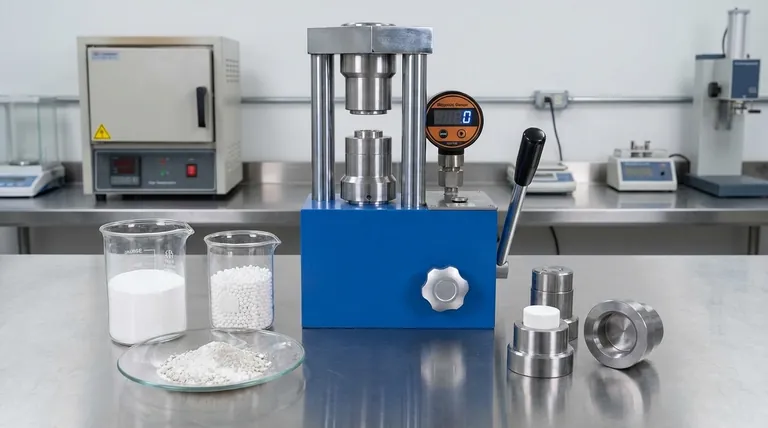
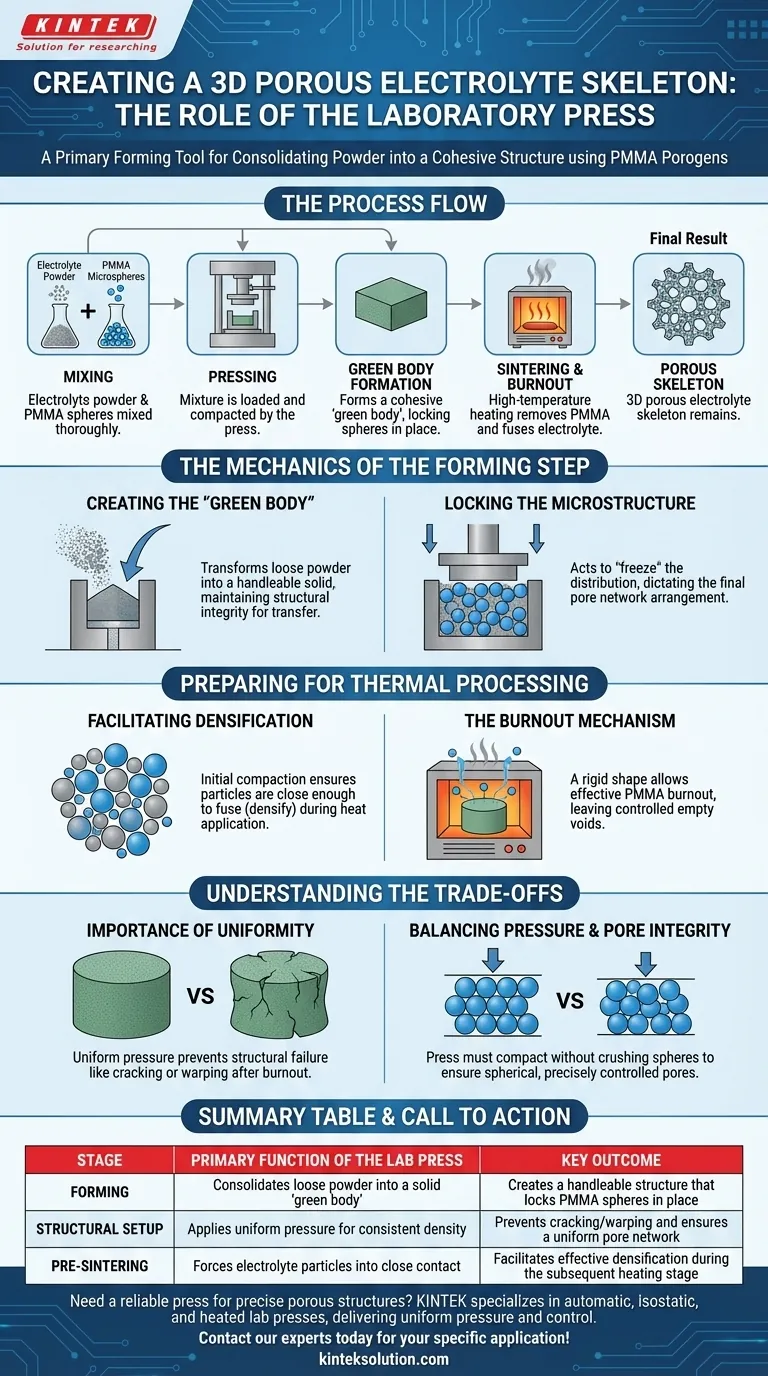
A laboratory press functions as the primary forming tool in this process, responsible for consolidating a loose mixture of electrolyte powder and PMMA microspheres into a solid, cohesive shape. By applying mechanical pressure, the press creates a "green body"—a compacted intermediate stage that locks the spherical templates in place before thermal processing begins.
The laboratory press does not create the porosity directly; rather, it establishes the structural framework required to support it. By compacting the electrolyte material around the PMMA spheres, the press ensures that a defined, interconnected network remains once the sacrificial spheres are removed during sintering.
The Mechanics of the Forming Step
Creating the "Green Body"
The immediate goal of the laboratory press is to transform loose composite powder into a handleable solid.
This compacted form is technically referred to as a green body. It possesses just enough structural integrity to hold its shape during the transfer from the press to the sintering furnace.
Locking the Microstructure
During mixing, the PMMA microspheres are distributed throughout the electrolyte powder.
The pressing stage acts to "freeze" this distribution in place. By eliminating air gaps and forcing the electrolyte particles to pack tightly around the PMMA spheres, the press dictates the final arrangement of the pore network.
Preparing for Thermal Processing
Facilitating Densification
The reference material highlights that the structure must eventually undergo "high-temperature sintering."
The press is vital for this because sintering requires particles to be in close contact. The initial compaction brings electrolyte particles close enough to fuse together (densify) once heat is applied.
The Burnout Mechanism
Once the green body is formed, it is subjected to heat to remove the PMMA.
Because the press has already established a rigid shape, the PMMA can be "burned out" effectively. This leaves behind empty voids where the spheres used to be, resulting in the desired porous electrolyte skeleton.
Understanding the Trade-offs
The Importance of Uniformity
The reference emphasizes the need for uniform density during the pressing stage.
If the pressure is applied unevenly, the green body will have varying densities across its geometry. This leads to structural failure, such as cracking or warping, once the PMMA is removed and the skeleton attempts to support itself.
Balancing Pressure and Pore Integrity
While high pressure is needed for densification, the process relies on the PMMA spheres maintaining their shape.
The press must apply enough force to compact the electrolyte without crushing or deforming the PMMA microspheres. If the spheres are distorted during pressing, the resulting pores will not be spherical or "precisely controlled."
Making the Right Choice for Your Goal
To achieve a high-quality electrolyte skeleton, you must view the press as a tool for structural consistency, not just shape formation.
- If your primary focus is structural strength: Ensure the press applies sufficient force to maximize the contact points between electrolyte particles, promoting better fusion during sintering.
- If your primary focus is pore interconnectivity: Prioritize the uniformity of the compaction to ensure the PMMA spheres are held rigidly in their distributed positions without segregation.
The success of the final porous network is determined by how well the laboratory press stabilizes the initial mixture.
Summary Table:
| Stage | Primary Function of the Lab Press | Key Outcome |
|---|---|---|
| Forming | Consolidates loose powder into a solid 'green body' | Creates a handleable structure that locks PMMA spheres in place |
| Structural Setup | Applies uniform pressure for consistent density | Prevents cracking/warping and ensures a uniform pore network |
| Pre-Sintering | Forces electrolyte particles into close contact | Facilitates effective densification during the subsequent heating stage |
Need a reliable press to create precise porous structures for your battery or fuel cell research?
KINTEK specializes in laboratory press machines, including automatic, isostatic, and heated lab presses, designed to deliver the uniform pressure and control critical for processes like creating 3D porous electrolyte skeletons. Our equipment helps researchers like you achieve consistent green bodies, maintain pore integrity, and ensure successful sintering outcomes.
Contact our experts today to discuss your specific application and find the perfect lab press for your needs!
Visual Guide
Related Products
- Laboratory Hydraulic Press 2T Lab Pellet Press for KBR FTIR
- Laboratory Hydraulic Press Lab Pellet Press Button Battery Press
- Laboratory Hydraulic Press Lab Pellet Press Machine for Glove Box
- Laboratory Hydraulic Pellet Press for XRF KBR FTIR Lab Press
- Laboratory Split Manual Heated Hydraulic Press Machine with Hot Plates
People Also Ask
- What is the role of a laboratory pressure machine and KBr in FTIR? Master Sample Preparation for Flame Retardants
- What is the role of a laboratory hydraulic press in high-loading NCM811 cathode prep for solid-state batteries?
- What role does a laboratory hydraulic press play in reaction pellets? Optimizing Lunar Soil and Metal Fuel Density
- Why is a laboratory hydraulic press necessary for sample preparation? Precise Pelleting for Spiro Heterocyclic Analysis
- Why is a laboratory hydraulic press required for M-N-C catalyst characterization? Enhance XAS and Mössbauer Accuracy



















