
Isostatic pressing is the critical technique used to overcome the density limitations of traditional ceramic forming. In the fabrication of solid electrolytes like LLZO, this process applies uniform hydrostatic pressure to ceramic powder from all directions. This creates a highly densified "green body" with minimal internal voids, serving as the essential foundation for sintering a mechanically robust and ionically conductive battery component.
Core Takeaway Achieving high ionic conductivity in solid-state batteries requires electrolytes with near-perfect density. Isostatic pressing solves the problem of uneven compaction found in standard methods, enabling the production of ceramic substrates that approach 100% of their theoretical density, thereby preventing dendrite growth and mechanical failure.
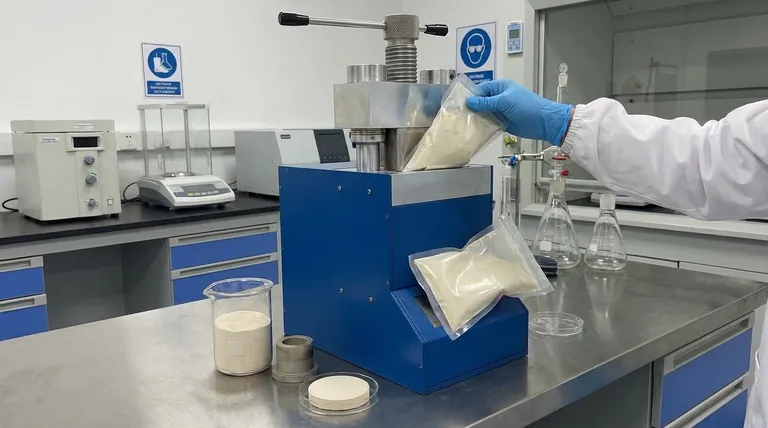
Creating the Foundation: Cold Isostatic Pressing (CIP)
The Mechanism of Uniformity
Unlike uniaxial pressing, which compresses powder from a single direction, Cold Isostatic Pressing (CIP) places the ceramic powder (such as c-LLZO) into a flexible mold submerged in a liquid medium.
Hydrostatic pressure is applied equally from all sides, often around 60 MPa. This multidirectional force ensures that the powder particles pack together evenly, regardless of the component's geometry.
Eliminating Internal Defects
The primary advantage of CIP is the elimination of density gradients. In traditional pressing, friction causes some areas to be denser than others, leading to stress concentrations.
CIP produces a "green body" (the unfired ceramic shape) with exceptional uniformity. This minimizes internal stress and significantly reduces the risk of cracks or deformation forming during the subsequent firing process.
Preparing for Sintering
The result of the CIP process is a compact with a relative density that can reach 90.5% before the main sintering phase even begins.
This high initial density is vital. It provides the structural integrity required for high-temperature sintering, ensuring the final ceramic sheet is defect-free.
Maximizing Performance: Hot Isostatic Pressing (HIP)
The Synergy of Heat and Pressure
While CIP forms the shape, Hot Isostatic Pressing (HIP) is often used as a post-sintering treatment to perfect the material properties.
This process places the component in an inert gas environment (typically argon) at extremely high temperatures—potentially up to 2000°C—while simultaneously applying high pressure.
Eradicating Residual Micropores
Even after standard sintering, small internal pores may remain in the ceramic. HIP leverages the combined action of heat and uniform pressure to collapse and eliminate these residual micropores.
This step pushes the material density from "high" to nearly 100% of its theoretical value.
Enhancing Battery Characteristics
The elimination of porosity has two direct benefits for LLZO electrolytes: it maximizes ionic conductivity by removing barriers to ion flow, and it improves fracture toughness.
A fully dense, tough ceramic is essential for preventing the penetration of lithium dendrites, which is the primary failure mode in solid-state batteries.
Understanding the Trade-offs and Distinctions
CIP vs. HIP Utilization
It is crucial to distinguish when these methods are applied. CIP is a forming process used on raw powder to create the initial shape (green body).
HIP is a densification process applied to an already sintered or semi-sintered component to remove the final fraction of porosity.
Fabrication vs. Assembly
While isostatic presses fabricate the ceramic substrate, standard pressing is often used later during battery assembly.
As noted in assembly contexts, external pressure is applied to ensure intimate contact between the soft lithium metal and the hard LLZO surface. This reduces interfacial resistance, but it is a distinct process from the isostatic fabrication of the ceramic itself.
How to Apply This to Your Project
To fabricate viable solid-state battery electrolytes, you must select the pressing method that aligns with your specific defect-reduction goals.
- If your primary focus is preventing cracking during firing: Implement Cold Isostatic Pressing (CIP) to ensure uniform green body density and eliminate stress gradients before sintering.
- If your primary focus is maximizing ionic conductivity: Utilize Hot Isostatic Pressing (HIP) post-sintering to eliminate residual micropores and achieve near 100% theoretical density.
- If your primary focus is reducing interfacial resistance: Ensure you differentiate between substrate fabrication and the separate need for pressure during the Lithium-LLZO assembly phase.
By systematically applying uniform pressure at the correct stage, you transform a brittle ceramic powder into a highly efficient, dendrite-resistant solid electrolyte.
Summary Table:
| Process | Stage | Key Benefit | Typical Pressure/Temp |
|---|---|---|---|
| Cold Isostatic Pressing (CIP) | Green Body Formation | Uniform density, eliminates stress gradients | ~60 MPa, Room Temp |
| Hot Isostatic Pressing (HIP) | Post-Sintering Densification | Eliminates residual micropores, achieves ~100% density | High Pressure, Up to 2000°C |
Ready to Fabricate High-Performance Solid Electrolytes?
KINTEK specializes in precision lab press machines, including automatic, isostatic, and heated lab presses designed for advanced ceramic research and production. Our isostatic press solutions are engineered to help you achieve the near-perfect density required for reliable LLZO solid electrolytes, preventing dendrite growth and maximizing ionic conductivity.
Let our experts help you select the right pressing technology for your specific application. Contact us today to discuss how our equipment can enhance your solid-state battery development process!
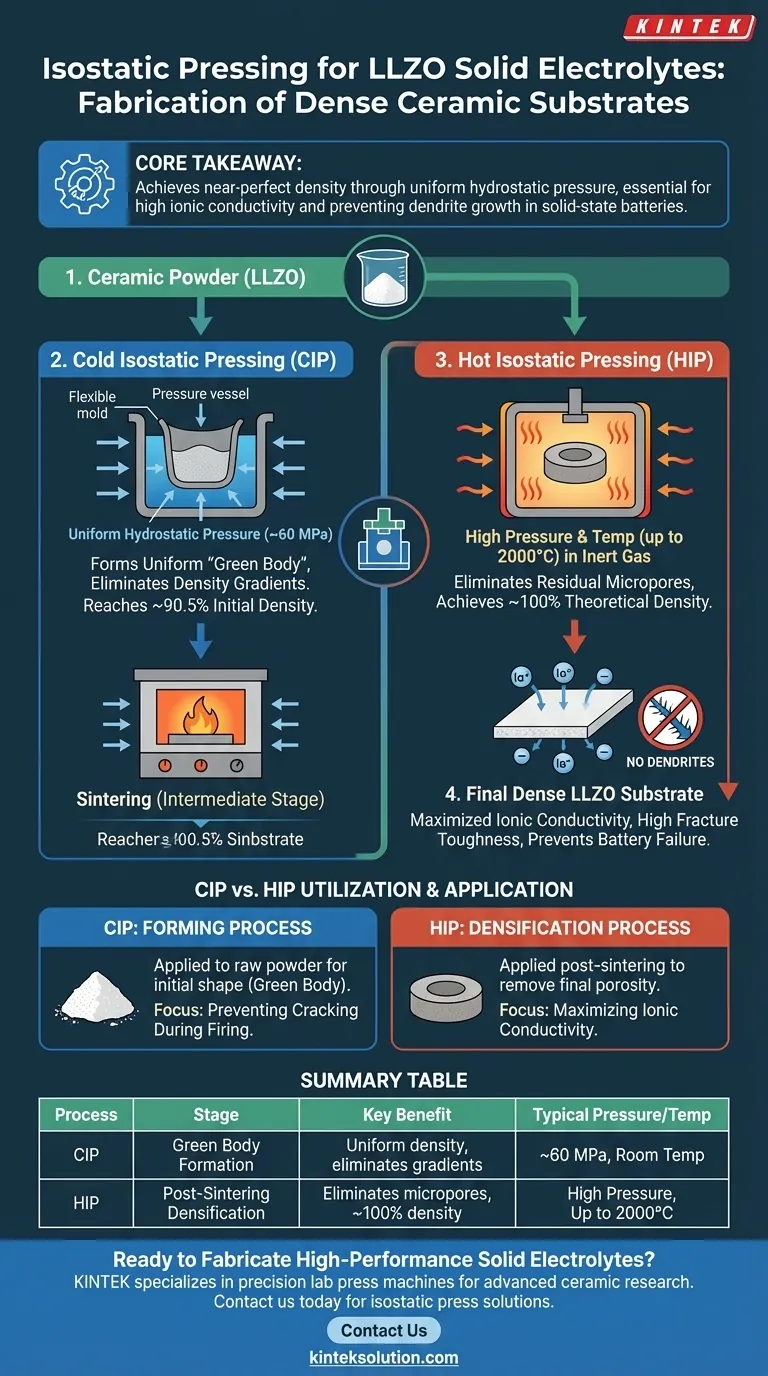
Visual Guide
Related Products
- Automatic Lab Cold Isostatic Pressing CIP Machine
- Electric Split Lab Cold Isostatic Pressing CIP Machine
- Electric Lab Cold Isostatic Press CIP Machine
- Manual Cold Isostatic Pressing CIP Machine Pellet Press
- Lab Isostatic Pressing Molds for Isostatic Molding
People Also Ask
- What are the key features of automated laboratory Cold Isostatic Press (CIP) systems? Achieve Precise, High-Pressure Powder Consolidation
- Why is an Isostatic Press (CIP) Necessary After Uniaxial Pressing? Achieve Transparency in Nd:Y2O3 Ceramics
- What is the primary function of a Cold Isostatic Press (CIP) in NASICON preparation? Achieve 96% Theoretical Density
- How does a Cold Isostatic Press (CIP) facilitate the preparation of CaO-doped silicon carbide (SiC) green bodies?
- How does a Cold Isostatic Press (CIP) increase Bi-2223/Ag current density? Boost Superconductivity with Uniform Pressure










