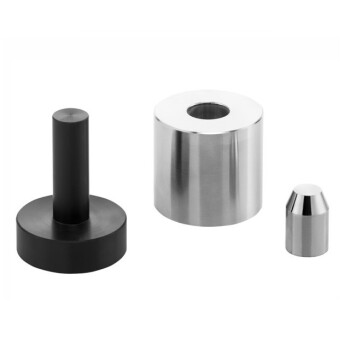
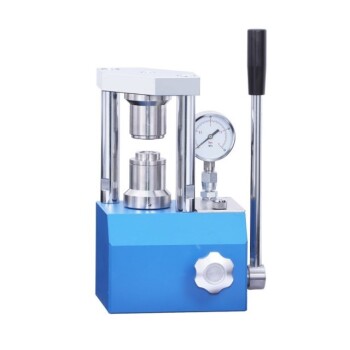
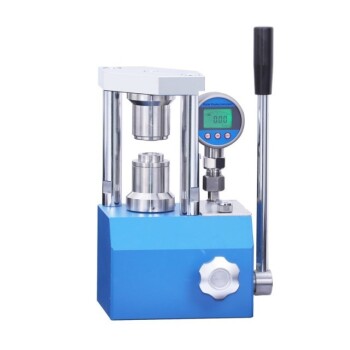
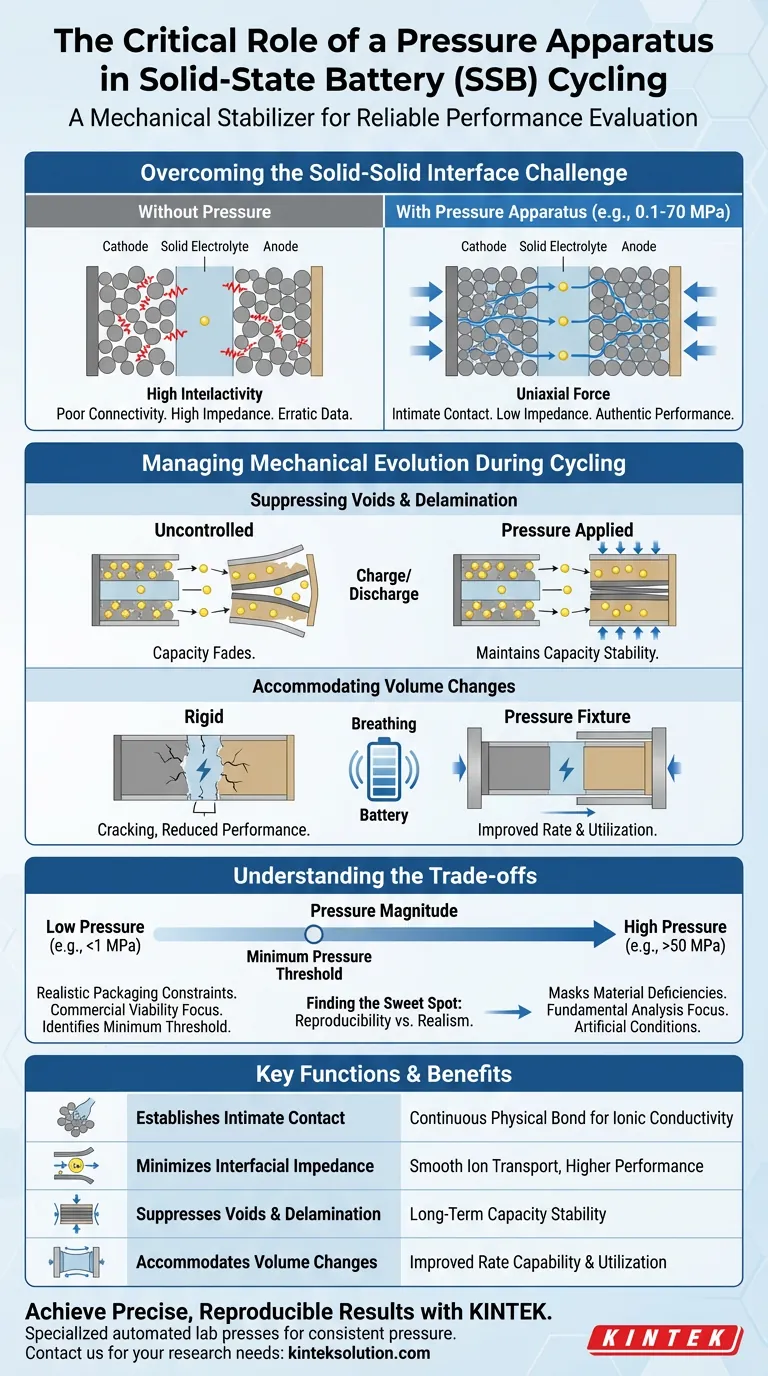
A pressure apparatus functions as a critical mechanical stabilizer within a solid-state battery testing system, applying precise, uniaxial force to maintain physical continuity between rigid cell components. By simulating various packaging conditions—typically ranging from 0.1 MPa to over 70 MPa—it forces the cathode, solid electrolyte, and anode into intimate contact, ensuring the ionic conductivity necessary to evaluate true electrochemical performance.
Unlike liquid electrolytes that naturally wet surfaces, solid-state batteries rely entirely on external force to bridge the gaps between particles. The pressure apparatus is not just a holder; it is an active variable that suppresses void formation and minimizes interfacial resistance, allowing researchers to determine the minimum pressure threshold required for stable, long-term cycling.
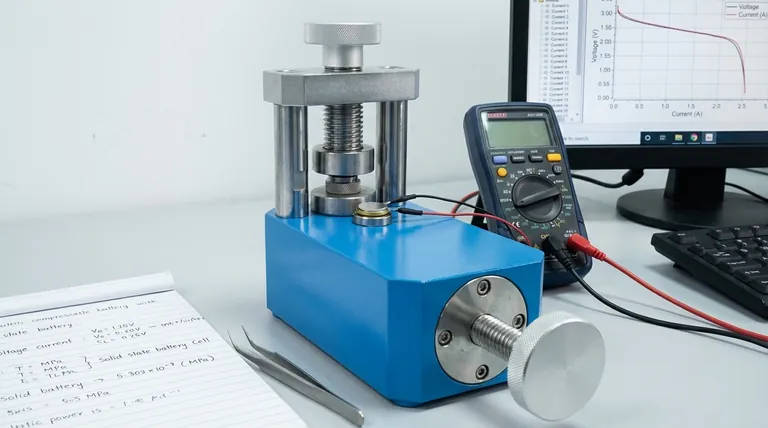
Overcoming the Solid-Solid Interface Challenge
Establishing Intimate Particle Contact
In solid-state batteries (SSBs), the internal interfaces are rigid. Without external force, the particles of the cathode, solid-state electrolyte, and anode barely touch, leading to poor connectivity.
A pressure apparatus applies a constant, uniform stack pressure to force these layers together. This ensures that the solid particles establish a continuous physical bond, which is the foundational requirement for the battery to function at all.
Minimizing Interfacial Impedance
Physical gaps between layers act as barriers to ion movement. These gaps result in high interfacial resistance (impedance), which severely degrades battery performance.
By creating a low-impedance solid-solid interface, the pressure apparatus facilitates the smooth and rapid transport of lithium ions. This allows researchers to obtain authentic performance data that reflects the material's chemistry rather than just poor assembly contact.
Managing Mechanical Evolution During Cycling
Suppressing Voids and Delamination
During the charge and discharge process (cycling), lithium is stripped from the anode, which can leave behind physical gaps or "voids."
The pressure apparatus counteracts this by maintaining compression on the stack. This applied pressure suppresses the formation of interfacial voids and prevents the layers from delaminating, which helps maintain the battery's capacity stability over time.
Accommodating Volume Changes
Active materials, such as specific cathodes (e.g., Nb2O5) or anodes, experience significant expansion and contraction during cycling.
A specialized testing fixture actively accommodates these volume changes while maintaining tight contact. By preventing the formation of cracks caused by this "breathing" effect, the apparatus improves the battery's rate performance and capacity utilization.
Understanding the Trade-offs
The Search for the Minimum Threshold
While high pressure generally improves performance by smashing layers together, relying on excessive pressure (e.g., 50-75 MPa) can mask material deficiencies and is impractical for commercial applications.
The critical trade-off lies in finding the minimum pressure threshold. Researchers must use the apparatus to dial down the pressure systematically (e.g., from 4.9 MPa down to 0.8 MPa) to identify the lowest force required to maintain stability, rather than simply applying maximum force.
Data Reproducibility vs. Artificial Conditions
Testing without a pressure apparatus leads to erratic, noisy data because the contact points shift unpredictably. However, testing with too much pressure simulates a packaging environment that may not be feasible in a real electric vehicle pack.
The apparatus ensures reproducibility, but the data it generates must always be contextualized by the magnitude of pressure applied. A battery that only cycles well at extreme pressures may not be viable for practical use.
Making the Right Choice for Your Goal
To extract the most value from your testing setup, align your pressure strategy with your specific research objective:
- If your primary focus is Fundamental Material Analysis: Apply consistently high pressure to eliminate contact resistance variables and isolate the intrinsic electrochemical properties of your materials.
- If your primary focus is Commercial Viability: Focus on determining the minimum pressure threshold to understand if the cell can survive under realistic packaging constraints (low pressure).
By precisely controlling the mechanical environment, you transform pressure from a passive variable into a quantifiable metric of battery stability.
Summary Table:
| Function | Key Benefit |
|---|---|
| Establishes Intimate Particle Contact | Creates a continuous physical bond for ionic conductivity |
| Minimizes Interfacial Impedance | Reduces resistance, enabling smooth ion transport |
| Suppresses Voids and Delamination | Maintains capacity stability during cycling |
| Accommodates Volume Changes | Improves rate performance and capacity utilization |
Ready to achieve precise, reproducible results in your solid-state battery research?
KINTEK specializes in advanced laboratory equipment, including automated and heated lab presses designed to deliver the consistent, uniform pressure required for reliable battery testing. Our solutions help you accurately simulate packaging conditions and determine critical performance thresholds.
Contact our experts today to find the perfect pressure apparatus for your specific research goals, from fundamental material analysis to commercial viability studies.
Visual Guide
Related Products
- Warm Isostatic Press for Solid State Battery Research Warm Isostatic Press
- Laboratory Hydraulic Press Lab Pellet Press Button Battery Press
- Lab Infrared Press Mold for Laboratory Applications
- Button Battery Sealing Press Machine for Lab
- Lab Cylindrical Press Mold for Laboratory Use
People Also Ask
- Why must composite cathodes be sealed in vacuum lamination bags for WIP? Ensure Battery Stability and Density
- What is the function of elastic molds in warm isostatic pressing? Achieve Uniform Density in Composite Particles
- How do sacrificial volume materials (SVM) maintain microchannels in isostatic pressing? Ensure Structural Integrity
- What is the function of hydraulic pressure in warm isostatic pressing? Achieve Uniform Material Density
- What is the process involved in warm isostatic pressing? Mastering Uniform Density with WIP Technology