
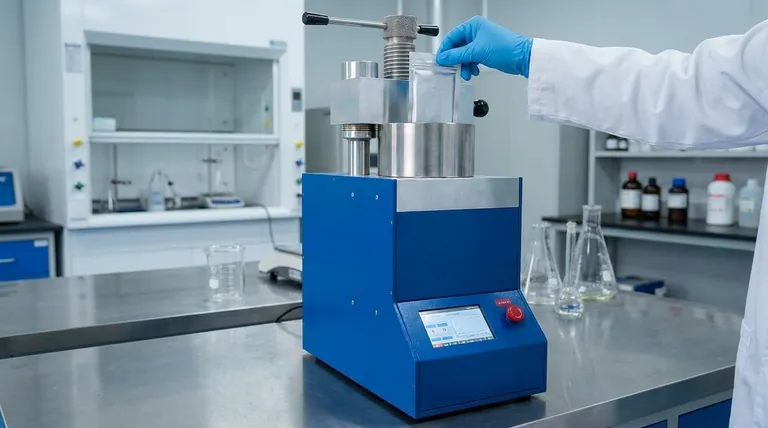
The primary specific function of using a Cold Isostatic Press (CIP) in the fabrication of Li-Lu-Zr-Cl based all-solid-state pouch cells is to create intimate, void-free contact between the solid electrode and electrolyte layers. By applying high, uniform pressure from all directions, the CIP process physically densifies the cell stack, ensuring the solid-solid interfaces are cohesive enough to facilitate efficient ion transport.
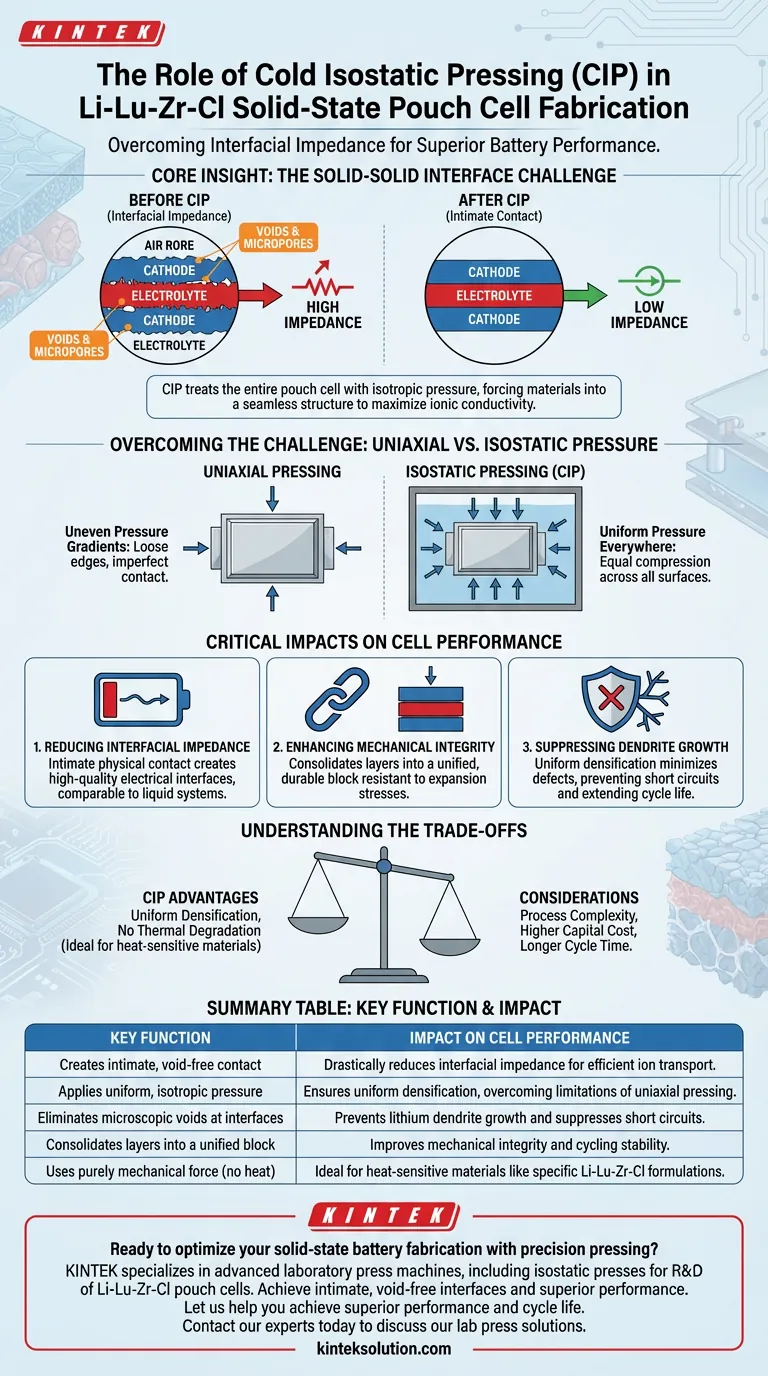
Core Insight The fundamental challenge in solid-state batteries is "interfacial impedance"—the resistance caused by microscopic gaps between rigid components. CIP solves this by treating the entire pouch cell with isotropic pressure, forcing materials into a seamless structure to maximize ionic conductivity and cycling stability.
Overcoming the Solid-Solid Interface Challenge
The Limits of Uniaxial Pressing
Standard pressing methods often apply force in only one direction (uniaxial). In complex multi-layered pouch cells, this can lead to pressure gradients where the edges or specific internal regions remain loosely packed.
The Isostatic Advantage
CIP utilizes a liquid medium to transmit pressure equally across every surface of the pouch cell. This ensures that the Li-Lu-Zr-Cl electrolyte layer and the composite cathode are compressed uniformly, regardless of slight variations in thickness or geometry.
Eliminating Microscopic Voids
The immediate goal of this pressure is to collapse internal micropores and voids located at the interfaces. These air gaps act as insulators that block lithium-ion movement; eliminating them creates a continuous path for ionic conduction.
Critical Impacts on Cell Performance
Reducing Interfacial Impedance
By forcing the electrode and the Li-Lu-Zr-Cl electrolyte into intimate physical contact, the contact resistance is drastically lowered. This creates a high-quality electrical interface comparable to those found in liquid electrolyte systems, which naturally wet the electrodes.
Enhancing Mechanical Integrity
The high pressure (often hundreds of MPa) effectively consolidates the layers into a unified block. This improves the mechanical strength of the cell, making it more durable and resistant to the physical stresses of expansion and contraction during cycling.
Suppressing Dendrite Growth
Uniform densification minimizes the structural defects where lithium dendrites typically nucleate. By creating a dense, defect-free electrolyte layer, the CIP process helps prevent short circuits and extends the operational life of the battery.
Understanding the Trade-offs
Process Complexity and Cost
Implementing CIP adds a distinct step to the manufacturing line requiring specialized high-pressure equipment. While it reduces waste by using raw materials efficiently, the initial capital investment and cycle time can be higher compared to simple calendering.
Thermal Considerations (CIP vs. WIP)
CIP relies purely on mechanical force, unlike Warm Isostatic Pressing (WIP) which introduces heat. While CIP avoids thermal degradation of heat-sensitive materials, it may require significantly higher pressures to achieve the same level of adhesion that WIP achieves at lower pressures.
Making the Right Choice for Your Goal
To maximize the effectiveness of your fabrication process, consider your specific performance targets:
- If your primary focus is minimizing internal resistance: Prioritize CIP parameters (pressure level and dwell time) that achieve maximum densification to ensure the lowest possible interfacial impedance.
- If your primary focus is material stability: Use CIP rather than hot pressing if your specific Li-Lu-Zr-Cl formulation or cathode binder is sensitive to the temperatures required for thermal bonding.
- If your primary focus is cycle life: Ensure the CIP process is applied to the final multi-layer stack to prevent delamination during the volume changes associated with long-term charging and discharging.
The success of a solid-state pouch cell relies not just on the chemistry of the Li-Lu-Zr-Cl electrolyte, but on the physical continuity of the assembly, which is definitively secured through cold isostatic pressing.
Summary Table:
| Key Function | Impact on Cell Performance |
|---|---|
| Creates intimate, void-free contact between layers | Drastically reduces interfacial impedance for efficient ion transport |
| Applies uniform, isotropic pressure from all directions | Ensures uniform densification, overcoming limitations of uniaxial pressing |
| Eliminates microscopic voids and pores at interfaces | Prevents lithium dendrite growth and suppresses short circuits |
| Consolidates layers into a mechanically strong, unified block | Improves mechanical integrity and cycling stability |
| Uses purely mechanical force (no heat) | Ideal for heat-sensitive materials like specific Li-Lu-Zr-Cl formulations |
Ready to optimize your solid-state battery fabrication with precision pressing?
KINTEK specializes in advanced laboratory press machines, including isostatic presses designed for R&D and small-scale production of next-generation batteries like Li-Lu-Zr-Cl pouch cells. Our equipment delivers the uniform, high-pressure conditions essential for creating the intimate, void-free interfaces your research demands.
Let us help you achieve superior performance and cycle life in your solid-state batteries. Contact our experts today to discuss how our lab press solutions can enhance your development process.
Visual Guide
Related Products
- Electric Lab Cold Isostatic Press CIP Machine
- Electric Split Lab Cold Isostatic Pressing CIP Machine
- Automatic Lab Cold Isostatic Pressing CIP Machine
- Manual Cold Isostatic Pressing CIP Machine Pellet Press
- Lab Isostatic Pressing Molds for Isostatic Molding
People Also Ask
- What role do electric lab cold isostatic presses play in industrial contexts? Bridge R&D and Manufacturing with Precision
- What are the applications of electric lab cold isostatic presses in research settings? Advance Material R&D with High-Pressure CIPs
- How does electrical Cold Isostatic Pressing (CIP) contribute to cost savings? Unlock Efficiency and Reduce Expenses
- What are some research applications of electric lab CIPs? Unlock Uniform Powder Densification for Advanced Materials
- What are the characteristics of standard off-the-shelf electric lab CIP solutions? Achieve Immediate, Cost-Effective Processing
















