
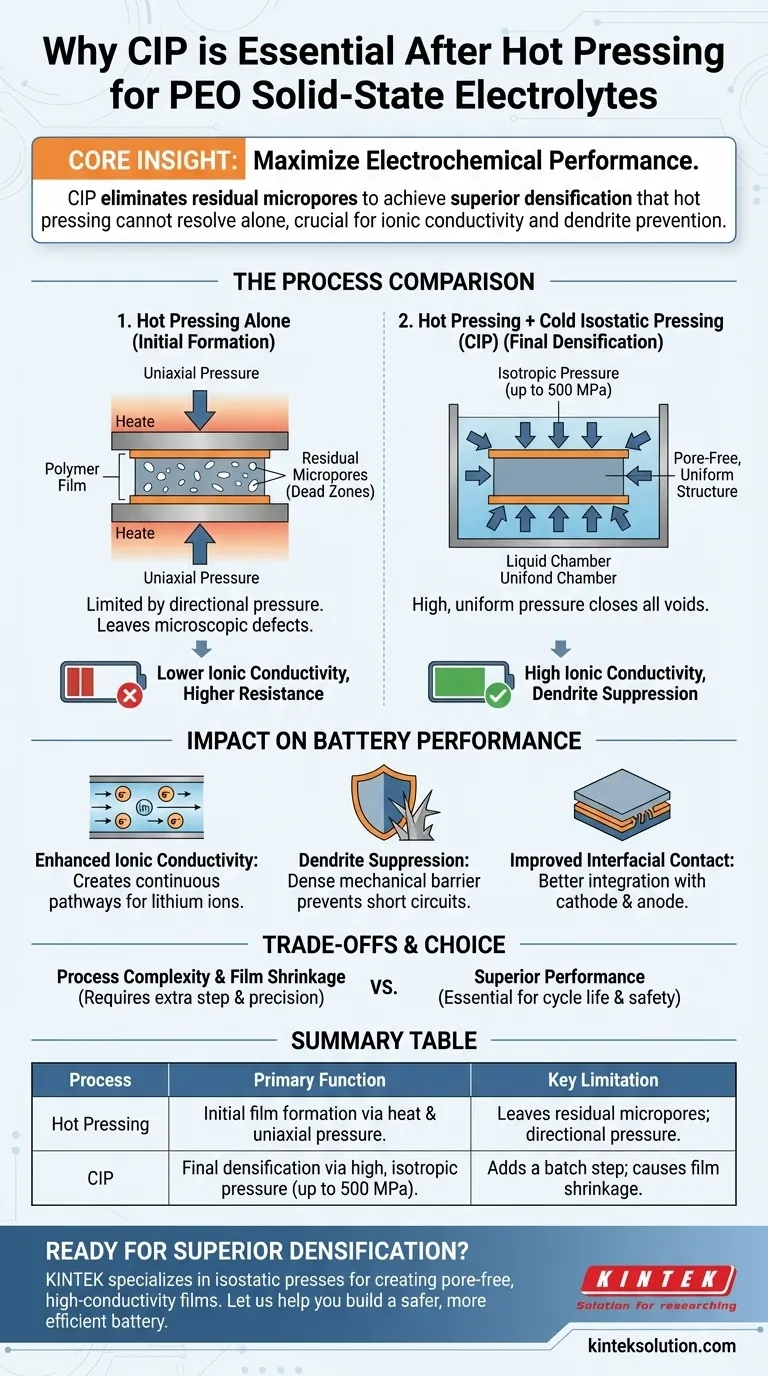
To maximize electrochemical performance, a Cold Isostatic Pressing (CIP) treatment is performed on previously hot-pressed PEO films to eliminate residual micropores and achieve superior densification. While hot pressing utilizes heat to soften the polymer and create the initial film structure, it is often limited by uniaxial pressure; CIP applies significantly higher, isotropic pressure to close microscopic voids that thermal treatment alone cannot resolve.
The Core Insight Hot pressing shapes the film through thermal flow, but often leaves microscopic defects due to pressure limitations. CIP acts as a secondary densification step, utilizing extreme hydrostatic pressure to create a void-free, uniform interface that is critical for preventing lithium dendrites and maximizing ionic conductivity.
The Limitations of Hot Pressing Alone
Uniaxial vs. Isotropic Pressure
Hot pressing applies pressure from two opposing directions (uniaxial). While effective for flattening the film and inducing polymer flow, this directionality can leave "shadowed" areas or uneven density distributions within the microstructure.
The Persistence of Micropores
Even when the PEO polymer is softened by heat, the pressure achievable in a standard hot press is often insufficient to collapse the smallest internal voids. These remaining micropores create "dead zones" where ions cannot travel, increasing the overall resistance of the electrolyte.
The Mechanism of Cold Isostatic Pressing (CIP)
High-Pressure Densification
CIP subjects the film to pressures significantly higher than standard hot pressing—often reaching up to 500 MPa. Because this pressure is transmitted through a liquid medium, it is applied equally from every direction (isostatically) rather than just top-down.
Eliminating the "Last Mile" of Defects
This immense, uniform pressure forces the material to consolidate further. It crushes remaining micropores and forces the solid electrolyte into intimate contact with any adjacent layers or particles.
Impact on Battery Performance
Enhanced Ionic Conductivity
By eliminating voids, CIP ensures a continuous pathway for lithium ions. A denser film translates directly to lower bulk resistance and higher ionic conductivity, which is the primary metric for electrolyte efficiency.
Suppression of Lithium Dendrites
Internal pores can act as nucleation sites or channels for lithium dendrites (metal spikes that cause short circuits). A highly densified, pore-free CIP-treated film offers superior mechanical strength and physical barriers that suppress dendrite growth, significantly improving battery safety.
Improved Interfacial Contact
CIP is particularly effective for multi-layer integration. It ensures the PEO electrolyte maintains perfect physical contact with the cathode and anode, reducing interfacial resistance which is often the bottleneck in solid-state battery performance.
Understanding the Trade-offs
Process Complexity vs. Performance
While CIP yields a superior material, it introduces an additional batch processing step into the manufacturing line. This increases production time and requires specialized high-pressure equipment distinct from the initial film-forming machinery.
Dimensional Changes
Because CIP induces significant densification, the film will undergo shrinkage. This dimensional change is generally predictable, but it requires precise calculation during the initial hot-pressing stage to ensure the final product meets target thickness specifications.
Making the Right Choice for Your Goal
While hot pressing is sufficient for forming the film, CIP is the defining step for high-performance applications.
- If your primary focus is basic material characterization: Hot pressing alone may suffice to test the chemical stability of the PEO polymer itself.
- If your primary focus is maximizing cycle life and safety: You must employ CIP to eliminate porosity, as this is critical for stopping dendrite penetration.
- If your primary focus is lowering cell impedance: Use CIP to maximize interfacial contact and ensure the highest possible ionic conductivity.
Ultimately, CIP transforms a structurally adequate film into an electrochemically superior component capable of meeting the rigorous demands of solid-state batteries.
Summary Table:
| Process Step | Primary Function | Key Limitation |
|---|---|---|
| Hot Pressing | Initial film formation via heat and uniaxial pressure. | Leaves residual micropores; pressure is directional. |
| Cold Isostatic Pressing (CIP) | Final densification via high, isotropic pressure (up to 500 MPa). | Adds a batch processing step; causes film shrinkage. |
| Combined Effect | Creates a dense, void-free film ideal for high-performance solid-state batteries. | Increases process complexity and cost. |
Ready to achieve superior densification for your solid-state battery research?
The performance of your PEO-based electrolytes hinges on eliminating the microscopic defects that hot pressing alone cannot resolve. KINTEK specializes in precision lab press machines, including isostatic presses designed for exactly this kind of critical R&D. Our equipment helps researchers like you create pore-free, high-conductivity films that maximize ionic conductivity and suppress dendrite growth.
Let us help you build a safer, more efficient battery.
Contact our experts today to discuss how our isostatic presses can enhance your lab's capabilities and accelerate your development cycle.
Visual Guide
References
- Benoît Denis Louis Campéon, Naoaki Yabuuchi. Virtues of Cold Isostatic Pressing for Preparation of All‐Solid‐State‐Batteries with Poly(Ethylene Oxide). DOI: 10.1002/cssc.202301054
This article is also based on technical information from Kintek Solution Knowledge Base .
Related Products
- Electric Lab Cold Isostatic Press CIP Machine
- Electric Split Lab Cold Isostatic Pressing CIP Machine
- Automatic Lab Cold Isostatic Pressing CIP Machine
- Manual Cold Isostatic Pressing CIP Machine Pellet Press
- Lab Isostatic Pressing Molds for Isostatic Molding
People Also Ask
- What are the applications of electric lab cold isostatic presses in research settings? Advance Material R&D with High-Pressure CIPs
- What role do electric lab cold isostatic presses play in industrial contexts? Bridge R&D and Manufacturing with Precision
- How does electrical Cold Isostatic Pressing (CIP) contribute to cost savings? Unlock Efficiency and Reduce Expenses
- What are some research applications of electric lab CIPs? Unlock Uniform Powder Densification for Advanced Materials
- What are the characteristics of standard off-the-shelf electric lab CIP solutions? Achieve Immediate, Cost-Effective Processing
















