
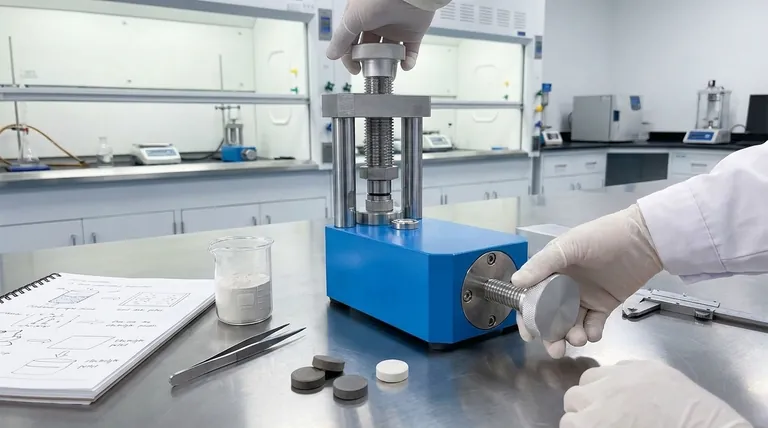
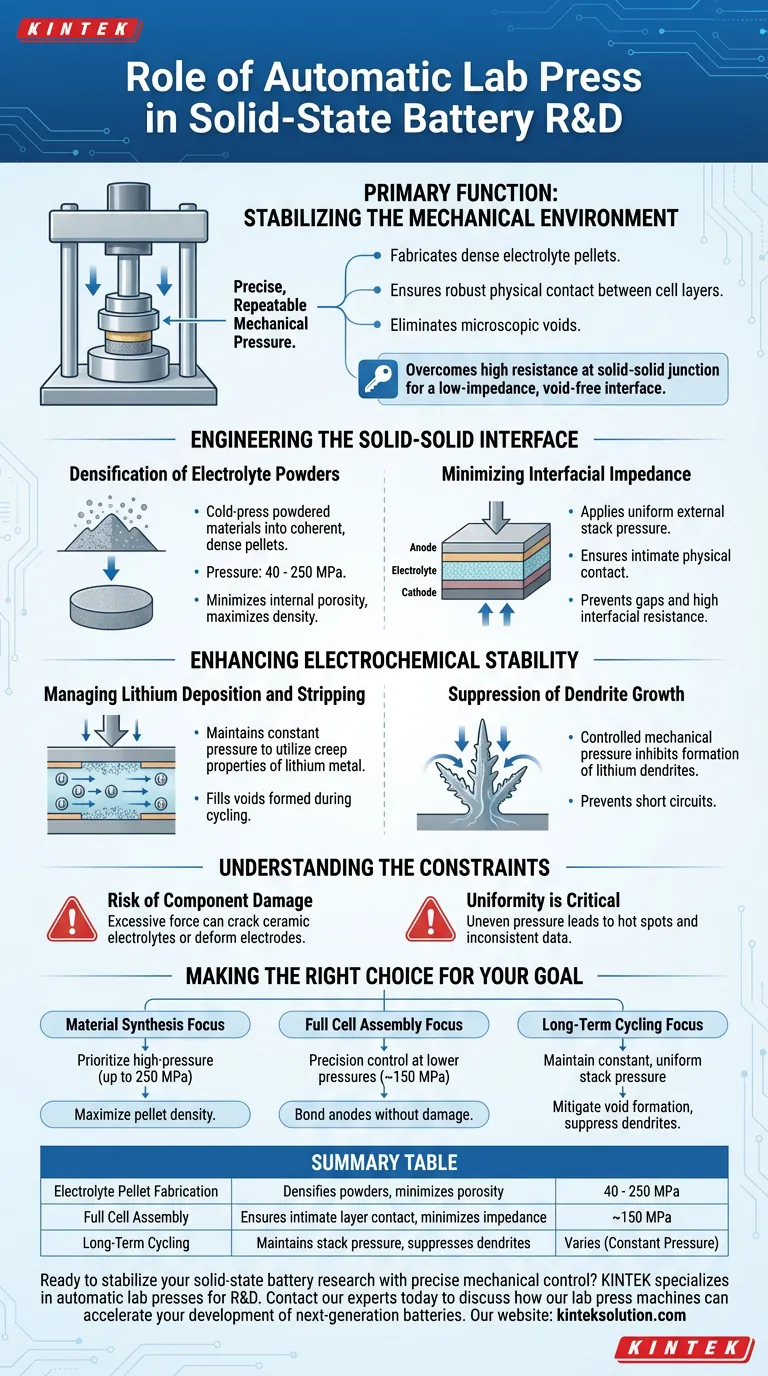
The primary function of an automatic laboratory press in solid-state battery research is to apply precise, repeatable mechanical pressure to fabricate dense electrolyte pellets and ensure robust physical contact between cell layers. This equipment transforms powdered materials into solid membranes and eliminates microscopic voids between components, which is the foundational requirement for ionic conductivity in solid-state systems.
In solid-state battery R&D, the greatest challenge is overcoming the high resistance found at the junction of two solid materials. The laboratory press solves this by creating a low-impedance, void-free interface, which is essential for stable electrochemical performance and the suppression of lithium dendrite growth.
Engineering the Solid-Solid Interface
The transition from liquid to solid electrolytes introduces a mechanical challenge: solids do not naturally flow to fill gaps. The laboratory press bridges this gap through two critical mechanisms.
Densification of Electrolyte Powders
The press is utilized to cold-press powdered materials—such as ceramic or polymer electrolytes—into coherent, dense pellets.
By applying high pressure, typically ranging from 40 to 250 MPa, the press significantly reduces internal porosity.
This compaction maximizes the density of the pellet, creating continuous pathways for ions to travel through the material.
Minimizing Interfacial Impedance
Beyond fabrication, the press is critical during the assembly of the cathode, anode, and electrolyte layers.
It applies uniform external stack pressure to ensure intimate physical contact between these disparate layers.
Without this pressure, gaps at the interface act as barriers to ion flow, leading to high interfacial resistance that renders the battery inefficient or non-functional.
Enhancing Electrochemical Stability
Once the cell is fabricated, the role of the press extends to influencing the battery's behavior during operation and testing.
Managing Lithium Deposition and Stripping
During charge and discharge cycles, the movement of lithium ions can create physical voids at the interface as lithium is stripped away.
A laboratory press maintains constant pressure to utilize the creep properties of lithium metal, effectively pushing the metal to fill these voids as they form.
This ensures continuous contact is maintained throughout the battery's life cycle, preventing contact loss and resistance spikes.
Suppression of Dendrite Growth
The application of controlled mechanical pressure is a known method for inhibiting the formation of lithium dendrites.
Dendrites are needle-like structures that can puncture the electrolyte and cause short circuits; the press allows researchers to investigate how different pressure levels suppress this phenomenon.
Understanding the Constraints
While pressure is vital, it must be applied with extreme precision to avoid compromising the experiment.
The Risk of Component Damage
While high pressure (e.g., 250 MPa) is beneficial for density, excessive force during assembly can crack brittle ceramic electrolytes or deform soft electrode materials.
Uniformity is Critical
The press must deliver pressure that is perfectly uniform across the surface area of the pellet or cell.
Uneven pressure distribution can lead to localized "hot spots" of current density, resulting in inconsistent data or premature cell failure.
Making the Right Choice for Your Goal
Selecting the right parameters for your laboratory press depends heavily on the specific stage of your research pipeline.
- If your primary focus is Material Synthesis: Prioritize high-pressure capabilities (up to 250 MPa) to maximize pellet density and minimize internal porosity in the electrolyte.
- If your primary focus is Full Cell Assembly: Focus on precision control at lower pressures (around 150 MPa) to bond anodes like Lithium-Indium alloys without damaging the electrolyte layer.
- If your primary focus is Long-Term Cycling: Ensure the press can maintain a constant, uniform "stack pressure" to mitigate void formation and suppress dendrites over time.
Ultimately, the laboratory press is not just a fabrication tool; it is the primary instrument for stabilizing the mechanical environment required for solid-state ion transport.
Summary Table:
| Application | Key Function | Typical Pressure Range |
|---|---|---|
| Electrolyte Pellet Fabrication | Densifies powders, minimizes porosity | 40 - 250 MPa |
| Full Cell Assembly | Ensures intimate layer contact, minimizes impedance | ~150 MPa |
| Long-Term Cycling | Maintains stack pressure, suppresses dendrites | Varies (Constant Pressure) |
Ready to stabilize your solid-state battery research with precise mechanical control? KINTEK specializes in automatic lab presses designed for the exacting demands of battery R&D. Our equipment delivers the uniform, repeatable pressure you need to fabricate dense electrolyte pellets and ensure robust layer interfaces—critical for achieving high ionic conductivity and suppressing dendrites. Contact our experts today to discuss how our lab press machines can accelerate your development of next-generation batteries.
Visual Guide
Related Products
- Automatic Laboratory Hydraulic Press Lab Pellet Press Machine
- Automatic Laboratory Hydraulic Press for XRF and KBR Pellet Pressing
- Automatic Heated Hydraulic Press Machine with Hot Plates for Laboratory
- Automatic Heated Hydraulic Press Machine with Heated Plates for Laboratory
- Automatic Lab Cold Isostatic Pressing CIP Machine
People Also Ask
- What is the primary purpose of a manual lab hydraulic pellet press? Ensure Accurate Sample Prep for XRF and FTIR
- What is the primary purpose of manual lab hydraulic pellet presses? Achieve High-Precision Sample Preparation for Spectroscopy
- How does an automatic laboratory hydraulic press improve KBr pellet preparation? Achieve Precision IR Spectroscopy
- What are the advantages of using an automatic laboratory hydraulic press? Enhance Precision in Sample Preparation
- What are the technical advantages of an automatic laboratory hydraulic press for biomimetic surfaces?



















