
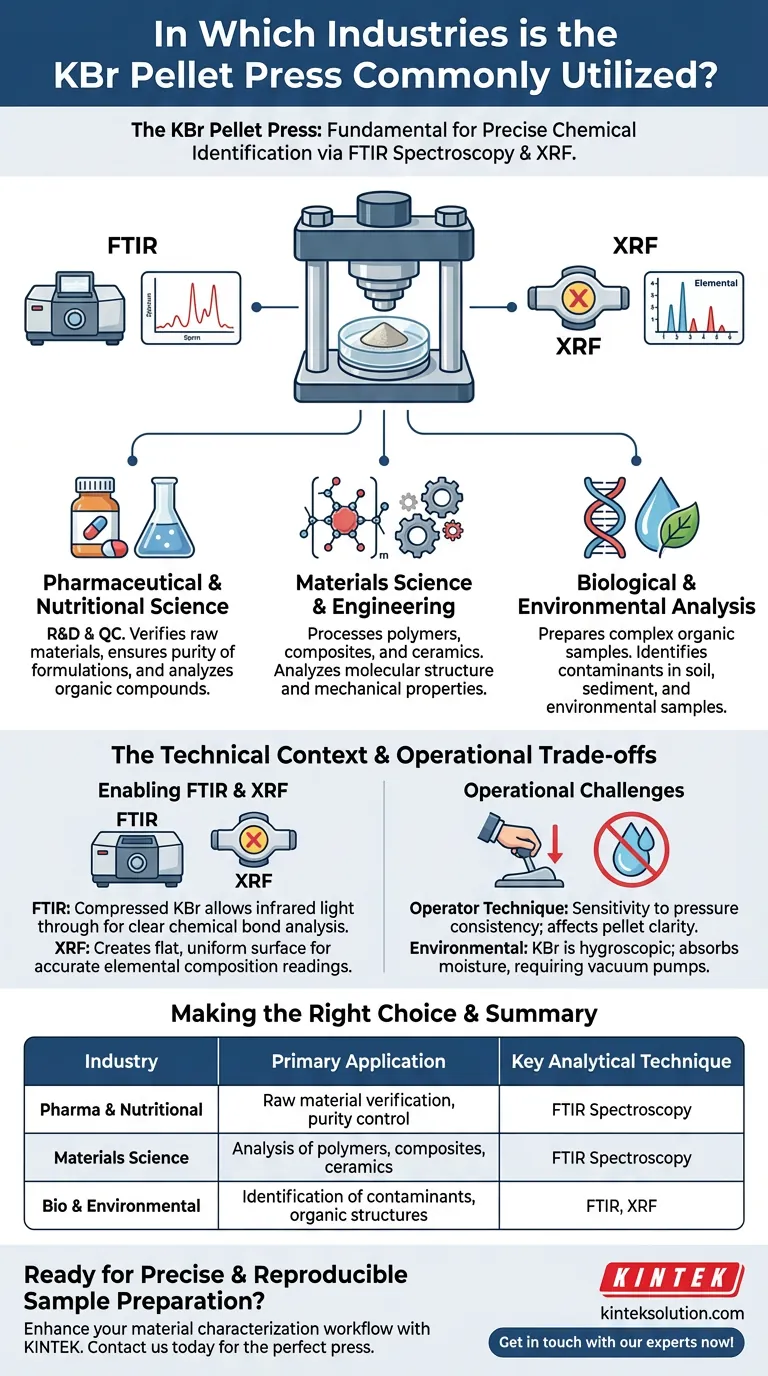
The KBr Pellet Press is a fundamental laboratory instrument primarily utilized in the pharmaceutical, biological, nutrition, and materials science industries. Its central function is to compress powder samples into transparent discs, enabling precise chemical identification via Fourier Transform Infrared (FTIR) spectroscopy and X-ray fluorescence (XRF).
The KBr Pellet Press is indispensable wherever material characterization is required. By producing homogeneous, transparent pellets, it allows researchers and quality control engineers to generate the accurate, reproducible spectral data necessary for verifying chemical composition and purity.
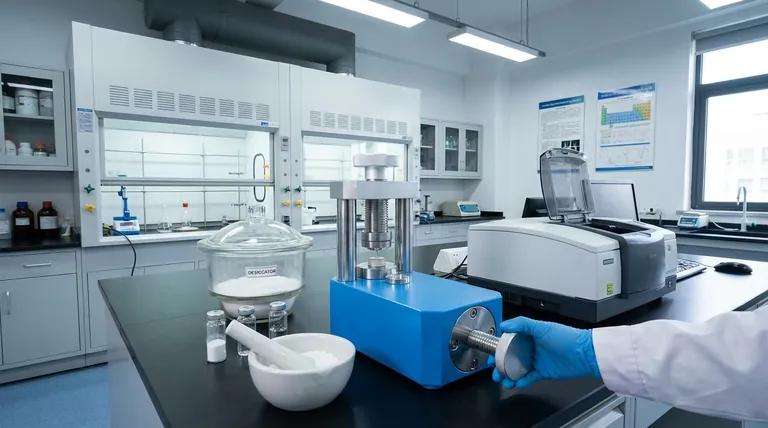
Key Industries Driving Demand
Pharmaceutical and Nutritional Science
The pharmaceutical industry relies heavily on the KBr press for both Research & Development (R&D) and Quality Control (QC). It is critical for verifying the identity of raw materials and ensuring the purity of final drug formulations. Similarly, in nutrition, it assists in the analysis of organic compounds and supplements to ensure consistency.
Materials Science and Engineering
In the development of advanced materials, the press is used to process polymers, composites, and ceramics. Researchers utilize the equipment to analyze the molecular structure of plastics or the curing process of composites. This ensures that materials meet specific mechanical and chemical standards before mass production.
Biological and Environmental Analysis
Biological research utilizes these presses to prepare samples for analyzing complex organic structures. Furthermore, environmental agencies employ the technology to identify contaminants. By compressing soil or sediment samples, analysts can detect pollutants and monitor environmental safety standards.
The Technical Context of Usage
Enabling FTIR Spectroscopy
The primary application of the KBr press is the preparation of samples for Fourier Transform Infrared (FTIR) analysis. Because Potassium Bromide (KBr) is transparent to infrared light, compressing a sample within KBr allows the spectrometer to "see" the chemical bonds clearly. This process ensures the acquisition of reliable analytical results.
Elemental Analysis via XRF
Beyond infrared spectroscopy, manual hydraulic pellet presses are widely used for X-ray fluorescence (XRF). This application focuses on elemental analysis rather than molecular structure. The press creates a flat, uniform surface essential for the X-ray detector to provide accurate readings of elemental composition.
Understanding the Operational Trade-offs
Sensitivity to Operator Technique
While the KBr press is a robust tool, the quality of the output depends heavily on the operator's consistency. If the mixture is not ground finely enough or if the pressure is applied unevenly, the resulting pellet may be cloudy. A cloudy pellet scatters light, resulting in poor spectral data and inaccurate analysis.
Environmental Vulnerabilities
Potassium Bromide is hygroscopic, meaning it absorbs moisture from the air. If the press is used in a humid environment without proper precautions, water bands will appear in the spectrum, obscuring the sample's data. Laboratories must often pair the press with vacuum pumps or desiccators to mitigate this issue.
Making the Right Choice for Your Goal
When integrating a KBr Pellet Press into your laboratory workflow, consider your specific analytical objectives to maximize utility.
- If your primary focus is Pharmaceutical QC: Prioritize a press known for high pressure consistency to ensure reproducibility across batches of medication.
- If your primary focus is Materials R&D: Look for a press capable of handling higher forces to effectively compress harder composites and ceramics.
- If your primary focus is Environmental Analysis: Ensure your setup includes vacuum capabilities to remove moisture from soil or organic samples during pressing.
The KBr Pellet Press remains the gold standard for producing the high-quality, transparent samples required for rigorous chemical and elemental analysis.
Summary Table:
| Industry | Primary Application | Key Analytical Technique |
|---|---|---|
| Pharmaceutical & Nutritional Science | Raw material verification, purity control of drug formulations | FTIR Spectroscopy |
| Materials Science & Engineering | Analysis of polymers, composites, and ceramics | FTIR Spectroscopy |
| Biological & Environmental Analysis | Identification of contaminants in soil/sediment, analysis of organic structures | FTIR, XRF |
Ready to achieve precise and reproducible sample preparation for your laboratory?
At KINTEK, we specialize in high-quality lab press machines, including automatic lab presses, isostatic presses, and heated lab presses designed to meet the rigorous demands of pharmaceutical, materials science, and environmental analysis. Our KBr Pellet Presses ensure the consistent pressure and reliability you need for accurate FTIR and XRF results.
Contact us today to find the perfect press for your application and enhance your material characterization workflow.
Get in touch with our experts now!
Visual Guide
Related Products
- Laboratory Hydraulic Press 2T Lab Pellet Press for KBR FTIR
- XRF KBR Plastic Ring Lab Powder Pellet Pressing Mold for FTIR
- XRF KBR Steel Ring Lab Powder Pellet Pressing Mold for FTIR
- Laboratory Hydraulic Pellet Press for XRF KBR FTIR Lab Press
- Automatic Laboratory Hydraulic Press for XRF and KBR Pellet Pressing
People Also Ask
- What is the role of a laboratory pressure machine and KBr in FTIR? Master Sample Preparation for Flame Retardants
- What is the role of a laboratory hydraulic press in high-loading NCM811 cathode prep for solid-state batteries?
- Why is a laboratory hydraulic press necessary for sample preparation? Precise Pelleting for Spiro Heterocyclic Analysis
- What role does a laboratory hydraulic press play in reaction pellets? Optimizing Lunar Soil and Metal Fuel Density
- Why is a laboratory hydraulic press necessary when preparing powder catalyst samples for SECM? Ensure Research Precision



















