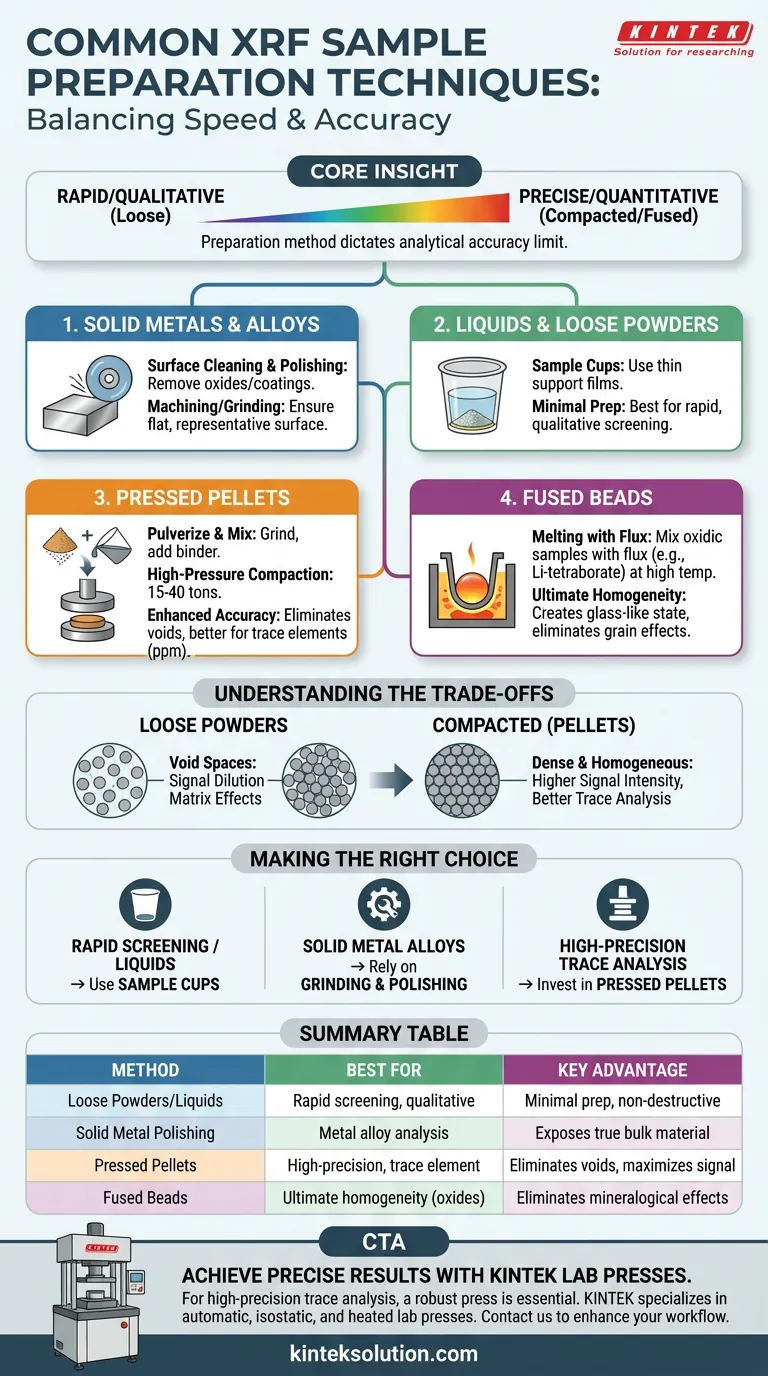
The most common sample preparation techniques for X-ray Fluorescence (XRF) range from simple non-destructive handling to complex chemical fusions depending on the required accuracy. Specifically, these methods include measuring loose powders or liquids in sample cups, polishing solid metal surfaces, compressing powders into dense pellets, and melting samples into fused beads.
Core Insight: The method of preparation dictates the limit of your analytical accuracy. While loose powders allow for rapid processing, they suffer from void spaces and signal dilution. To achieve precise quantitative results—especially for trace elements—you must use compaction (pellets) or fusion (beads) to create a homogeneous sample representation.
Preparing Solid Metals and Alloys
Surface Cleaning and Polishing
Direct analysis of solid samples, such as metal alloys, requires a pristine surface. You must clean the material to remove surface layers, such as oxides or protective coatings, which can skew results.
Machining and Grinding
Solid samples are ideally finished using machining or grinding methods. This ensures the surface is perfectly flat and provides a representative cross-section of the bulk material for the spectrometer.
Handling Liquids and Loose Powders
Using Sample Cups
For liquids, small particles, or loose powders, the standard method involves filling XRF sample cups. These cups are fitted with a thin support film designed to allow the X-ray beam to pass through with as little interaction as possible.
Minimal Preparation Approach
This technique is often categorized as "no preparation." It is best suited for scenarios where the sample cannot be altered or when rapid, qualitative screening is the priority over high-precision quantitative analysis.
Pressed Pellets for Enhanced Accuracy
Pulverizing and Mixing
To create a pressed pellet, the sample must first be milled or ground to a fine, consistent powder. While some powders are pressed alone, it is common to mix them with a binder, such as cellulose wax, to improve cohesion and durability.
High-Pressure Compaction
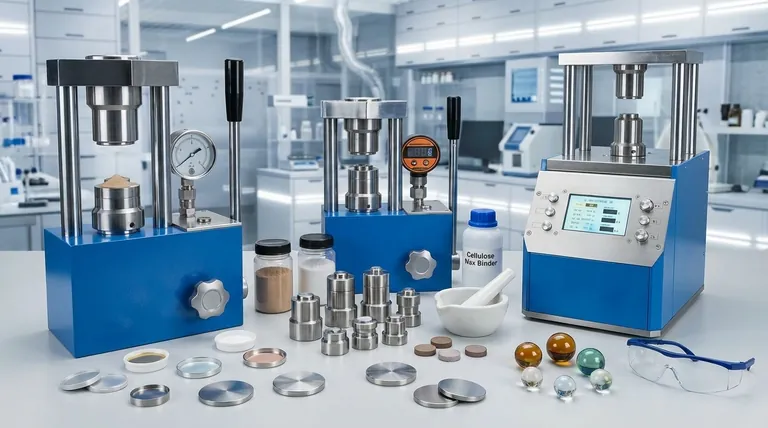
The powder mixture is placed into a die and compressed, typically at pressures between 15 and 40 tons. This process can be performed using manual, hydraulic, or automated presses depending on the volume of samples.
Mechanical Support Options
For samples that are difficult to bind or require extra stability, the powder can be pressed into an aluminum cup. This provides a rigid backing for the pellet, preventing breakage during handling and analysis.
Fused Beads for Homogeneity
Melting with Flux
This advanced technique involves mixing oxidic samples with a flux agent, such as lithium-tetraborate. The mixture is then melted at high temperatures.
Eliminating Grain Effects
The melting process creates a fused bead. By transforming the sample into a glass-like state, this method completely eliminates particle size effects and mineralogical heterogeneity, offering the highest level of homogeneity.
Understanding the Trade-offs: Loose vs. Compacted
The Problem with Void Spaces
Analyzing loose powders introduces significant matrix effects due to air gaps and void spaces between particles. These voids cause sample dilution and variations in the emission spectra, which impairs accuracy.
The Advantage of Density
Pressing a sample into a dense pellet eliminates these void spaces. This creates a more homogeneous representation of the material and mitigates the errors caused by surface variations and localized heterogeneities.
Sensitivity to Trace Elements
Compaction results in higher signal intensities for most elements. Therefore, pressed pellets are superior to loose powders when analyzing elements present in trace amounts (ppm range).
Making the Right Choice for Your Goal
Selecting the correct preparation method requires balancing the physical state of your sample against your need for analytical sensitivity.
- If your primary focus is rapid screening or liquid analysis: Use sample cups with support films to analyze the material with little to no modification.
- If your primary focus is analyzing solid metal alloys: Rely on grinding and polishing to remove surface oxides and expose the true bulk material.
- If your primary focus is high-precision trace analysis: Invest in pressed pellets to eliminate void spaces and maximize signal intensity.
The goal of all sample preparation is to present a surface to the spectrometer that is as close to a perfectly homogeneous representation of the bulk material as possible.
Summary Table:
| Preparation Method | Best For | Key Advantage |
|---|---|---|
| Loose Powders/Liquids | Rapid screening, qualitative analysis | Minimal preparation, non-destructive |
| Solid Metal Polishing | Metal alloy analysis | Exposes true bulk material |
| Pressed Pellets | High-precision, trace element analysis | Eliminates voids, maximizes signal |
| Fused Beads | Ultimate homogeneity for oxides | Eliminates mineralogical effects |
Achieve precise and reliable XRF results with the right lab press. The quality of your sample preparation directly impacts your analytical accuracy. For high-precision trace analysis, a robust press for creating consistent pellets is essential. KINTEK specializes in lab press machines, including automatic, isostatic, and heated lab presses, designed to meet the demanding needs of modern laboratories.
Let our expertise help you enhance your sample preparation workflow. Contact our team today to discuss your application and find the perfect press for your lab.
Visual Guide