
In the world of scientific research and quality control, a high-quality laboratory press is defined by its precision, reproducibility, and robust construction. The most notable features include precision-ground, temperature-controlled platens for uniform heat, advanced digital controls for pressure and temperature, and a rigid frame that ensures consistent results under load. These elements work in concert to deliver reliable and accurate outcomes for material testing, sample preparation, and lamination.
The defining characteristic of a superior lab press isn't just its power, but its ability to deliver that power with absolute precision and repeatability in both temperature and pressure. This ensures your results are scientifically valid and consistent every time.
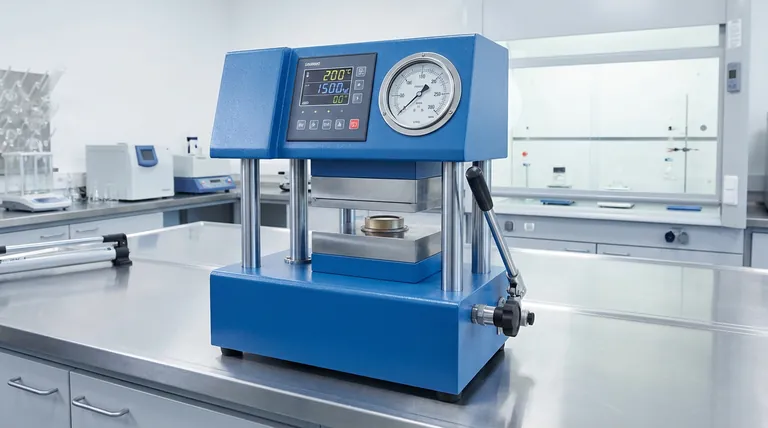
The Foundation: Precision Platens and Thermal Control
The platen system is the heart of any laboratory press. Its ability to manage heat and maintain its physical integrity under pressure directly impacts the quality of your work.
Uniform Temperature Distribution
High-end presses feature precision-ground steel platens that ensure perfectly parallel surfaces. This mechanical solidity guarantees uniform sample thickness and consistent closure force across the entire sample area.
This uniformity is critical for achieving reproducible sample characteristics, a non-negotiable demand for serious scientific research.
Advanced Temperature Control
Precision digital controllers allow for accurate and consistent heating, with typical ranges from 100°F to 600°F. This allows you to precisely manage processes like curing, melting, or bonding.
Top-tier models may also feature electrically cooled platens, enabling rapid cooling for processes that require specific thermal cycling profiles.
Serviceability and Longevity
Well-designed presses often include replaceable heating elements. This seemingly minor feature is a significant advantage, as it simplifies maintenance and extends the operational life of the equipment, representing a better long-term investment.
Achieving Force with Accuracy and Control
Applying the correct amount of force is fundamental, but how that force is applied, controlled, and sustained is what separates a basic press from a high-performance instrument.
Precise Pressure Application
A key feature is a unique dual-acting pump, which allows for rapid ram advance to close the daylight quickly, followed by a slower, more controlled application of high pressure.
This is often paired with a side-mounted release valve, giving the operator the ability to make micro-adjustments or release pressure with extreme precision.
Sustained Pressure Holding
For applications like curing composites or creating laminated structures, the ability to hold a set pressure for an extended period without deviation is crucial. High-quality hydraulic systems are designed to hold pressure for hours with minimal to no drop-off.
Versatility in Configuration
Superior presses often include a removable ram adaptor. Removing it increases the "daylight," or the maximum vertical working height, allowing the press to accommodate thicker molds or fixtures for a wider range of applications.
Modern Control and Usability Features
Modern lab presses integrate digital technology and thoughtful design to enhance repeatability, safety, and ease of use in a busy lab environment.
Programmable Controls and Data Logging
The most advanced presses feature programmable controls that allow you to define multi-step recipes involving specific temperatures, pressures, and durations.
Data logging capabilities are essential for quality control and research, providing a verifiable record of the exact parameters used for each sample. This is critical for validating results and meeting regulatory standards.
Ergonomics and Lab Footprint
Manufacturers of high-quality presses understand that lab space is a premium. These machines are often designed with a compact, benchtop footprint and engineered for quiet operation.
Optional pedestals are available to convert them to floor-standing models, offering flexibility in lab layout.
Understanding the Trade-offs
Choosing a press involves balancing capability with cost and complexity. Understanding the trade-offs is key to making an informed decision.
Manual vs. Automated Control
A simple manual press is cost-effective and straightforward, but its repeatability depends entirely on operator skill. An automated press with programmable controls offers unmatched consistency but comes at a higher price and requires more initial setup.
Required Tonnage vs. Precision
It can be tempting to opt for the highest tonnage available, but this is often unnecessary. The more important feature is how precisely that force can be controlled, especially at the lower end of the pressure range. A press that is precise at low pressures is often more valuable than one with a higher maximum force.
Heating vs. Heating and Cooling
If your process only requires heating and ambient air cooling, a standard press is sufficient. However, if your material requires rapid quenching or specific cooling rates to achieve desired properties, a press with integrated water or electric cooling is a necessity, though it represents a greater initial investment.
Making the Right Choice for Your Goal
Selecting the right press requires aligning its features with the specific demands of your work.
- If your primary focus is material science research: Prioritize a press with programmable controls, data logging, and exceptionally uniform temperature distribution for maximum reproducibility.
- If your primary focus is quality control and testing: Look for mechanical solidity, a certified pressure gauge, and the proven ability to hold pressure reliably to meet established testing standards.
- If your primary focus is general sample preparation or education: A durable, low-maintenance press with simple manual controls and robust safety features is the most practical and cost-effective choice.
A well-chosen laboratory press moves beyond being a simple tool to become a cornerstone of reliable and repeatable results.
Summary Table:
| Feature | Description |
|---|---|
| Precision Platens | Ensure uniform temperature and sample thickness for reproducible results. |
| Advanced Controls | Digital systems for accurate pressure and temperature management. |
| Rigid Frame | Provides stability and consistent performance under load. |
| Programmable Recipes | Allows multi-step processes with data logging for validation. |
| Versatile Configurations | Includes removable ram adaptors for varied application heights. |
Upgrade your laboratory with KINTEK's precision lab press machines! Whether you need an automatic lab press, isostatic press, or heated lab press, our equipment delivers unmatched accuracy, reproducibility, and durability for material testing, sample preparation, and more. Enhance your research and quality control outcomes—contact us today to discuss your specific needs and discover how we can support your laboratory's success!
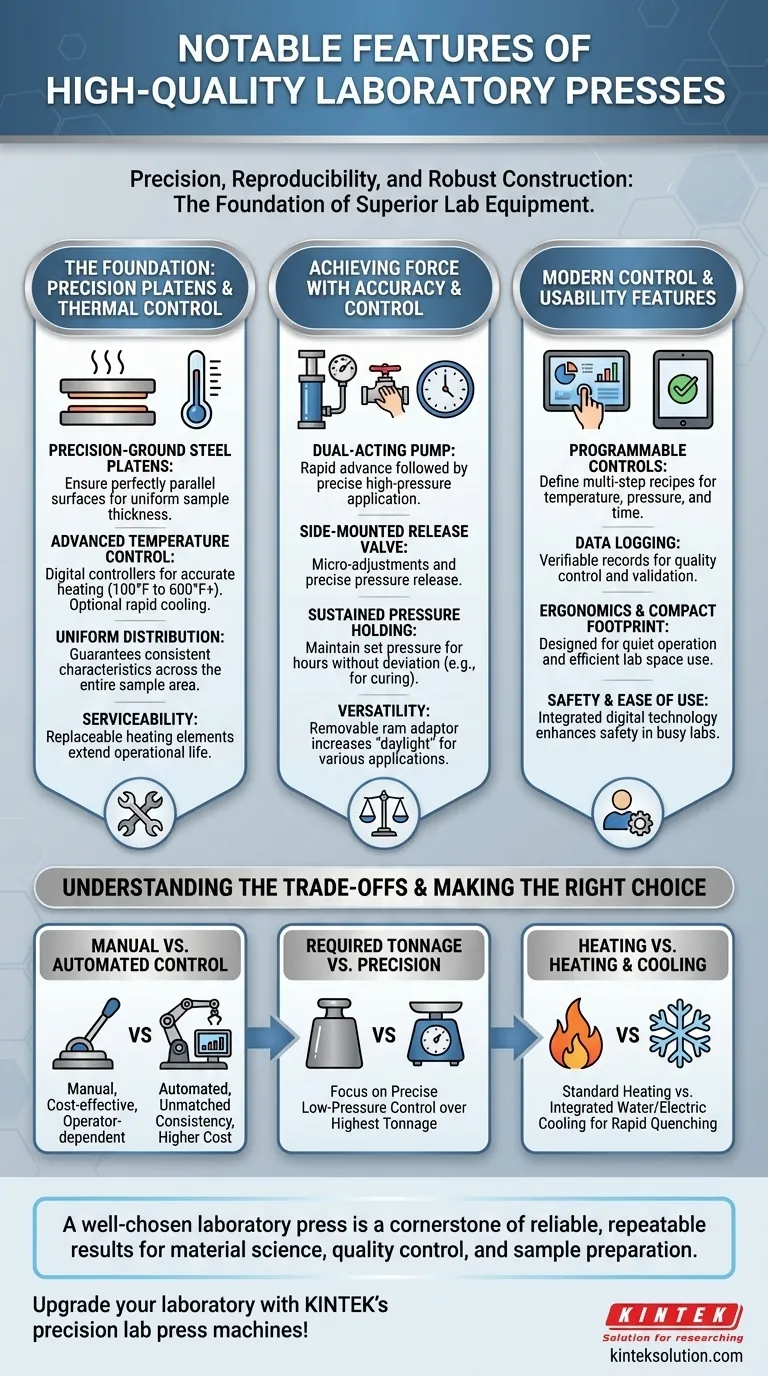
Visual Guide
Related Products
- Laboratory Hydraulic Press Lab Pellet Press Button Battery Press
- Laboratory Hydraulic Press 2T Lab Pellet Press for KBR FTIR
- Laboratory Hydraulic Press Lab Pellet Press Machine for Glove Box
- Laboratory Hydraulic Pellet Press for XRF KBR FTIR Lab Press
- Laboratory Split Manual Heated Hydraulic Press Machine with Hot Plates
People Also Ask
- How is a laboratory hydraulic press used for HAP composite gels? Master Mineral Substrate Standardization
- What role does a laboratory hydraulic press play in reaction pellets? Optimizing Lunar Soil and Metal Fuel Density
- What role does a laboratory hydraulic press play in the preparation of piezoelectric ceramic discs for DC-PG? | KINTEK
- Why is a laboratory hydraulic press required for PBAT and PLA sample preparation? Achieve Flawless Characterization
- What role does a laboratory hydraulic press play in the assembly of all-solid-state battery test cells? Expert Guide



















