
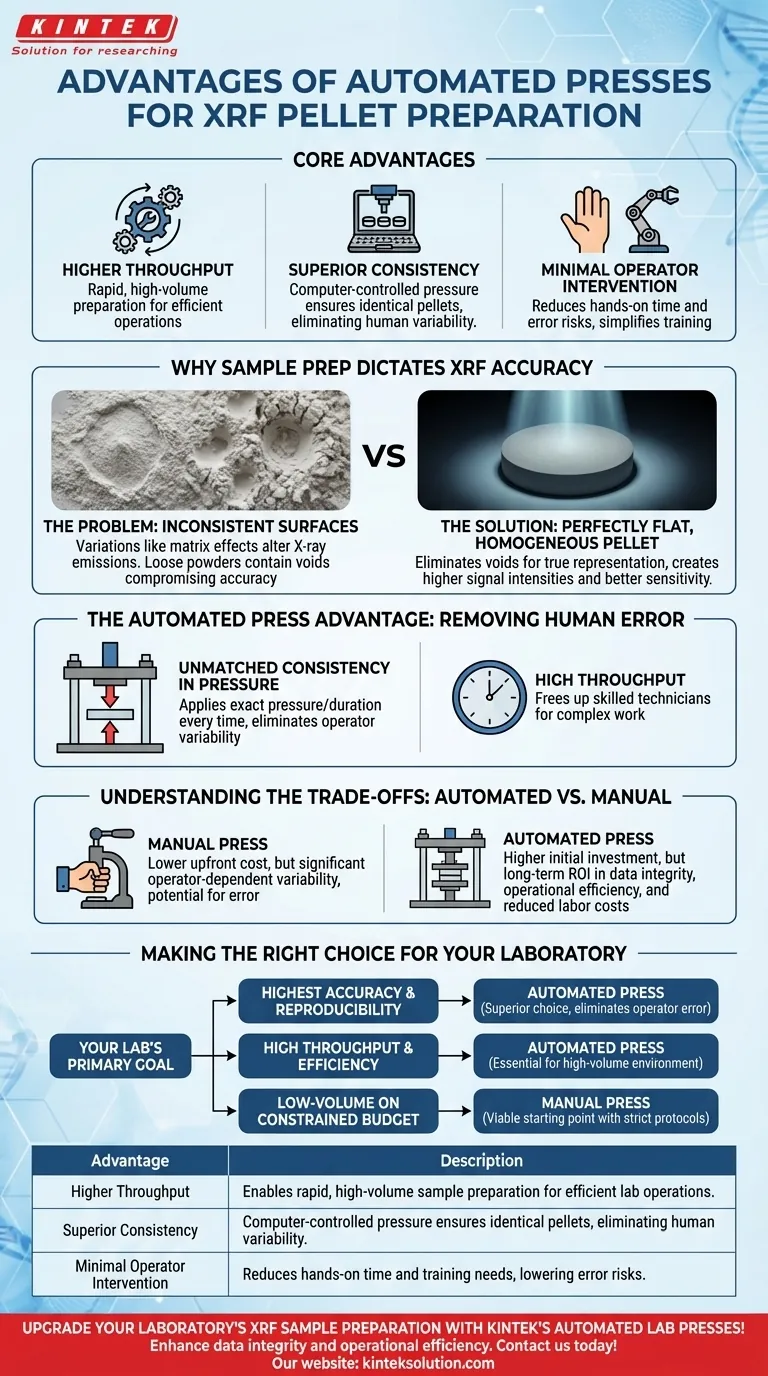
At their core, automated presses provide three primary advantages for X-Ray Fluorescence (XRF) pellet preparation: significantly higher throughput, superior consistency through computer-controlled pressure, and minimal need for operator intervention. This combination allows laboratories to produce a large volume of identical sample pellets efficiently and reliably.
The true value of an automated press is not merely speed, but its ability to eliminate the human variability inherent in manual methods. This guarantees a level of sample consistency that is fundamental to achieving accurate and reproducible XRF results.
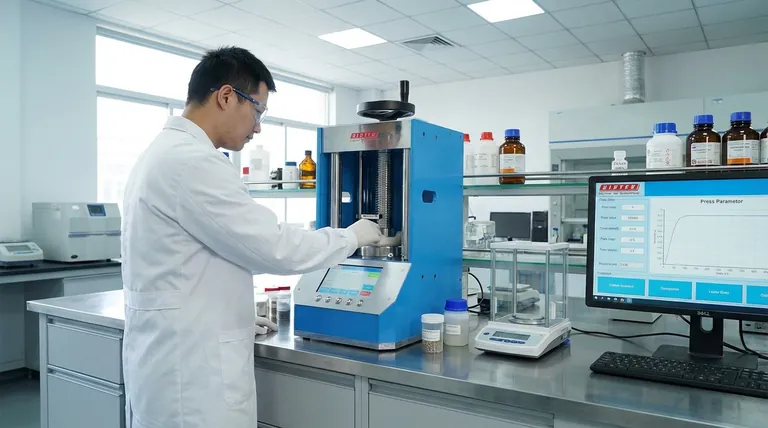
Why Sample Preparation Dictates XRF Accuracy
Before evaluating the press itself, we must understand why the pellet is so critical. The quality of your XRF analysis is determined long before the sample ever enters the spectrometer.
The Problem of Inconsistent Surfaces
XRF analysis is highly sensitive to the sample's surface. Variations in texture, density, or composition—known as matrix effects—can alter the X-ray emissions and corrupt your results.
An unprepared powder sample is filled with localized heterogeneities. A pressed pellet, by contrast, creates a perfectly flat, homogeneous surface that is the ideal representation of the bulk material.
Eliminating Voids for True Representation
Loose powders contain significant void spaces between particles. This inconsistency can lead to ineffective sampling by the X-ray beam, compromising the accuracy of the analysis.
Pressing the powder into a solid pellet eliminates these voids. This creates a dense, uniform sample that ensures the X-ray beam is analyzing the material itself, not empty space, leading to higher signal intensities and better sensitivity for trace elements.
The Automated Press Advantage: Removing Human Error
While any press is better than loose powder, an automated press solves the final variable in achieving perfect consistency: the operator.
Unmatched Consistency in Pressure
A hydraulic automated press is operated by a computer. It applies the exact same pressure, for the exact same duration, every single time.
This level of precision is impossible to replicate manually, where pressure can vary based on the operator's technique, strength, or fatigue. Automated consistency translates directly to analytical reproducibility.
High Throughput for Efficient Operations
For laboratories processing a high volume of samples, speed is a critical factor. Automated presses are designed for rapid, high-volume preparation.
This efficiency frees up skilled technicians from the repetitive task of manually pressing pellets, allowing them to focus on more complex analytical work.
Reduced Operator Intervention
Once a method is programmed, an automated press requires minimal hands-on time. This reduces the potential for human error and simplifies the training process for new personnel.
Understanding the Trade-offs: Automated vs. Manual
While automation offers clear advantages in data quality and efficiency, it is not the only option. Understanding the trade-offs is key to making an informed decision.
The Case for Manual Presses
The primary advantage of a manual press is its lower upfront cost. This makes it a suitable option for laboratories with smaller budgets or very low sample throughput requirements.
The Hidden Cost of Manual Methods
The lower cost of a manual press comes with a significant trade-off: operator-dependent variability. The consistency of the pellets relies entirely on the skill and diligence of the person operating the press.
This can introduce a subtle but significant source of error, potentially compromising the reliability of your final analytical data, especially when comparing results over time or between different operators.
The Investment in Automation
An automated press represents a higher initial investment. However, this cost should be weighed against the long-term return on investment in data integrity, operational efficiency, and reduced labor costs.
Making the Right Choice for Your Laboratory
Your decision should be guided by your lab's primary goals for accuracy, throughput, and budget.
- If your primary focus is the highest possible analytical accuracy and reproducibility: An automated press is the superior choice, as it eliminates operator variability as a source of error.
- If your primary focus is high sample throughput and operational efficiency: Automation is essential for meeting the demands of a high-volume environment while optimizing staff resources.
- If your primary focus is low-volume analysis on a constrained budget: A manual press can be a viable starting point, but you must implement strict protocols to minimize operator-induced inconsistencies.
Ultimately, investing in the right sample preparation tool is an investment in the integrity of your data.
Summary Table:
| Advantage | Description |
|---|---|
| Higher Throughput | Enables rapid, high-volume sample preparation for efficient lab operations. |
| Superior Consistency | Computer-controlled pressure ensures identical pellets, eliminating human variability. |
| Minimal Operator Intervention | Reduces hands-on time and training needs, lowering error risks. |
Upgrade your laboratory's XRF sample preparation with KINTEK's automated lab presses! Our advanced equipment, including automatic lab presses, isostatic presses, and heated lab presses, delivers unmatched consistency, high throughput, and reduced operator dependency to ensure accurate, reproducible results. Serving laboratories worldwide, we help you enhance data integrity and operational efficiency. Contact us today to discuss your needs and see how our solutions can benefit your lab!
Visual Guide
Related Products
- Automatic Laboratory Hydraulic Press for XRF and KBR Pellet Pressing
- Laboratory Hydraulic Pellet Press for XRF KBR FTIR Lab Press
- XRF KBR Plastic Ring Lab Powder Pellet Pressing Mold for FTIR
- Automatic Laboratory Hydraulic Press Lab Pellet Press Machine
- XRF KBR Steel Ring Lab Powder Pellet Pressing Mold for FTIR
People Also Ask
- Why is pressing powder into a pellet critical before sintering? Ensure Dense, Conductive Solid-State Electrolytes
- What is the role of a laboratory pressure machine and KBr in FTIR? Master Sample Preparation for Flame Retardants
- What are the advantages of using a laboratory automatic hydraulic press for HEA green compact forming?
- What are the advantages of using a lab automatic hydraulic press for HEA green body molding? Ensure Material Integrity
- What are the advantages of using an automatic laboratory hydraulic press? Enhance Precision in Sample Preparation



















