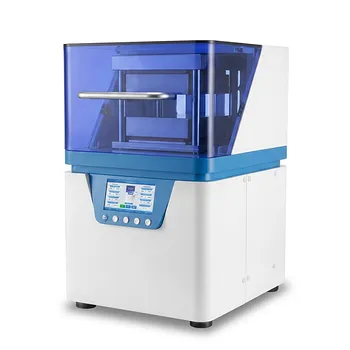
Hydraulic presses are defined by their ability to generate immense force output with relatively low energy input, offering a superior balance of power and precision compared to mechanical or pneumatic alternatives. They allow operators to maintain complete control over stroke speed, pressure, and position, making them uniquely suitable for heavy-duty applications requiring high consistency and safety.
The Core Takeaway While mechanical presses rely on momentum and pneumatic presses rely on air pressure, hydraulic presses utilize fluid mechanics to deliver consistent, controllable high-tonnage force. They are the optimal choice when your application requires deep material forming, holding pressure over time, or high safety standards without the massive footprint of traditional machinery.
The Mechanics of Force Generation
Immense Power with Efficiency
The most distinct advantage of a hydraulic system is the ratio of output force to input energy. These presses can generate significantly higher pressures—often in the region of 10,000 psi—compared to pneumatic systems, which typically top out around 100 psi.
Consistent Pressure Application
Unlike mechanical presses, which deliver force based on the position of a flywheel or crank, a hydraulic press applies full tonnage at any point in the stroke. This allows for "dwelling" or holding pressure on a material, which is critical for applications like laminating or hot embossing.
Precision and Operational Control
Granular Command of Movement
Operators are not limited to a fixed cycle. You can precisely control the ram speed, the specific pressure applied, and the length of the stroke. This flexibility ensures that delicate tasks can be performed without damaging the workpiece.
Programmable Automation
Modern electric hydraulic presses enhance this precision with programmable cycles. Users can set specific timers, create step functions for gradual load increases, and utilize auto top-up features to maintain consistent loads. This ensures high repeatability for laboratory sampling or industrial quality control.
Versatility and Design Benefits
Adaptability Across Materials
Because the pressure and tooling can be easily adjusted, a single hydraulic press can handle a wide spectrum of tasks. They are equally effective at simple pressing jobs as they are at complex molding, deep drawing, or creating thin polymer films.
Economical Footprint
Despite their high power, hydraulic presses often occupy less floor space than mechanical presses of comparable tonnage. Their design is economical with materials, making them a space-efficient solution for both industrial floors and smaller laboratories.
Safety and Durability
Intrinsic Safety Features
Hydraulic presses are generally safer than their mechanical counterparts because they are less prone to sudden, catastrophic structural failures. They are equipped with overload protection and pressure relief valves that prevent the machine from exceeding its rated pressure.
Low Maintenance Reliability
With fewer moving parts than mechanical systems, hydraulic presses are engineered for durability. They withstand heavy use and high-pressure conditions while generally requiring less maintenance, making them a cost-effective long-term investment.
Understanding the Trade-offs
Manual Effort vs. Automation
While standard manual hydraulic presses are cost-effective, they require physical effort from the technician. For high-volume environments, this can lead to fatigue. In these cases, opting for an electric version is necessary to gain the benefits of automated efficiency and reduced physical strain.
Space Considerations for Standard Units
While "mini" presses are available for benchtops, standard hydraulic units can still be substantial. It is vital to assess whether you need a compact lab unit or a full-sized industrial floor model, as the footprint varies significantly based on the tonnage capacity.
Making the Right Choice for Your Goal
To select the correct press for your needs, evaluate your primary operational constraints:
- If your primary focus is heavy-duty forming: Prioritize a hydraulic press for its ability to deliver consistent high pressure (10,000+ psi) throughout the entire stroke.
- If your primary focus is laboratory precision: Choose an electric hydraulic press with programmable cycles to ensure repeatability in sample preparation.
- If your primary focus is cost and simplicity: A manual hydraulic press offers the same force benefits and durability but requires more operator effort and offers less automation.
Ultimately, the hydraulic press is the superior choice when your project demands high tonnage and precise control in a safe, reliable package.
Summary Table:
| Feature | Hydraulic Press | Mechanical Press | Pneumatic Press |
|---|---|---|---|
| Force Application | Constant tonnage throughout stroke | Peaks at bottom of stroke | Limited to air pressure |
| Pressure Control | Highly precise & programmable | Fixed by flywheel/crank | Moderate |
| Max Pressure | Very High (10,000+ psi) | High (impact-based) | Low (~100 psi) |
| Versatility | Excellent (forming, molding, laminating) | Limited (stamping, punching) | Low (light assembly) |
| Safety | High (overload protection valves) | Lower (risk of structural failure) | Moderate |
Elevate Your Laboratory Precision with KINTEK
At KINTEK, we specialize in comprehensive laboratory pressing solutions designed to meet the rigorous demands of modern research. Whether you are conducting battery research or material characterization, our diverse range of equipment provides the reliability you need.
Our value to you:
- Versatile Model Range: Choose from manual, automatic, heated, and multifunctional presses.
- Specialized Applications: Explore glovebox-compatible models and advanced cold/warm isostatic presses.
- Unmatched Control: Achieve high repeatability with programmable cycles and consistent tonnage.
Ready to optimize your lab’s efficiency? Contact our experts today to find the perfect pressing solution for your application.
Related Products
- Automatic Hydraulic Hot Press with Large Plate and Precision Temperature Control for Advanced Material Sample Preparation and Industrial Research
- Automatic Hydraulic Heat Press Machine with Multi Stage Programmable Control and Integrated Water Cooling Plate Size 180x180mm
- Automatic High Temperature Heated Hydraulic Press Machine with Heated Plates for Lab
- Automatic Heated Hydraulic Lab Press with Programmable Touch Screen Controls and Precision Temperature Regulation
- Manual Heated Hydraulic Lab Press with Integrated Hot Plates Hydraulic Press Machine
People Also Ask
- What are the specific features and applications of hydraulic hot press machines? Precision Solutions for Modern Labs
- How does an automatic hydraulic press operate? Achieve Precision and Consistency in Lab Pelleting
- What are the advantages and common applications of an automatic hydraulic press? Elevate Your Lab's Precision
- What is the technical significance of setting a precise dwell time? Achieve Peak Material Density and Stability
- When is an automatic hydraulic press more suitable than a manual press? Scale Your Lab with Precision & Speed