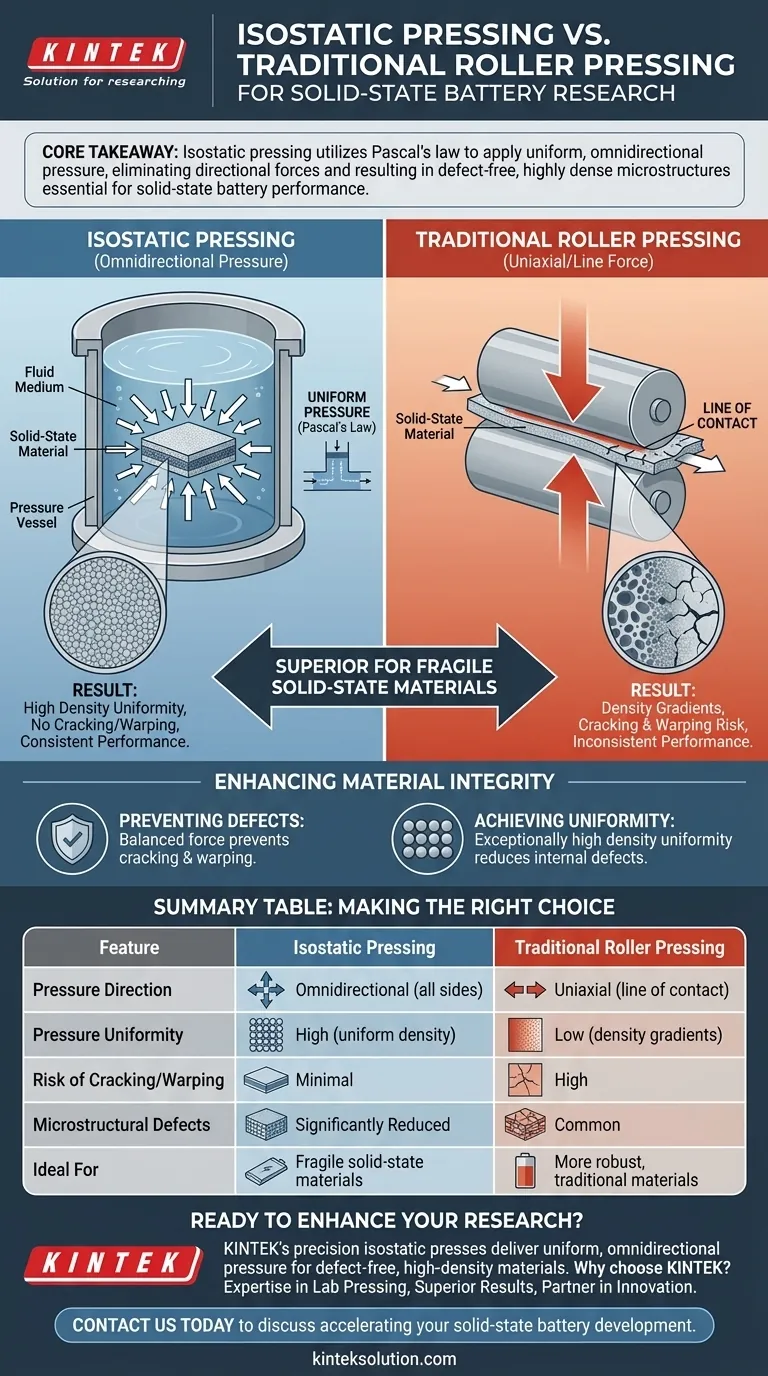
The primary advantage of using an isostatic press over traditional roller pressing is the application of uniform, omnidirectional pressure. While roller pressing creates directional stress along a specific line of contact, isostatic pressing utilizes a fluid medium to compress the sample equally from all sides. This fundamental difference is critical for solid-state battery research, as it minimizes the risk of warping and cracking while ensuring consistent material density.
Core Takeaway Traditional pressing methods often introduce internal stress and friction that compromise fragile solid-state materials. Isostatic pressing leverages Pascal’s law to eliminate these directional forces, resulting in a defect-free, highly dense microstructure that is essential for reliable battery performance.
The Mechanics of Pressure Application
Omnidirectional vs. Line Force
Traditional roller pressing applies force uniaxially or along a single line of contact. This often leads to uneven pressure distribution across the electrode sheet.
In contrast, isostatic pressing works by submerging the sample in a liquid medium, such as water or oil. The pressure is applied to the fluid, which then transfers that force equally to every surface of the sample simultaneously.
The Role of Pascal’s Law
The effectiveness of this method is rooted in Pascal’s law. This principle dictates that pressure applied to a confined fluid is transmitted undiminished in all directions.
By utilizing this physical law, researchers can completely bypass the mechanical friction limitations inherent in solid die or roller pressing.
Enhancing Material Integrity
Preventing Structural Defects
Solid-state battery components are often brittle and sensitive to stress. The uneven force distribution caused by line pressing can lead to significant internal stress.
This stress frequently manifests as cracking or warping of the material. Isostatic pressing effectively prevents these issues by ensuring the compactive force is perfectly balanced around the entire sample.
Achieving Microstructural Uniformity
Reliability in solid-state batteries depends heavily on the internal structure of the electrodes and electrolytes.
Isostatic pressing produces components with exceptionally high density uniformity. This reduction in internal defects is vital for ensuring the consistent electrochemical performance required in advanced battery research.
Understanding the Trade-offs: Why the Method Matters
The Limitation of Direct Contact
It is important to recognize why traditional methods fail in this specific context. Direct contact methods, like rolling or die pressing, rely on mechanical friction.
This friction creates gradients of density—some areas become highly compressed while others remain porous.
The Consequence of Non-Uniformity
In solid-state research, non-uniform density is a critical failure point. It creates pathways for dendrites or areas of high resistance.
While roller pressing is standard for traditional manufacturing, its inability to provide omnidirectional support makes it less suitable for the rigorous demands of densifying solid-state electrolytes and electrodes without damage.
Making the Right Choice for Your Research
When selecting a densification method for solid-state battery development, consider your specific fabrication goals.
- If your primary focus is maximizing component density: Isostatic pressing is the superior choice for achieving high density without introducing density gradients.
- If your primary focus is eliminating mechanical failure: Use isostatic pressing to apply stress-free force, effectively preventing the cracking and warping common with roller methods.
- If your primary focus is microstructure reliability: Choose isostatic pressing to ensure a uniform internal structure with minimal defects for consistent battery performance.
Adopting isostatic pressing shifts your process from a mechanical compromise to a physics-driven solution, ensuring the structural integrity necessary for successful solid-state battery innovation.
Summary Table:
| Feature | Isostatic Pressing | Traditional Roller Pressing |
|---|---|---|
| Pressure Direction | Omnidirectional (all sides) | Uniaxial (line of contact) |
| Pressure Uniformity | High (uniform density) | Low (density gradients) |
| Risk of Cracking/Warping | Minimal | High |
| Microstructural Defects | Significantly Reduced | Common |
| Ideal For | Fragile solid-state materials | More robust, traditional materials |
Ready to Enhance Your Solid-State Battery Research?
Achieving defect-free, high-density materials is critical for reliable battery performance. KINTEK's precision isostatic presses are engineered to provide the uniform, omnidirectional pressure your research demands, eliminating the cracking and density gradients common with traditional methods.
Why choose KINTEK?
- Expertise in Lab Pressing: We specialize in automatic lab presses, isostatic presses, and heated lab presses, designed specifically for advanced laboratory applications.
- Superior Results: Our technology ensures uniform microstructures essential for consistent electrochemical performance in solid-state batteries.
- Partner in Innovation: We provide the reliable tools you need to push the boundaries of battery research.
Contact us today using the form below to discuss how our isostatic presses can accelerate your solid-state battery development. Let's build the future of energy storage, together.
Visual Guide
Related Products
- Warm Isostatic Press for Solid State Battery Research Warm Isostatic Press
- Lab Isostatic Pressing Molds for Isostatic Molding
- Electric Lab Cold Isostatic Press CIP Machine
- Manual Cold Isostatic Pressing CIP Machine Pellet Press
- Automatic Lab Cold Isostatic Pressing CIP Machine
People Also Ask
- Why must composite cathodes be sealed in vacuum lamination bags for WIP? Ensure Battery Stability and Density
- What is the function of elastic molds in warm isostatic pressing? Achieve Uniform Density in Composite Particles
- How do sacrificial volume materials (SVM) maintain microchannels in isostatic pressing? Ensure Structural Integrity
- What is the role of the flexible material in warm isostatic pressing? Key to Uniform Density & Precision
- What is the significance of temperature control in Warm Isostatic Pressing? Unlock Uniform Densification and Process Stability