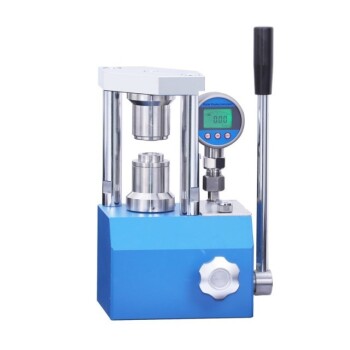
Squeeze casting significantly enhances material quality by applying high pressure within a metal mold while the A356/Al2O3 slurry solidifies. This process is essential for overcoming the two main defects in nanocomposites: it physically breaks up clustered nanoparticles and drastically reduces gas porosity to improve overall density.
By forcing the slurry to solidify under load, squeeze casting addresses the inherent challenges of processing A356/Al2O3 nanocomposites. It lowers porosity to below 2% and fractures nanoparticle agglomerates, resulting in a significantly denser and more uniform material.
The Mechanics of Structural Improvement
Reducing Gas Porosity
The primary advantage of squeeze casting is the significant reduction of voids within the material. By applying high pressure, the process compresses gas pockets that typically form during the semi-solid state.
According to the data, this technique effectively lowers the porosity of the final sample to below 2%. This is a critical threshold for ensuring high structural integrity in the cast part.
Breaking Up Agglomerates
Nanoparticles, such as Al2O3, have a natural tendency to clump together, or agglomerate, within the mixture. These clusters can create weak points in the final product.
The physical pressure exerted during squeeze casting helps to break up these nanoparticle agglomerates. This ensures a more homogeneous distribution of the reinforcement material throughout the aluminum matrix.
Maximizing Material Density
The combination of reduced porosity and improved particle dispersion leads to a direct increase in material density.
By forcing the slurry to solidify under load, the process creates a tighter microstructural grain. The result is a final component with significantly higher density compared to methods that do not apply external pressure during solidification.
Operational Considerations
Tooling Requirements
Unlike gravity-based casting methods, this process relies on specific hardware to generate the necessary force. It requires metal molds capable of withstanding high internal pressures.
Process Dependency
The effectiveness of this technique is entirely dependent on the application of load during the solidification phase. The pressure must be maintained until the material is set to achieve the density benefits described.
Making the Right Choice for Your Goal
To maximize the performance of your A356/Al2O3 nanocomposites, align your processing method with your specific quality targets:
- If your primary focus is Structural Integrity: Utilize squeeze casting to drive porosity levels below 2%, ensuring the material is dense and void-free.
- If your primary focus is Material Uniformity: rely on the high-pressure application to fracture nanoparticle agglomerates for an even distribution of Al2O3.
Squeeze casting is the definitive choice when high density and uniform particle dispersion are non-negotiable requirements.
Summary Table:
| Key Benefit | Improvement Mechanism | Outcome |
|---|---|---|
| Porosity Control | High-pressure compression of gas pockets | Porosity levels reduced to <2% |
| Particle Dispersion | Physical fracturing of Al2O3 clusters | Elimination of weak points/agglomerates |
| Microstructure | Load-applied solidification | Tighter grain structure and higher density |
| Component Quality | Uniform reinforcement distribution | Enhanced mechanical property consistency |
Precision Laboratory Solutions for Advanced Material Research
Maximize the structural integrity of your nanocomposites and battery materials with KINTEK. Whether you are working with A356/Al2O3 slurries or advanced energy storage components, our comprehensive laboratory pressing solutions provide the precise pressure control required for uniform density and superior material performance.
Our specialized lineup includes:
- Manual & Automatic Presses for versatile lab applications.
- Heated & Multifunctional Models for complex solidification studies.
- Cold & Warm Isostatic Presses (CIP/WIP) optimized for high-performance battery research.
- Glovebox-Compatible Systems for air-sensitive material processing.
Ready to elevate your material density and research outcomes? Contact KINTEK today to find your ideal pressing solution.
References
- E. Y. El-Kady, M. H. Abdelaziz. Dynamic Behaviour of Cast A356/Al<sub>2</sub>O<sub>3</sub> Aluminum Metal Matrix Nanocomposites. DOI: 10.4236/msa.2012.311118
This article is also based on technical information from Kintek Solution Knowledge Base .
Related Products
- Lab Cylindrical Press Mold for Laboratory Use
- Manual Laboratory Hydraulic Press Lab Pellet Press
- Lab Infrared Press Mold for No Demolding
- Laboratory Hydraulic Split Electric Lab Pellet Press
- Lab Button Battery Disassembly and Sealing Mold
People Also Ask
- What is the purpose of incorporating cartridge heaters into a lab press mold for MLCC block compression? Optimize Results
- What is the function of a pressing tool in thermoplastic panels? Master Precision Shaping & Fusion Bonding
- Why is precise cooling management of the lab press mold necessary? Protect Core Integrity in Thermoforming
- Why is a high-performance laboratory molding press critical for in-situ electrolyte formation? Unlock Battery Success
- How does the geometry of laboratory molds influence mycelium-based composites? Optimize Density and Strength