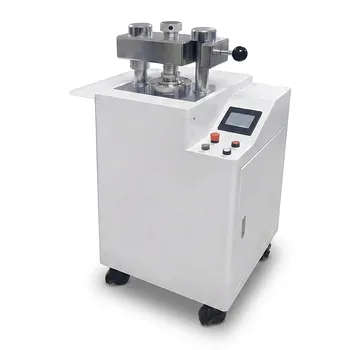
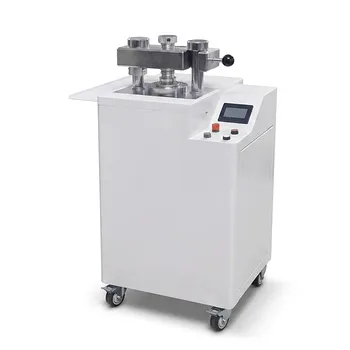
Laboratory press pellets serve critical roles in analytical chemistry and material science, functioning as the standard sample preparation method for ensuring consistent results. While their primary application is creating transparent discs for spectroscopic analysis (such as IR and X-ray), they are equally vital in pharmaceutical development, ceramic synthesis, and biomass energy research.
Core Takeaway
The fundamental purpose of a laboratory press is to transform loose, irregular powders into dense, uniform solids. By eliminating air gaps and creating a flat surface, these pellets ensure accurate data during analysis and efficient diffusion during chemical synthesis.
Applications in Analytical Spectroscopy
Infrared (IR) Spectroscopy
The most common use of a laboratory press is preparing samples for Infrared spectroscopy.
Compacting a mixture of sample powder and Potassium Bromide (KBr) creates a transparent pellet.
This transparency allows infrared light to pass through the sample with minimal scattering, providing a clear spectral reading.
X-Ray Spectroscopy
For X-ray fluorescence (XRF) and similar techniques, sample density is paramount.
Presses compact powder into flat discs to ensure the X-ray beam interacts with a uniform mass.
This consistency is required to quantify elemental composition accurately without data noise caused by loose particles.
Applications in X-Ray Diffraction (PXRD)
Ensuring Surface Uniformity
Powder X-Ray Diffraction (PXRD) requires the sample surface to be perfectly flat and even.
A press creates a dense pellet that allows X-rays to irradiate the surface uniformly.
Reducing Data Distortion
Loose powders can cause diffraction peak shifts or intensity distortions.
By standardizing the sample surface, pellets allow for the precise detection of subtle lattice parameter changes and verification of symmetry.
Applications in Material Science and Ceramics
Creating "Green Pellets"
In ceramic engineering, a "green pellet" is a compacted powder form created prior to high-temperature heating.
A uniaxial press applies specific pressure (e.g., 7 MPa) to create a specific shape with defined mechanical strength.
Enhancing Solid-State Diffusion
Compacting powders minimizes the gaps between individual particles.
This increased contact area facilitates efficient solid-state diffusion during sintering processes (often exceeding 1200 °C).
This leads to the production of dense, well-crystallized polycrystalline materials that are less prone to cracking.
Applications in Energy and Pharmaceuticals
Biomass Fuel Research
Researchers use hydraulic presses to compress biomass into high-density fuel pellets.
This increases energy density and volumetric stability, ensuring repeatable data during combustion or pyrolysis experiments.
Pharmaceutical Development
In drug formulation, laboratory presses mimic industrial tableting on a small scale.
They are used to form tablets to test dissolution rates, hardness, and durability before mass production.
Battery Electrolyte Development
Presses are used to compact powders like NZSP into solid electrolytes.
A well-formed pellet is essential for preventing macroscopic defects that could lead to failure during battery operation.
Understanding the Trade-offs
Density Gradients
Applying pressure from only one direction (uniaxial) can sometimes lead to uneven density within the pellet.
The edges may be denser than the center, which can result in warping during sintering.
Over-Pressing Risks
While density is the goal, excessive pressure can cause capping or lamination.
If the internal stress is too high, the pellet may fracture or crumble upon ejection from the die.
Contamination
The high pressure involved forces the sample against the die walls.
If the die is not perfectly clean, cross-contamination between samples is highly likely, compromising sensitive spectroscopic data.
Making the Right Choice for Your Goal
The specific application of your pellets determines the precision and force required from your press.
- If your primary focus is Spectroscopic Analysis: Prioritize a press capable of handling KBr to create transparent, defect-free discs for clear light transmission.
- If your primary focus is Ceramics or Sintering: Ensure your press can deliver high enough pressure to maximize particle contact and ensure efficient solid-state diffusion.
- If your primary focus is PXRD: Focus on the flatness and surface finish of the pellet to prevent peak shifts and diffraction errors.
- If your primary focus is Biomass or Fuel: Look for a press that offers precise pressure control to ensure uniform density for repeatable combustion data.
Ultimately, the quality of your data—whether spectral, structural, or kinetic—relies entirely on the uniformity of the pellet you create.
Summary Table:
| Application Category | Primary Goal | Key Benefit |
|---|---|---|
| IR Spectroscopy | Create KBr transparent discs | Minimal light scattering for clear spectral readings |
| X-Ray Analysis (XRF) | Uniform sample density | Accurate elemental quantification without data noise |
| Ceramics & Sintering | Form "Green Pellets" | Enhanced solid-state diffusion and dense crystallization |
| Pharmaceuticals | Tablet formulation testing | Accurate assessment of dissolution rates and hardness |
| Energy Research | Biomass & Battery pellets | Increased energy density and improved electrolyte stability |
Elevate Your Sample Preparation with KINTEK Precision
At KINTEK, we understand that the quality of your analytical data depends entirely on the uniformity of your pellets. Whether you are conducting sensitive IR spectroscopy or developing the next generation of solid-state batteries, our comprehensive laboratory pressing solutions provide the consistency you need.
Why choose KINTEK?
- Versatile Range: From manual and automatic to heated and multifunctional models.
- Specialized Systems: Glovebox-compatible designs and advanced cold/warm isostatic presses.
- Expertly Engineered: Optimized for battery research, ceramic synthesis, and pharmaceutical development.
Contact us today to find the perfect press for your lab!
Related Products
- Laboratory Hydraulic Split Electric Lab Pellet Press
- Automatic Laboratory Hydraulic Press Lab Pellet Press Machine
- Manual Laboratory Hydraulic Pellet Press Lab Hydraulic Press
- Laboratory Hydraulic Pellet Press for XRF KBR FTIR Lab Press
- Automatic Laboratory Hydraulic Press for XRF and KBR Pellet Pressing
People Also Ask
- What are the emerging trends in the design and materials of lab pellet presses? Modernize Your Lab Efficiency
- How do lab pellet presses support customization and flexibility? Optimize Your Sample Prep for Any Material
- What are common lab pellet press issues? Expert Troubleshooting Guide for Reliable Material Research
- What are the common operational types of lab pellet presses? Choosing the Right Manual, Automatic, or Hydraulic System
- Why use a laboratory pellet press for solid-state battery evaluation? Ensure Accuracy in Interface Stability Testing