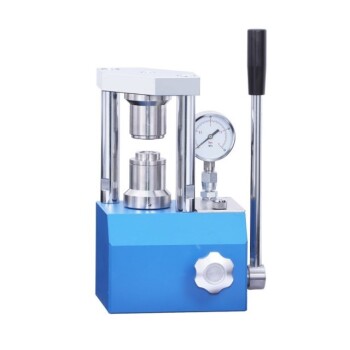
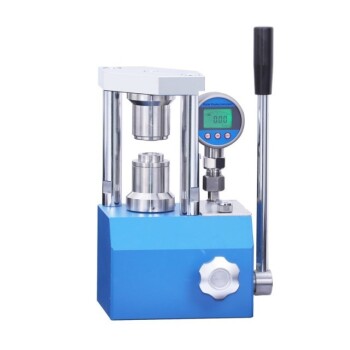
High-precision lithium foil rollers and laboratory presses are fundamental tools for overcoming the physical limitations of solid-solid interfaces in battery assembly. The roller is primarily used for the thinning and surface flattening of the metallic lithium anode, while the laboratory press applies controlled axial pressure to the finished stack to force intimate physical contact between the electrolyte and electrodes.
Core Takeaway In all-solid-state batteries, liquid wetting is absent, making physical contact the primary challenge. These tools effectively substitute chemical wetting with mechanical force, reducing interfacial resistance and suppressing dendrite growth to ensure the battery actually functions.
Optimizing the Anode Surface
The Role of the Lithium Foil Roller
The primary application of the high-precision roller is the preparation of the metallic lithium anode. Before assembly, the raw lithium material must be processed to precise specifications.
Thinning and Flattening
The roller reduces the thickness of the lithium foil to meet specific energy density requirements. Simultaneously, it flattens the surface, removing irregularities that could later create gaps or voids when pressed against the solid electrolyte.
Ensuring Interfacial Integrity
The Role of the Laboratory Press
Once the battery stack is assembled—comprising the cathode, solid-state electrolyte, and the rolled lithium anode—the laboratory press becomes the critical assembly tool. Its function is to apply controlled axial pressure.
Eliminating Contact Voids
Unlike liquid electrolytes, solid-state electrolytes (such as LLZT@mPEG-CPE or sulfides) do not flow into pores. The press applies sufficient force (often 25–75 MPa for sulfides) to eliminate pores and force the materials into atomic-level close contact.
Reducing Interface Resistance
By maximizing the effective contact area, the press significantly reduces solid-solid interface contact resistance (impedance). This is essential for facilitating efficient lithium-ion transport between the active material and the electrolyte.
Enhancing Long-Term Stability
Uniform Electric Field Distribution
The precise pressure loading from the laboratory press induces a more uniform electric field distribution across the cell. This uniformity helps inhibit lithium dendrite formation, a common failure mode caused by uneven current density at contact points.
Preventing Interface Detachment
During charge and discharge cycles, electrode materials expand and contract. The initial high-precision pressing ensures the viscoelastic electrolyte is tightly bonded to the anode, preventing physical separation or "peeling" during cycling.
Understanding the Trade-offs
The Necessity of Precision
While pressure is vital, uniformity is non-negotiable. A standard press that applies uneven force will create localized high-impedance zones, leading to uneven current distribution and accelerated dendrite growth.
Pressure Calibration Dependencies
The amount of pressure required is not universal; it depends heavily on the specific chemistry. For instance, sulfide-based systems generally require significantly higher pressures to eliminate particle pores compared to polymer-based composites. Applying incorrect pressure can either fail to close voids or potentially damage fragile solid electrolyte membranes.
Making the Right Choice for Your Goal
- If your primary focus is Cycle Life: Prioritize a Laboratory Press with high-precision force control to ensure the tightest possible interface bonding, which prevents detachment during repeated expansion/contraction cycles.
- If your primary focus is Energy Density: Prioritize a High-Precision Roller to achieve the thinnest possible lithium anode with a perfectly flat surface, maximizing volume efficiency.
- If your primary focus is Rate Performance: Ensure your press can deliver sufficient compaction density (e.g., 25-75 MPa for sulfides) to eliminate voids and minimize charge transfer resistance.
Success in solid-state battery assembly relies not just on the materials, but on the mechanical precision used to bond them together.
Summary Table:
| Equipment Type | Primary Function in Battery Assembly | Key Impact on Performance |
|---|---|---|
| Lithium Foil Roller | Thinning & surface flattening of metallic lithium anodes | Increases energy density and ensures surface uniformity |
| Laboratory Press | Application of controlled axial pressure to the cell stack | Eliminates contact voids and reduces interfacial resistance |
| Sulfide-based Systems | High-pressure compaction (25–75 MPa) | Facilitates atomic-level contact for efficient ion transport |
| Polymer Composites | Low-to-moderate pressure bonding | Prevents interface detachment during charge/discharge cycles |
Accelerate your solid-state battery breakthroughs with KINTEK’s precision engineering. As specialists in comprehensive laboratory pressing solutions, we provide a versatile range of manual, automatic, heated, and glovebox-compatible presses, as well as high-precision rollers and isostatic presses tailored for battery research. Ensure perfect interfacial contact and suppress dendrite growth in your cells—contact KINTEK today to find the ideal solution for your lab!
References
- Yin Cui, Xidong Lin. In‐Situ Coupled Macromolecular Bridge Enables All‐Solid‐State Lithium Metal Batteries Capable of Extremely High Temperature Operation. DOI: 10.1002/cnl2.70099
This article is also based on technical information from Kintek Solution Knowledge Base .
Related Products
- Lab Cylindrical Press Mold for Laboratory Use
- Lab Round Bidirectional Press Mold
- Lab XRF Boric Acid Powder Pellet Pressing Mold for Laboratory Use
- XRF KBR Plastic Ring Lab Powder Pellet Pressing Mold for FTIR
- Lab Ring Press Mold for Sample Preparation
People Also Ask
- What is the purpose of incorporating cartridge heaters into a lab press mold for MLCC block compression? Optimize Results
- What is the function of a pressing tool in thermoplastic panels? Master Precision Shaping & Fusion Bonding
- Why is precise cooling management of the lab press mold necessary? Protect Core Integrity in Thermoforming
- Why is a high-performance laboratory molding press critical for in-situ electrolyte formation? Unlock Battery Success
- How does the geometry of laboratory molds influence mycelium-based composites? Optimize Density and Strength