
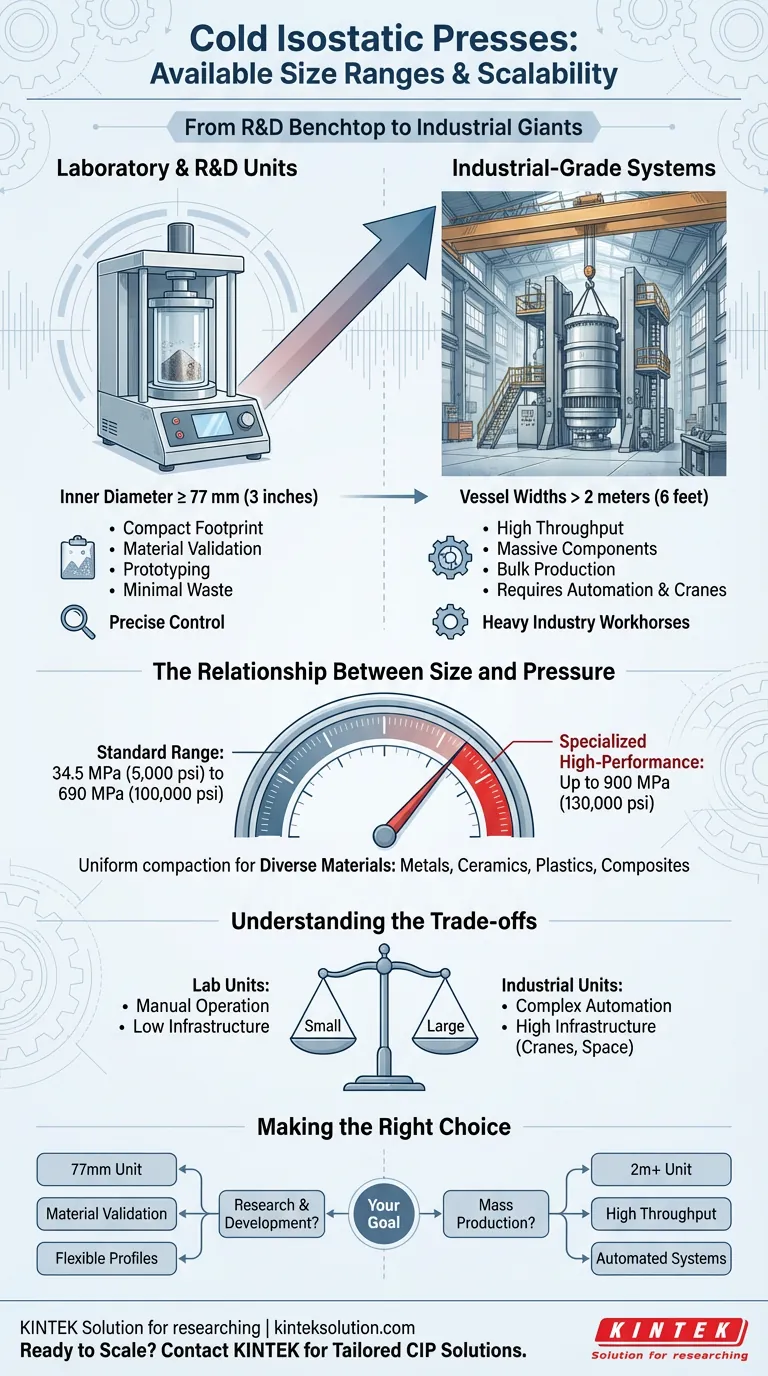
Cold isostatic presses (CIP) span a massive operational range, starting from compact laboratory units with inner diameters as small as 77 mm (3 inches) up to industrial giants exceeding 2 meters (6 feet) in width. This extensive spectrum allows manufacturers to scale seamlessly from initial material research to full-scale bulk production using the same fundamental technology.
Core Takeaway The size of a Cold Isostatic Press is not a rigid constraint but a scalable variable. Whether you are compacting small powder samples for R&D or manufacturing massive industrial components, the technology offers vessel dimensions and pressure capabilities tailored to the specific volume and density requirements of your application.
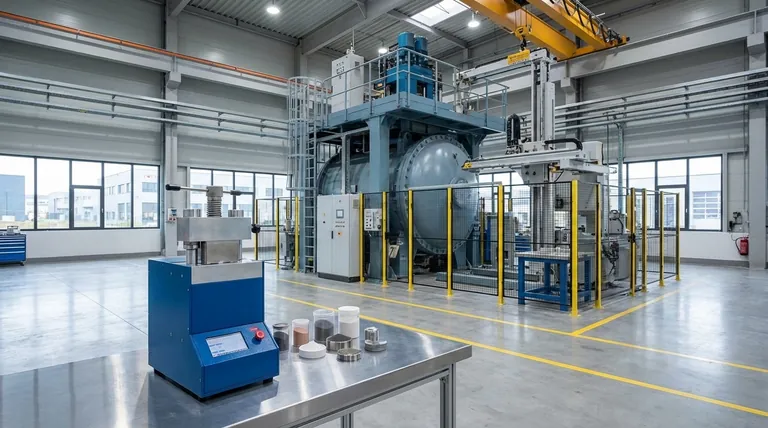
Scaling from Benchtop to Factory Floor
The primary advantage of CIP technology is its scalability. Manufacturers can validate a process on a small unit and replicate the results on a much larger scale.
Laboratory and R&D Units
For research, prototyping, and small-batch testing, laboratory units are the standard. These presses are designed with compact footprints, featuring inner diameters as small as 77 mm (3 inches).
These smaller units are ideal for validating material properties without the waste associated with large-scale trials. They are frequently used for developing new composites, ceramics, and powdered metals.
Industrial-Grade Systems
On the production end, the equipment scales up significantly to handle bulk requirements. Industrial presses can feature vessel widths exceeding 2 meters (6 feet).
These large-scale systems are engineered to process massive single components or high-volume batches of smaller parts simultaneously. They are the workhorses for heavy industry, capable of sustaining high throughput.
Customization and Flexibility
Beyond standard sizes, electric lab presses offer high customizability. Units can be engineered with specific dimensions to match unique product characteristics.
This flexibility ensures that the vessel geometry is optimized for the user's specific intended use, rather than forcing a process to fit a standard machine size.
The Relationship Between Size and Pressure
While physical dimensions determine what fits inside the press, the pressure capability determines how the material is processed. Understanding the interplay between size and pressure is essential.
Operational Pressure Ranges
CIP systems generally operate between 34.5 MPa (5,000 psi) and 690 MPa (100,000 psi).
For specialized high-performance applications, capabilities can reach as high as 900 MPa (130,000 psi). This broad range allows for the compaction of diverse materials, including metals, ceramics, plastics, and composites.
Cycle Profile Control
Modern electric lab presses allow for precise control over pressurization rates and depressurization profiles.
This ensures that regardless of the vessel size, the pressure is applied uniformly and released safely, preventing defects in the final compacted part.
Understanding the Trade-offs
Scaling up a cold isostatic press involves more than just increasing the vessel size. There are logistical and operational complexities that must be managed as dimensions increase.
Infrastructure Requirements
As press size increases, manual handling becomes impossible. Industrial-grade units often require additional equipment modules, such as overhead cranes for batch loading and unloading.
Integrating these systems requires significant floor space and infrastructure planning beyond the footprint of the press itself.
Complexity of Automation
While lab units can be manually operated, larger or high-throughput systems often necessitate fully automated loading and unloading systems.
Adding automation increases efficiency but also raises the complexity of the maintenance and operation of the system.
Making the Right Choice for Your Goal
Selecting the correct CIP size requires balancing your current testing needs with your future production goals.
- If your primary focus is Research & Development: Prioritize a 77 mm (3 inch) unit with customizable pressure profiles to validate materials with minimal waste.
- If your primary focus is Mass Production: Specify an industrial unit exceeding 2 meters (6 feet) integrated with automated batch loading systems for maximum throughput.
By matching the vessel dimensions and pressure capabilities to your specific material requirements, you ensure a cost-effective and technically sound compaction process.
Summary Table:
| Application | Typical Vessel Diameter | Key Characteristics |
|---|---|---|
| Laboratory & R&D | 77 mm (3 inches) and up | Compact footprint, ideal for material validation and prototyping with minimal waste. |
| Industrial Production | Up to 2+ meters (6+ feet) | High-throughput, often requires automation and auxiliary handling equipment like cranes. |
| Pressure Range | 34.5 MPa to 690 MPa (up to 900 MPa for specialized applications) | Ensures uniform compaction for diverse materials like metals, ceramics, and composites. |
Ready to Scale Your Compaction Process from R&D to Production?
Whether you are compacting small powder samples in a research lab or manufacturing large industrial components, KINTEK's expertise in lab press machines ensures you get the right Cold Isostatic Press (CIP) for your needs. From automatic lab presses to large-scale isostatic systems, we provide tailored solutions with the precise size and pressure capabilities your application demands.
Contact KINTEK today to discuss your specific requirements and let our experts help you achieve a cost-effective and technically superior compaction process.
Visual Guide
Related Products
- Electric Lab Cold Isostatic Press CIP Machine
- Electric Split Lab Cold Isostatic Pressing CIP Machine
- Automatic Lab Cold Isostatic Pressing CIP Machine
- Manual Cold Isostatic Pressing CIP Machine Pellet Press
- Lab Isostatic Pressing Molds for Isostatic Molding
People Also Ask
- What role do electric lab cold isostatic presses play in industrial contexts? Bridge R&D and Manufacturing with Precision
- What are the applications of electric lab cold isostatic presses in research settings? Advance Material R&D with High-Pressure CIPs
- How does electrical Cold Isostatic Pressing (CIP) contribute to cost savings? Unlock Efficiency and Reduce Expenses
- What are some research applications of electric lab CIPs? Unlock Uniform Powder Densification for Advanced Materials
- What are the characteristics of standard off-the-shelf electric lab CIP solutions? Achieve Immediate, Cost-Effective Processing
















