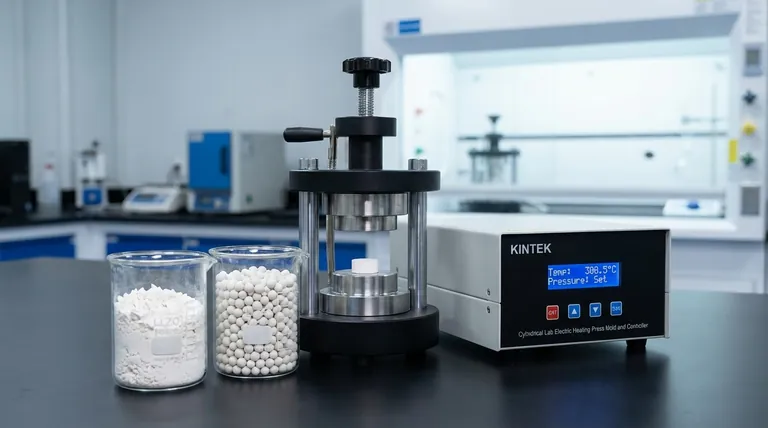
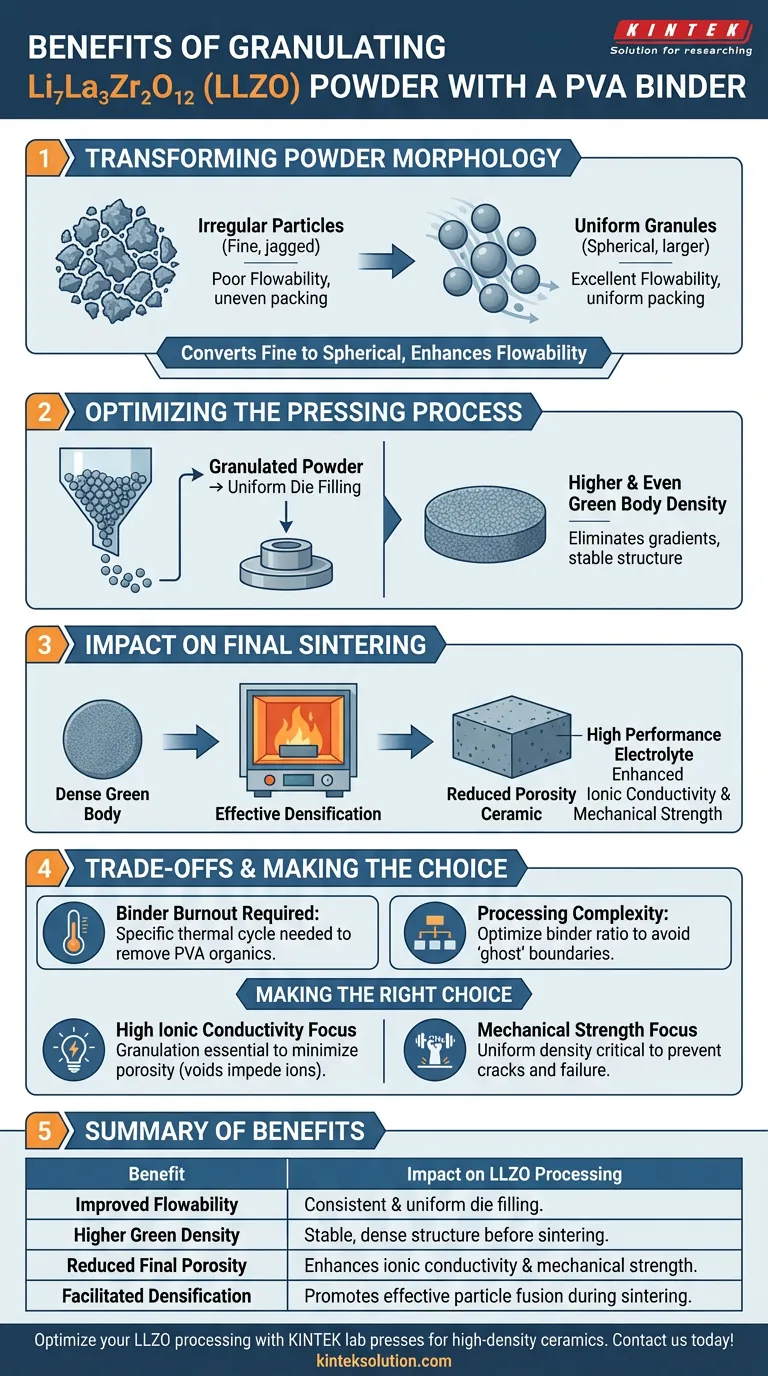
Granulating LLZO powder with a PVA binder fundamentally alters the physical characteristics of the material to solve handling and density challenges. This process converts fine, irregular particles into uniform, spherical granules that exhibit superior flowability, ensuring consistent die filling and higher green body density. Ultimately, this preparation step is essential for maximizing densification and minimizing porosity in the final sintered ceramic.
Direct pressing of fine powders often leads to uneven packing and structural defects. Granulation creates a free-flowing feedstock that ensures the "green" (unfired) compact has the uniform density required for high-performance sintering.
Transforming Powder Morphology
From Irregular to Spherical
Calcined Li₇La₃Zr₂O₁₂ (LLZO) powder typically exists as fine, jagged, and irregularly shaped particles.
By mixing this powder with a Polyvinyl Alcohol (PVA) binder and granulating it, you convert these difficult particles into larger, uniform granules. These granules are spherical or near-spherical in shape, which is mechanically superior for processing.
Enhancing Flowability
Fine powders are prone to clumping and possess high inter-particle friction, making them difficult to handle.
The spherical nature of granulated powder drastically improves flowability. Instead of sticking together, the granules roll over one another, acting almost like a fluid during the manufacturing process.
Optimizing the Pressing Process
Uniform Die Filling
When powder flows poorly, it leaves air gaps and uneven pile-ups inside the pressing die.
Granulated LLZO flows effortlessly into the die, ensuring consistent and uniform filling. This eliminates the density gradients that often cause warping or cracking in non-granulated samples.
Maximizing Green Body Density
The "green body" is the compacted object formed after pressing but before firing.
Because granulated powder packs more efficiently, the resulting green body achieves a significantly higher density. Furthermore, this density is evenly distributed throughout the part, providing a stable structure for the next stage.
Impact on Final Sintering
Facilitating Densification
High-temperature sintering is where the ceramic particles fuse together to form a solid electrolyte.
A green body formed from granulated powder facilitates a more effective densification process. Because the particles are already packed tightly and uniformly, they fuse more readily and predictably during heating.
Reducing Final Porosity
Porosity is the enemy of conductivity in solid-state electrolytes.
The superior packing efficiency achieved through granulation directly leads to a final ceramic product with reduced porosity. This results in a dense, mechanically robust electrolyte capable of higher performance.
Understanding the Trade-offs
The Binder Burnout Requirement
While PVA improves pressing, it introduces organic material that must be removed.
You must implement a specific binder burnout thermal cycle prior to high-temperature sintering. Failure to remove the PVA completely can leave carbon residues that degrade the electrolyte's performance.
Processing Complexity
Granulation introduces an additional variable into your workflow.
You must optimize the ratio of binder to powder carefully. If granules are too hard, they may not crush completely during pressing, leaving "ghost" boundaries; if too soft, they may not flow properly.
Making the Right Choice for Your Goal
To determine if this step is necessary for your specific application, consider the following principles:
- If your primary focus is high ionic conductivity: Granulation is essential to minimize porosity, as voids impede the movement of lithium ions.
- If your primary focus is mechanical strength: The uniform density provided by granulation is critical to preventing cracks and structural failure in the ceramic.
By controlling particle morphology through granulation, you establish the structural foundation necessary for a high-quality solid electrolyte.
Summary Table:
| Benefit | Impact on LLZO Processing |
|---|---|
| Improved Flowability | Ensures consistent and uniform die filling. |
| Higher Green Density | Provides a stable, dense structure before sintering. |
| Reduced Final Porosity | Enhances ionic conductivity and mechanical strength. |
| Facilitated Densification | Promotes effective particle fusion during sintering. |
Ready to optimize your LLZO processing for superior solid electrolytes? KINTEK specializes in lab press machines, including automatic and heated lab presses, designed to meet the precise demands of laboratory research and development. Our equipment ensures the uniform pressing required for high-density ceramic components. Contact us today to learn how our solutions can enhance your material synthesis and achieve your performance goals!
Visual Guide
Related Products
- Manual Laboratory Hydraulic Press Lab Pellet Press
- Lab Cylindrical Press Mold for Laboratory Use
- Lab Round Bidirectional Press Mold
- XRF KBR Plastic Ring Lab Powder Pellet Pressing Mold for FTIR
- Lab Ring Press Mold for Sample Preparation
People Also Ask
- How does a laboratory manual hydraulic press assist in powder canning? Maximize Density and Structural Integrity
- What is the primary objective of using a laboratory manual hydraulic press at 20 MPa? Achieve Perfect Green Body Shaping
- What is the primary purpose of manual lab hydraulic pellet presses? Achieve High-Precision Sample Preparation for Spectroscopy
- What is the primary purpose of a manual lab hydraulic pellet press? Ensure Accurate Sample Prep for XRF and FTIR
- How do lab pellet presses support customization and flexibility? Optimize Your Sample Prep for Any Material