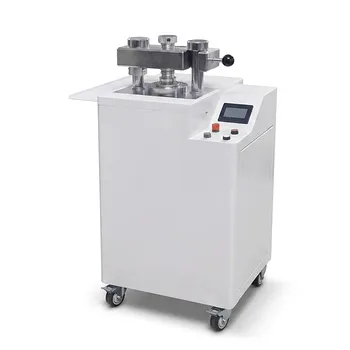
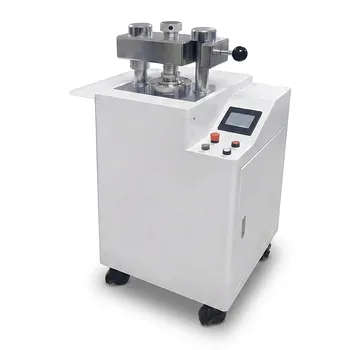
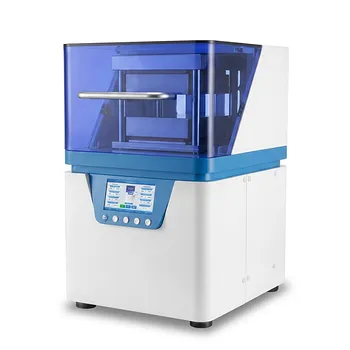
The primary benefit of using a pellet press for FTIR sample preparation is the assurance of data integrity through mechanical consistency. It delivers reliable, reproducible results by standardizing sample compaction and ensuring optimal optical quality. Beyond accuracy, it enhances workflow efficiency, accommodates a wide variety of sample types (such as pharmaceuticals and polymers), and reduces long-term costs by bringing preparation capabilities in-house.
Core Takeaway The pellet press is not merely a compaction tool; it is a standardization device. By applying uniform, high-magnitude pressure, it transforms variable powder mixtures into homogenous, transparent discs, eliminating the physical inconsistencies that lead to spectral noise and scattering.
The Mechanics of Spectral Quality
Achieving Optical Transparency
The fundamental goal of FTIR preparation is to create a medium that allows infrared light to pass through with minimal obstruction.
A pellet press applies significant force (often around 70 MPa) to a mixture of sample and Potassium Bromide (KBr). This pressure binds the powder tightly, eliminating internal pores and air bubbles. The result is a highly transparent disc that ensures accurate transmission spectrum data.
Minimizing Light Scattering
Inconsistent sample preparation often results in cloudy pellets that scatter infrared light.
By exerting stable and consistent pressure, a hydraulic press ensures the sample is homogeneously distributed within the pellet. This uniformity reduces baseline noise and ensures clear definition of characteristic peaks, which is vital for advanced techniques like two-dimensional correlation spectroscopy (2DCOS).
Operational Efficiency and Reproducibility
Standardizing Compaction
Manual preparation methods introduce human error, leading to variability between samples.
A pellet press removes this variable by providing enhanced pressure control. This ensures that every pellet is compressed with the same force, making the process highly reproducible. Whether analyzing humic acids or pharmaceuticals, you can trust that differences in spectra are due to chemical changes, not preparation inconsistencies.
Accelerating the Workflow
Time efficiency is a critical factor in high-throughput laboratories.
Modern pellet presses are designed to streamline the preparation process. They offer simplified operation that accelerates the workflow, allowing users of all skill levels to produce high-quality pellets quickly without extensive training.
Versatility and Cost Management
Handling Diverse Matrices
A major advantage of the pellet press is its adaptability to different physical states.
It offers versatility for a wide range of sample types, effectively compressing difficult materials ranging from ground glass powder to complex polymers and pharmaceutical compounds. This makes it a universal tool for diverse analytical chemistry applications.
Reducing Outsourcing Costs
Relying on external labs for sample preparation creates bottlenecks and expenses.
Bringing a pellet press in-house is cost-effective over the long term. It eliminates the need for outsourced preparation services, giving you immediate control over your data generation and quality assurance processes.
Understanding the Trade-offs
The KBr Variable
While the press standardizes the physical compression, the chemical mixture remains a variable. The user must still ensure the sample is mixed with KBr at the correct ratio (typically 1:100) and ground thoroughly. A perfect press cannot fix a poorly mixed sample.
Moisture Sensitivity
The standard matrix material, KBr, is hygroscopic (absorbs water). While the press creates a solid pellet, the process must be done quickly or in a controlled environment to prevent water peaks from appearing in the spectra, which can obscure critical data.
Making the Right Choice for Your Goal
- If your primary focus is Data Integrity: Prioritize a press with precise pressure controls to ensure the elimination of internal pores and maximum transparency.
- If your primary focus is Lab Throughput: Look for a press designed for simplified operation and rapid cycle times to maximize the number of samples processed per hour.
- If your primary focus is Cost Reduction: Focus on the robust build quality to minimize maintenance, as the elimination of outsourcing will quickly offset the initial hardware investment.
Ultimately, the pellet press bridges the gap between raw material and analytical insight by turning a physical powder into an optical standard.
Summary Table:
| Feature | Benefit for FTIR Analysis |
|---|---|
| High-Magnitude Pressure | Eliminates air bubbles and internal pores for maximum optical transparency. |
| Uniform Force Distribution | Minimizes light scattering and baseline noise for clear spectral peaks. |
| Standardized Compaction | Ensures high reproducibility and removes human error from sample preparation. |
| Versatile Matrix Handling | Effectively processes diverse samples from polymers to pharmaceuticals. |
| In-house Capability | Accelerates workflow efficiency and significantly reduces outsourcing costs. |
Elevate Your Analytical Precision with KINTEK
Don't let inconsistent sample preparation compromise your research integrity. KINTEK specializes in comprehensive laboratory pressing solutions, offering manual, automatic, heated, multifunctional, and glovebox-compatible models, as well as cold and warm isostatic presses.
Whether you are conducting cutting-edge battery research or routine pharmaceutical analysis, our precision-engineered presses deliver the mechanical consistency your lab demands. Contact us today to find the perfect press for your workflow and experience the KINTEK advantage in durability and data accuracy.
Related Products
- Automatic XRF Pellet Press for Laboratory Spectrometry Sample Preparation
- Laboratory Hydraulic Split Electric Lab Pellet Press
- Laboratory Hydraulic Pellet Press for XRF KBR FTIR Lab Press
- Manual Laboratory Hydraulic Pellet Press Lab Hydraulic Press
- Automatic Fluorescence Sample Preparation Press 40 Ton Lab Pellet Press for XRF Analysis
People Also Ask
- How can contamination occur during the preparation of pressed pellets for XRF analysis? Expert Prevention Guide
- How does the sample material influence the required pressing load for making an XRF pellet? Find the Optimal Pressure
- What are the different methods for preparing a sample pellet for XRF analysis? Expert Guide to Superior XRF Results
- What are the advantages of preparing a sample as a dense pellet for XRF? Unlock High-Precision Trace Element Analysis
- What is the primary purpose of using an automatic pellet press? Achieve Precise Geopolymer Analysis Results